Author: David, TechFlow On the afternoon of the 10th, President Trump announced on Truth Social that he would impose a 100% tariff on Chinese goods. This news instantly triggered panic in global financial markets. Over the next 24 hours, the cryptocurrency market experienced its largest liquidation event in history, with over $19 billion in leveraged positions forced to close. Bitcoin plummeted from $117,000 to below $102,000, a daily drop of over 12%. The US stock market was also not immune to the disaster. At the close of trading on October 10, the S&P 500 fell 2.71%, the Dow Jones Industrial Average fell 878 points, and the Nasdaq Composite fell 3.58%, all marking their largest single-day declines since April. However, the real hard-hit areas are those DAT (Digital Asset Treasury) companies that use crypto assets as treasury reserves. MicroStrategy, the largest corporate Bitcoin holder, saw its stock price fall, while other crypto asset reserve companies saw even more significant drops. According to after-hours trading data, investors are still selling. For these companies exposed to both crypto and stock market risks, is the worst over? Why did DAT companies fall even harder? The first thing DAT companies have to face is a direct impact on their balance sheets. Take MicroStrategy, for example. The company holds approximately 639,835 Bitcoins. When the Bitcoin price drops by 12%, the value of its assets instantly evaporates by nearly $10 billion. Under accounting standards, this type of loss must be recorded as an "unrealized loss." Although it's not a true loss as long as the stock isn't sold, the figures in the financial statements are real. As an investor, you are seeing a company's core assets rapidly depreciating in value. There is also a multiplier effect on market confidence. At the beginning of 2025, MicroStrategy's stock was trading at a premium of 2 times its net asset value (NAV), but by the end of September it had compressed to 1.44 times; it is currently around 1.2. For some other companies, mNAV is almost returning to 1, and some have even fallen below 1. These changes in figures reflect a harsh reality: the market's confidence in the DAT model is being shaken in extreme market conditions. In a bull market, investors are willing to give these companies a premium, and the narrative can be that they are at the vanguard of crypto innovation. But when the market turns, the same narrative becomes unnecessary risk exposure. Non-Bitcoin cryptocurrencies suffered huge technical damage in this round of leverage-induced plunge, with some even plummeting to zero in an instant; even large-cap altcoins saw their values halved or even dropped more due to insufficient liquidity. The stocks of companies holding these assets have become the preferred short-selling targets when market sentiment deteriorates. When the market panics, investors need to quickly reduce their holdings. While the Bitcoin market operates 24/7, large sell-offs can significantly impact the price. In contrast, selling a stock like MSTR on the Nasdaq is much easier. Selling tens of billions of dollars worth of gold wouldn’t disrupt the market, but selling $70 billion worth of Bitcoin could cause a price crash and trigger mass liquidations; this liquidity disparity makes DAT company stocks a channel for rapid capital withdrawal. To make matters worse, many institutional investors have strict risk management guidelines. When volatility exceeds a certain threshold, they must reduce their holdings, whether they want to or not. And DATs happen to be among the most volatile stocks. To make an inappropriate analogy, if ordinary technology companies are sitting on a boat, then DAT companies are like two boats tied together, one sailing in the stock market and the other struggling in the crypto market. When both sides encounter severe weather at the same time, the impact they endure is not added but multiplied. Who is the worst off and who is the most resilient? Looking through the list of DAT companies with the largest declines in the previous trading day, you can clearly see that the smaller the company, the bigger the decline. Forward Industries fell 15.32%, with its mNAV at just 0.053. BTCS Inc. fell 12.70%, and Helius Medical Tech dropped 12.91%. These small companies, with a market capitalization of less than $100 million, found few buyers amid the panic. In contrast, MicroStrategy, the largest Bitcoin holder, saw its stock fall by only 4.84%. The logic behind this is simple: liquidity. When panic sets in, the bid-ask spreads of small-cap stocks widen dramatically, and a slightly larger sell order can drive the stock price through. Compared to DATs with relatively large market capitalizations, MicroStrategy's mNAV is only 1.28x, practically trading at the value of its holdings. The market valuations these companies essentially represent the value of their crypto assets plus a slight premium. When the crypto market crashes, these companies have no other businesses to cushion the blow. When a company’s market capitalization is almost equal to the value of its crypto holdings (mNAV is close to 1), it means that the market believes that the company has no added value other than hoarding cryptocurrencies. Bitmine's mNAV is 0.98, and other companies without precise mNAV data are likely to be much lower. These companies have effectively become crypto ETFs disguised as public companies. The question is, since there are real Bitcoin and other ETFs available to buy, why do investors still need to hold it indirectly through these companies? This may explain why these low mNAV companies tend to fall more during panics. They carry both crypto asset risk and stock market risk without providing any additional value. The US stock market will open in a few hours. Will market sentiment improve after the weekend cool-down? Will the sell-off of smaller DATs, which have fallen by more than 10%, continue, or will bargain-hunting funds enter the market? Judging from the data, companies with an mNAV below 1 may have oversold opportunities, but they may also be value traps. After all, when a business model itself is questionable, cheapness is not necessarily a reason to buy.Author: David, TechFlow On the afternoon of the 10th, President Trump announced on Truth Social that he would impose a 100% tariff on Chinese goods. This news instantly triggered panic in global financial markets. Over the next 24 hours, the cryptocurrency market experienced its largest liquidation event in history, with over $19 billion in leveraged positions forced to close. Bitcoin plummeted from $117,000 to below $102,000, a daily drop of over 12%. The US stock market was also not immune to the disaster. At the close of trading on October 10, the S&P 500 fell 2.71%, the Dow Jones Industrial Average fell 878 points, and the Nasdaq Composite fell 3.58%, all marking their largest single-day declines since April. However, the real hard-hit areas are those DAT (Digital Asset Treasury) companies that use crypto assets as treasury reserves. MicroStrategy, the largest corporate Bitcoin holder, saw its stock price fall, while other crypto asset reserve companies saw even more significant drops. According to after-hours trading data, investors are still selling. For these companies exposed to both crypto and stock market risks, is the worst over? Why did DAT companies fall even harder? The first thing DAT companies have to face is a direct impact on their balance sheets. Take MicroStrategy, for example. The company holds approximately 639,835 Bitcoins. When the Bitcoin price drops by 12%, the value of its assets instantly evaporates by nearly $10 billion. Under accounting standards, this type of loss must be recorded as an "unrealized loss." Although it's not a true loss as long as the stock isn't sold, the figures in the financial statements are real. As an investor, you are seeing a company's core assets rapidly depreciating in value. There is also a multiplier effect on market confidence. At the beginning of 2025, MicroStrategy's stock was trading at a premium of 2 times its net asset value (NAV), but by the end of September it had compressed to 1.44 times; it is currently around 1.2. For some other companies, mNAV is almost returning to 1, and some have even fallen below 1. These changes in figures reflect a harsh reality: the market's confidence in the DAT model is being shaken in extreme market conditions. In a bull market, investors are willing to give these companies a premium, and the narrative can be that they are at the vanguard of crypto innovation. But when the market turns, the same narrative becomes unnecessary risk exposure. Non-Bitcoin cryptocurrencies suffered huge technical damage in this round of leverage-induced plunge, with some even plummeting to zero in an instant; even large-cap altcoins saw their values halved or even dropped more due to insufficient liquidity. The stocks of companies holding these assets have become the preferred short-selling targets when market sentiment deteriorates. When the market panics, investors need to quickly reduce their holdings. While the Bitcoin market operates 24/7, large sell-offs can significantly impact the price. In contrast, selling a stock like MSTR on the Nasdaq is much easier. Selling tens of billions of dollars worth of gold wouldn’t disrupt the market, but selling $70 billion worth of Bitcoin could cause a price crash and trigger mass liquidations; this liquidity disparity makes DAT company stocks a channel for rapid capital withdrawal. To make matters worse, many institutional investors have strict risk management guidelines. When volatility exceeds a certain threshold, they must reduce their holdings, whether they want to or not. And DATs happen to be among the most volatile stocks. To make an inappropriate analogy, if ordinary technology companies are sitting on a boat, then DAT companies are like two boats tied together, one sailing in the stock market and the other struggling in the crypto market. When both sides encounter severe weather at the same time, the impact they endure is not added but multiplied. Who is the worst off and who is the most resilient? Looking through the list of DAT companies with the largest declines in the previous trading day, you can clearly see that the smaller the company, the bigger the decline. Forward Industries fell 15.32%, with its mNAV at just 0.053. BTCS Inc. fell 12.70%, and Helius Medical Tech dropped 12.91%. These small companies, with a market capitalization of less than $100 million, found few buyers amid the panic. In contrast, MicroStrategy, the largest Bitcoin holder, saw its stock fall by only 4.84%. The logic behind this is simple: liquidity. When panic sets in, the bid-ask spreads of small-cap stocks widen dramatically, and a slightly larger sell order can drive the stock price through. Compared to DATs with relatively large market capitalizations, MicroStrategy's mNAV is only 1.28x, practically trading at the value of its holdings. The market valuations these companies essentially represent the value of their crypto assets plus a slight premium. When the crypto market crashes, these companies have no other businesses to cushion the blow. When a company’s market capitalization is almost equal to the value of its crypto holdings (mNAV is close to 1), it means that the market believes that the company has no added value other than hoarding cryptocurrencies. Bitmine's mNAV is 0.98, and other companies without precise mNAV data are likely to be much lower. These companies have effectively become crypto ETFs disguised as public companies. The question is, since there are real Bitcoin and other ETFs available to buy, why do investors still need to hold it indirectly through these companies? This may explain why these low mNAV companies tend to fall more during panics. They carry both crypto asset risk and stock market risk without providing any additional value. The US stock market will open in a few hours. Will market sentiment improve after the weekend cool-down? Will the sell-off of smaller DATs, which have fallen by more than 10%, continue, or will bargain-hunting funds enter the market? Judging from the data, companies with an mNAV below 1 may have oversold opportunities, but they may also be value traps. After all, when a business model itself is questionable, cheapness is not necessarily a reason to buy.

After the crypto market crash, are the stocks of DAT companies doing well?

2025/10/15 07:00
6 min read
For feedback or concerns regarding this content, please contact us at crypto.news@mexc.com

Author: David, TechFlow

On the afternoon of the 10th, President Trump announced on Truth Social that he would impose a 100% tariff on Chinese goods. This news instantly triggered panic in global financial markets.

Over the next 24 hours, the cryptocurrency market experienced its largest liquidation event in history, with over $19 billion in leveraged positions forced to close. Bitcoin plummeted from $117,000 to below $102,000, a daily drop of over 12%.

The US stock market was also not immune to the disaster. At the close of trading on October 10, the S&P 500 fell 2.71%, the Dow Jones Industrial Average fell 878 points, and the Nasdaq Composite fell 3.58%, all marking their largest single-day declines since April.

However, the real hard-hit areas are those DAT (Digital Asset Treasury) companies that use crypto assets as treasury reserves.

MicroStrategy, the largest corporate Bitcoin holder, saw its stock price fall, while other crypto asset reserve companies saw even more significant drops. According to after-hours trading data, investors are still selling.

For these companies exposed to both crypto and stock market risks, is the worst over?

Why did DAT companies fall even harder?

The first thing DAT companies have to face is a direct impact on their balance sheets. Take MicroStrategy, for example. The company holds approximately 639,835 Bitcoins. When the Bitcoin price drops by 12%, the value of its assets instantly evaporates by nearly $10 billion.

Under accounting standards, this type of loss must be recorded as an "unrealized loss." Although it's not a true loss as long as the stock isn't sold, the figures in the financial statements are real.

As an investor, you are seeing a company's core assets rapidly depreciating in value. There is also a multiplier effect on market confidence.

At the beginning of 2025, MicroStrategy's stock was trading at a premium of 2 times its net asset value (NAV), but by the end of September it had compressed to 1.44 times; it is currently around 1.2.

For some other companies, mNAV is almost returning to 1, and some have even fallen below 1. These changes in figures reflect a harsh reality: the market's confidence in the DAT model is being shaken in extreme market conditions.

In a bull market, investors are willing to give these companies a premium, and the narrative can be that they are at the vanguard of crypto innovation. But when the market turns, the same narrative becomes unnecessary risk exposure.

Non-Bitcoin cryptocurrencies suffered huge technical damage in this round of leverage-induced plunge, with some even plummeting to zero in an instant; even large-cap altcoins saw their values halved or even dropped more due to insufficient liquidity.

The stocks of companies holding these assets have become the preferred short-selling targets when market sentiment deteriorates.

When the market panics, investors need to quickly reduce their holdings. While the Bitcoin market operates 24/7, large sell-offs can significantly impact the price. In contrast, selling a stock like MSTR on the Nasdaq is much easier.

Selling tens of billions of dollars worth of gold wouldn’t disrupt the market, but selling $70 billion worth of Bitcoin could cause a price crash and trigger mass liquidations; this liquidity disparity makes DAT company stocks a channel for rapid capital withdrawal.

To make matters worse, many institutional investors have strict risk management guidelines. When volatility exceeds a certain threshold, they must reduce their holdings, whether they want to or not. And DATs happen to be among the most volatile stocks.

To make an inappropriate analogy, if ordinary technology companies are sitting on a boat, then DAT companies are like two boats tied together, one sailing in the stock market and the other struggling in the crypto market.

When both sides encounter severe weather at the same time, the impact they endure is not added but multiplied.
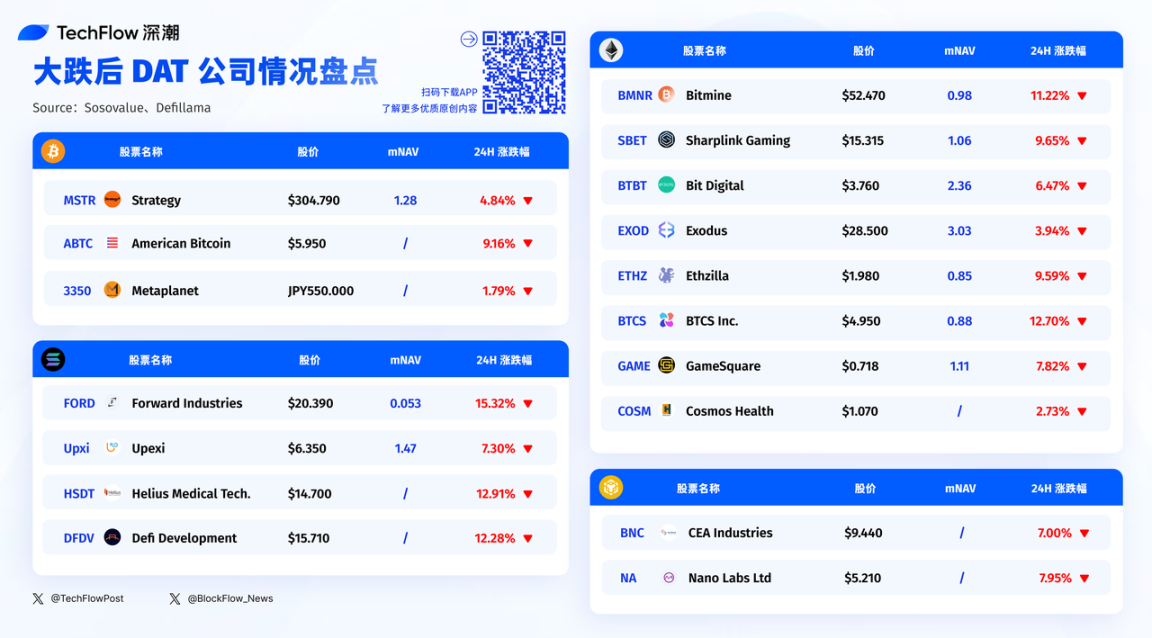
Who is the worst off and who is the most resilient?

Looking through the list of DAT companies with the largest declines in the previous trading day, you can clearly see that the smaller the company, the bigger the decline.

Forward Industries fell 15.32%, with its mNAV at just 0.053. BTCS Inc. fell 12.70%, and Helius Medical Tech dropped 12.91%.

These small companies, with a market capitalization of less than $100 million, found few buyers amid the panic. In contrast, MicroStrategy, the largest Bitcoin holder, saw its stock fall by only 4.84%.

The logic behind this is simple: liquidity.

When panic sets in, the bid-ask spreads of small-cap stocks widen dramatically, and a slightly larger sell order can drive the stock price through.

Compared to DATs with relatively large market capitalizations, MicroStrategy's mNAV is only 1.28x, practically trading at the value of its holdings. The market valuations these companies essentially represent the value of their crypto assets plus a slight premium. When the crypto market crashes, these companies have no other businesses to cushion the blow.

When a company’s market capitalization is almost equal to the value of its crypto holdings (mNAV is close to 1), it means that the market believes that the company has no added value other than hoarding cryptocurrencies.

Bitmine's mNAV is 0.98, and other companies without precise mNAV data are likely to be much lower. These companies have effectively become crypto ETFs disguised as public companies.

The question is, since there are real Bitcoin and other ETFs available to buy, why do investors still need to hold it indirectly through these companies?

This may explain why these low mNAV companies tend to fall more during panics. They carry both crypto asset risk and stock market risk without providing any additional value.

The US stock market will open in a few hours. Will market sentiment improve after the weekend cool-down? Will the sell-off of smaller DATs, which have fallen by more than 10%, continue, or will bargain-hunting funds enter the market?

Judging from the data, companies with an mNAV below 1 may have oversold opportunities, but they may also be value traps. After all, when a business model itself is questionable, cheapness is not necessarily a reason to buy.


Disclaimer: The articles reposted on this site are sourced from public platforms and are provided for informational purposes only. They do not necessarily reflect the views of MEXC. All rights remain with the original authors. If you believe any content infringes on third-party rights, please contact crypto.news@mexc.com for removal. MEXC makes no guarantees regarding the accuracy, completeness, or timeliness of the content and is not responsible for any actions taken based on the information provided. The content does not constitute financial, legal, or other professional advice, nor should it be considered a recommendation or endorsement by MEXC.

You May Also Like

Let insiders trade – Blockworks

Let insiders trade – Blockworks

The post Let insiders trade – Blockworks appeared on BitcoinEthereumNews.com. This is a segment from The Breakdown newsletter. To read more editions, subscribe ​​“The most valuable commodity I know of is information.” — Gordon Gekko, Wall Street Ten months ago, FBI agents raided Shayne Coplan’s Manhattan apartment, ostensibly in search of evidence that the prediction market he founded, Polymarket, had illegally allowed US residents to place bets on the US election. Two weeks ago, the CFTC gave Polymarket the green light to allow those very same US residents to place bets on whatever they like. This is quite the turn of events — and it’s not just about elections or politics. With its US government seal of approval in hand, Polymarket is reportedly raising capital at a valuation of $9 billion — a reflection of the growing belief that prediction markets will be used for much more than betting on elections once every four years. Instead, proponents say prediction markets can provide a real service to the world by providing it with better information about nearly everything. I think they might, too — but only if insiders are free to participate. Yesterday, for example, Polymarket announced new betting markets on company earnings reports, with a promise that it would improve the information that investors have to work with.  Instead of waiting three months to find out how a company is faring, investors could simply watch the odds on Polymarket.  If the probability of an earnings beat is rising, for example, investors would know at a glance that things are going well. But that will only happen if enough of the people betting actually know how things are going. Relying on the wisdom of crowds to magically discern how a business is doing won’t add much incremental knowledge to the world; everyone’s guesses are unlikely to average out to the truth. If…
Share
BitcoinEthereumNews2025/09/18 05:16
Republican knives come out for Kristi Noem: ‘I don’t think she walks away from this’

Republican knives come out for Kristi Noem: ‘I don’t think she walks away from this’

MAGA lawmakers have started to unleash their real thoughts on ousted Homeland Security Secretary Kristi Noem, The Daily Beast reported on Friday. Rep. Nancy Mace
Share
Rawstory2026/03/07 05:57
Kazakhstan to launch $350M national crypto reserve

Kazakhstan to launch $350M national crypto reserve

The government of Kazakhstan is ready to begin acquiring cryptocurrencies and related stocks in a few weeks’ time, the country’s monetary authority unveiled. Some
Share
Cryptopolitan2026/03/07 05:40





