This paper examines how auction theory and randomized scheduling algorithms can improve transaction fee mechanisms (TFMs) in blockchain systems. It highlights a critical gap in current research: most models assume myopic miners and overlook transactions with finite lifetimes. By incorporating deadline-aware and non-myopic perspectives, the study draws parallels with fields like job scheduling and packet management, proposing a more robust, time-sensitive framework for blockchain resource allocation.This paper examines how auction theory and randomized scheduling algorithms can improve transaction fee mechanisms (TFMs) in blockchain systems. It highlights a critical gap in current research: most models assume myopic miners and overlook transactions with finite lifetimes. By incorporating deadline-aware and non-myopic perspectives, the study draws parallels with fields like job scheduling and packet management, proposing a more robust, time-sensitive framework for blockchain resource allocation.

How Auction Theory Shapes Smarter Blockchain Transaction Fee Models

2025/10/14 03:54
3 min read
For feedback or concerns regarding this content, please contact us at crypto.news@mexc.com

Abstract and 1. Introduction

1.1 Our Approach

1.2 Our Results & Roadmap

1.3 Related Work

  1. Model and Warmup and 2.1 Blockchain Model

    2.2 The Miner

    2.3 Game Model

    2.4 Warm Up: The Greedy Allocation Function

  2. The Deterministic Case and 3.1 Deterministic Upper Bound

    3.2 The Immediacy-Biased Class Of Allocation Function

  3. The Randomized Case

  4. Discussion and References

  • A. Missing Proofs for Sections 2, 3
  • B. Missing Proofs for Section 4
  • C. Glossary

2 Model and Warmup

Our game proceeds in T ∈ N turns. At each one, a set of new transactions is broadcast to the network by users, and a miner is chosen to create the upcoming block. The miner, assumed to be profit-maximizing, has the sole authority to decide which transactions to allocate to its block, among the set of valid transactions which were not allocated beforehand.

\ We proceed to formally define the model. A summary of all notations appears in Appendix C.

2.1 Blockchain Model

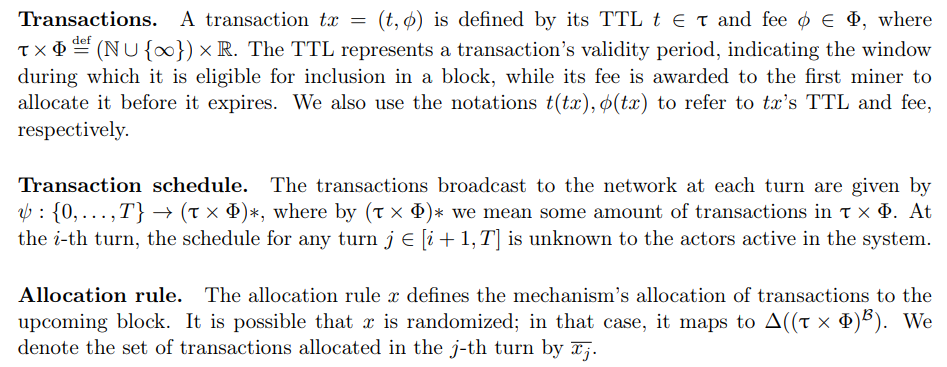
Blocks. Blocks have a predefined maximal capacity of B ∈ N∪ {∞} identically-sized transactions. We focus on the case where B = 1

\
2.2 The Miner

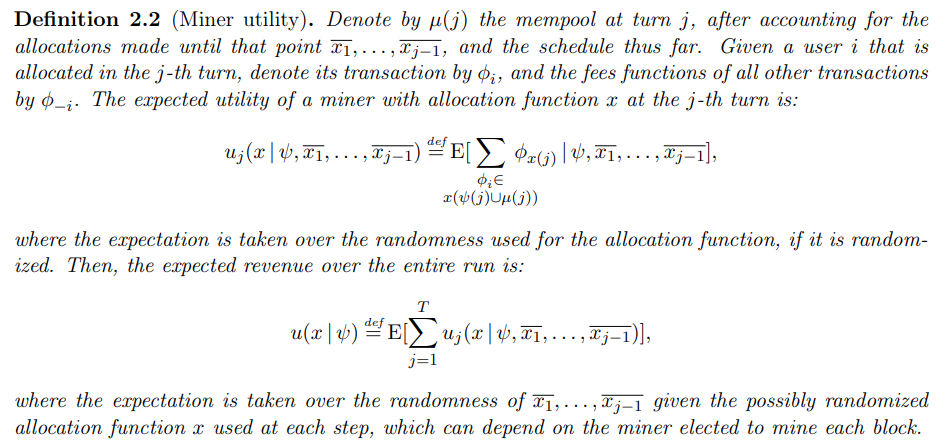
We examine a far-sighted miner who plans the allocation of transactions to the next T blocks.

\ Allocation strategy. The miner’s allocation strategy is given by its allocation function x.

\ Discount factor. Miners may prefer to receive revenue earlier rather than later, as dependent on the economy’s interest rate. For example, this could be due to the profit which a miner participating in a PoS mechanism can obtain by staking funds, or a Proof-of-Work (PoW) miner can make by using its funds to purchase additional mining equipment. This is captured by the miner’s discount factor, denoted by λ ≤ 1.

\ \

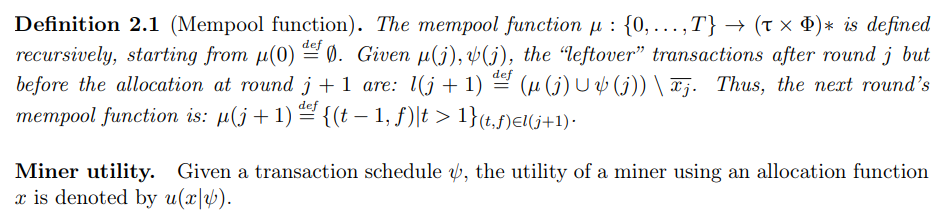
\ \ Mempool. The miner stores valid transactions that were not yet allocated to a block or expired in a data structure called the memory pool (mempool). Transactions which are not allocated to the upcoming block have to wait at least one more block until being mined, but some may become ineligible for inclusion as dependent on their TTL, which decreases by 1 with each passing turn. We define a mempool function that outputs the set of transactions viable for inclusion in each block.

\ \
\ \ \
\ \ \

\ \ \

:::info Authors:

(1) Yotam Gafni, Weizmann Institute (yotam.gafni@gmail.com);

(2) Aviv Yaish, The Hebrew University, Jerusalem (aviv.yaish@mail.huji.ac.il).

:::


:::info This paper is available on arxiv under CC BY 4.0 DEED license.

:::

\

Market Opportunity
BounceToken Logo
BounceToken Price(AUCTION)
$4.739
$4.739$4.739
+0.42%
USD
BounceToken (AUCTION) Live Price Chart
Disclaimer: The articles reposted on this site are sourced from public platforms and are provided for informational purposes only. They do not necessarily reflect the views of MEXC. All rights remain with the original authors. If you believe any content infringes on third-party rights, please contact crypto.news@mexc.com for removal. MEXC makes no guarantees regarding the accuracy, completeness, or timeliness of the content and is not responsible for any actions taken based on the information provided. The content does not constitute financial, legal, or other professional advice, nor should it be considered a recommendation or endorsement by MEXC.
Tags:

You May Also Like

Kast Stablecoin Firm Hits $600M Valuation after $80M Raise: Report

Kast Stablecoin Firm Hits $600M Valuation after $80M Raise: Report

The post Kast Stablecoin Firm Hits $600M Valuation after $80M Raise: Report appeared on BitcoinEthereumNews.com. Stablecoin payments company Kast has raised $80
Share
BitcoinEthereumNews2026/03/10 11:31
Should you claim capital cost allowance on a rental property?

Should you claim capital cost allowance on a rental property?

Rental property investors need to report their annual income and expenses on their tax return. You must also track your adjusted cost base (ACB), which may increase
Share
Moneysense2026/03/10 10:50
UK and US Seal $42 Billion Tech Pact Driving AI and Energy Future

UK and US Seal $42 Billion Tech Pact Driving AI and Energy Future

The post UK and US Seal $42 Billion Tech Pact Driving AI and Energy Future appeared on BitcoinEthereumNews.com. Key Highlights Microsoft and Google pledge billions as part of UK US tech partnership Nvidia to deploy 120,000 GPUs with British firm Nscale in Project Stargate Deal positions UK as an innovation hub rivaling global tech powers UK and US Seal $42 Billion Tech Pact Driving AI and Energy Future The UK and the US have signed a “Technological Prosperity Agreement” that paves the way for joint projects in artificial intelligence, quantum computing, and nuclear energy, according to Reuters. Donald Trump and King Charles review the guard of honour at Windsor Castle, 17 September 2025. Image: Kirsty Wigglesworth/Reuters The agreement was unveiled ahead of U.S. President Donald Trump’s second state visit to the UK, marking a historic moment in transatlantic technology cooperation. Billions Flow Into the UK Tech Sector As part of the deal, major American corporations pledged to invest $42 billion in the UK. Microsoft leads with a $30 billion investment to expand cloud and AI infrastructure, including the construction of a new supercomputer in Loughton. Nvidia will deploy 120,000 GPUs, including up to 60,000 Grace Blackwell Ultra chips—in partnership with the British company Nscale as part of Project Stargate. Google is contributing $6.8 billion to build a data center in Waltham Cross and expand DeepMind research. Other companies are joining as well. CoreWeave announced a $3.4 billion investment in data centers, while Salesforce, Scale AI, BlackRock, Oracle, and AWS confirmed additional investments ranging from hundreds of millions to several billion dollars. UK Positions Itself as a Global Innovation Hub British Prime Minister Keir Starmer said the deal could impact millions of lives across the Atlantic. He stressed that the UK aims to position itself as an investment hub with lighter regulations than the European Union. Nvidia spokesman David Hogan noted the significance of the agreement, saying it would…
Share
BitcoinEthereumNews2025/09/18 02:22