Bitcoin crashed Friday night, but Bitcoin Hyper investors didn't lose a cent. Whales accumulated $1M in just 3 days before the correction, locking in presale prices that never decrease.Bitcoin crashed Friday night, but Bitcoin Hyper investors didn't lose a cent. Whales accumulated $1M in just 3 days before the correction, locking in presale prices that never decrease.

Smart Money Is Buying the Dip with $1M in Bitcoin Hyper in 3 Days

Smart Money Is Buying the Dip with $1M in Bitcoin Hyper in 3 Days

KEY POINTS:

➡ Bitcoin crashed Friday night, but $HYPER presale prices stayed locked, so early investors are protected from volatility.

➡ Whales accumulated $1M in 3 days before the crash, pushing Bitcoin Hyper past the $23M milestone.

➡ $HYPER aims to solve Bitcoin’s fatal flaw: slow speeds and no DeFi capability, using Solana speed with BTC security.

Bitcoin crashed Friday night. By Saturday morning, portfolios across the board were bleeding red. But there’s one group of investors who didn’t lose a single dollar: those who bought Bitcoin Hyper (HYPER) during the presale.
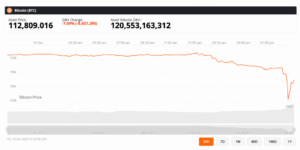
Bitcoin dropped sharply.

Source: BNC

Just days before the crash, whales poured $1M into $HYPER in 72 hours, pushing the project past the $23M milestone. While spot Bitcoin holders watch their investments evaporate, $HYPER presale buyers sit protected behind prices that never go down.

This is the advantage of presale allocations during volatile markets. You’re not trying to catch a falling knife. You’re accumulating fixed-price tokens in infrastructure that becomes more valuable as Bitcoin eventually recovers.

Bitcoin’s Fatal Flaw: Speed Kills Adoption

Bitcoin’s recent crash highlights a deeper problem that has nothing to do with price volatility. After 16 years, Bitcoin still can’t function as anything beyond digital gold.

It’s main problems:

  • Crippling speed at 3-7 transactions per second
  • Fees that spike to $50+ during network congestion
  • Zero native support for the DeFi applications and dApp ecosystems that drive hundreds of billions in capital flow across Ethereum, Solana, and other chains

Every scaling solution has required fatal compromises. Lightning Network forces users to lock funds in payment channels with liquidity limitations. Sidechains introduce entirely new security assumptions that undermine Bitcoin’s core value proposition.

So Bitcoin holders sit on the sidelines watching other networks capture developer talent and user adoption while $BTC remains locked in its limited utility cage.

Bitcoin Hyper’s Solution: Solana Performance Without Bitcoin Compromises

Bitcoin Hyper cracks the code by building the first genuine Layer-2 that merges Solana Virtual Machine speed with Bitcoin’s unmatched security architecture.

$BTC bridges into the Bitcoin Hyper network through a Canonical Bridge, creating wrapped $BTC that maintains a 1:1 peg. This wrapped version becomes the native currency for a high-speed ecosystem where developers can build using Rust-based SDKs and APIs, the same tools that made Solana a developer magnet.

Bitcoin Hyper Ecosystem.

Applications run at Solana-level throughput while every transaction anchors back to Bitcoin’s main chain for final settlement. No security trade-offs. No experimental consensus mechanisms. Just Bitcoin, finally operating at speeds that make real adoption possible.

As $BTC gets locked in the bridge, main chain supply contracts while utility explodes. More developer activity means more $BTC absorbed into the ecosystem, creating organic demand pressure that doesn’t rely on store-of-value narratives or hoping for the next bull run.

Here’s a better explanation of Bitcoin Hyper’s ecosystem.

Whales Positioned Before the Crash – $3.3M in One Week

The data reveals who saw this coming.

Since September 29, Bitcoin Hyper has raised $4.3M. Nearly $3.3M came from whale wallets in a single week, with accumulation accelerating in the days before Friday’s crash.

One address alone acquired 62.2M $HYPER tokens worth $833K. That wallet started buying during the previous weekend with 42.2M $HYPER, then added another 20M tokens on Monday, well before the Friday correction that caught retail off guard.
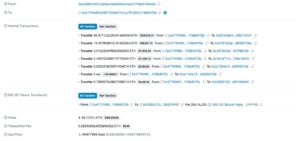
Bitcoin Hyper Whale Buy.

The whale buying triggered retail momentum. From Tuesday through Friday, another $1M flooded in as smaller investors recognized the pattern.

Presale prices remain locked at $0.013105 regardless of Bitcoin’s spot price chaos. Your entry point doesn’t change while you wait for $BTC to find its floor and resume climbing.

Current round closes in 28 hours. After that, the price automatically increases to the next tier.

➡ See our Bitcoin Hyper price prediction to get a glimpse of its potential.

Earn 50% APY While Waiting Out the Crash

Bitcoin Hyper’s staking protocol is already operational, offering 51% APY on staked tokens. Over 1B $HYPER are currently staked, generating passive income before the token generation event.

This creates a compounding advantage during uncertain times. You’re earning a substantial yield (50% now) throughout the entire presale and beyond.

By the time $HYPER lists publicly and Bitcoin stabilizes, your position has already grown significantly through staking rewards alone. The crash becomes an opportunity rather than a loss.

But remember that the staking APY will go down as more people stake tokens.

How to Buy Before the Price Increases in 28 Hours

To join the presale, visit the official website. $HYPER accepts $SOL, $ETH, $USDT, $USDC, $BNB, and credit cards. Here’s a step-by-step guide to buy Bitcoin Hyper.

Best Wallet, a top-rated Bitcoin and crypto wallet, lists $HYPER under its Upcoming Tokens section, making it simple to buy, track, and claim once the token goes live.

Bitcoin’s recovery timeline is uncertain, but presale prices stay locked regardless of how deep the correction goes or how long it takes $BTC to find support.

While panic sellers capitulate and bottom-fishers gamble on timing, smart money is accumulating in the Layer-2 infrastructure that finally makes Bitcoin functional for mass adoption.

Visit Bitcoin Hyper to secure your allocation before the 28-hour deadline.

Market Opportunity
Smart Blockchain Logo
Smart Blockchain Price(SMART)
$0.004929
$0.004929$0.004929
-0.68%
USD
Smart Blockchain (SMART) Live Price Chart
Disclaimer: The articles reposted on this site are sourced from public platforms and are provided for informational purposes only. They do not necessarily reflect the views of MEXC. All rights remain with the original authors. If you believe any content infringes on third-party rights, please contact service@support.mexc.com for removal. MEXC makes no guarantees regarding the accuracy, completeness, or timeliness of the content and is not responsible for any actions taken based on the information provided. The content does not constitute financial, legal, or other professional advice, nor should it be considered a recommendation or endorsement by MEXC.

You May Also Like

Ethereum Fusaka Upgrade Set for December 3 Mainnet Launch, Blob Capacity to Double

Ethereum Fusaka Upgrade Set for December 3 Mainnet Launch, Blob Capacity to Double

Ethereum developers confirmed the Fusaka upgrade will activate on mainnet on December 3, 2025, following a systematic testnet rollout beginning on October 1 on Holesky. The major hard fork will implement around 11-12 Ethereum Improvement Proposals targeting scalability, node efficiency, and data availability improvements without adding new user-facing features. According to Christine Kim, the upgrade introduces a phased blob capacity expansion through Blob Parameter Only forks occurring two weeks after Fusaka activation. Initially maintaining current blob limits of 6/9 target/max, the first BPO fork will increase capacity to 10/15 blobs one week later. A second BPO fork will further expand limits to 14/21 blobs, more than doubling total capacity within two weeks. Strategic Infrastructure Overhaul Fusaka prioritizes backend protocol improvements over user-facing features, focusing on making Ethereum faster and less resource-intensive. The upgrade includes PeerDAS implementation through EIP-7594, allowing validator nodes to verify data by sampling small pieces rather than downloading entire blobs. This reduces bandwidth and storage requirements while enhancing Layer 2 rollup scalability. The upgrade builds on recent gas limit increases from 30 million to 45 million gas, with ongoing discussions for further expansion. EIP-7935 proposes increasing limits to 150 million gas, potentially enabling significantly higher transaction throughput. These improvements complement broader scalability efforts, including EIP-9698, which suggests a 100x gas limit increase over two years to reach 2,000 transactions per second. Fusaka removes the previously planned EVM Object Format redesign to reduce complexity while maintaining focus on essential infrastructure improvements. The upgrade introduces bounded base fees for blob transactions via EIP-7918, creating more predictable transaction costs for data-heavy applications. Enhanced spam resistance and security improvements strengthen network resilience against scalability bottlenecks and attacks. Technical Implementation and Testing Timeline The Fusaka rollout follows a conservative four-phase approach across Ethereum testnets before mainnet deployment. Holesky upgrade occurs October 1, followed by Sepolia on October 14 and Hoodi on October 28. Each testnet will undergo the complete BPO fork sequence to validate the blob capacity expansion mechanism. BPO forks activate automatically based on predetermined epochs rather than requiring separate hard fork processes. On mainnet, the first BPO fork launches December 17, increasing blob capacity to 10/15 target/max. The second BPO fork activates January 7, 2026, reaching the final capacity of 14/21 blobs. This automated approach enables flexible blob scaling without requiring full network upgrades. Notably, node operators face release deadlines ranging from September 25 for Holesky to November 3 for mainnet preparation. The staggered timeline, according to the developers, allows comprehensive testing while giving infrastructure providers sufficient preparation time. Speculatively, the developers use this backward-compatible approach to ensure smooth transitions with minimal disruption to existing applications. PeerDAS implementation reduces node resource demands, potentially increasing network decentralization by lowering barriers for smaller operators. The technology enables more efficient data availability sampling, crucial for supporting growing Layer 2 rollup adoption. Overall, these improvements, combined with increased gas limits, will enable Ethereum to handle higher transaction volumes while maintaining security guarantees. Addressing Network Scalability Pressures The Fusaka upgrade addresses mounting pressure for Ethereum base layer improvements amid criticism of Layer 2 fragmentation strategies. Critics argue that reliance on rollups has created isolated chains with limited interoperability, complicating user experiences. The upgrade’s focus on infrastructure improvements aims to enhance base layer capacity while supporting continued Layer 2 growth. The recent validator queue controversy particularly highlights ongoing network scalability challenges. According to a Cryptonews report covered yesterday, currently, over 2M ETH sits in exit queues facing 43-day delays, while entry queues process in just 7 days.Ethereum Validator Queue (Source: ValidatorQueue) However, Vitalik Buterin defended these delays as essential for network security, comparing validator commitments to military service requiring “friction in quitting.” The upgrade coincides with growing institutional interest in Ethereum infrastructure, with VanEck predicting that Layer 2 networks could reach $1 trillion market capitalization within six years. Fusaka’s emphasis on data availability and node efficiency supports Ethereum’s evolution toward seamless cross-chain interoperability. The upgrade complements initiatives like the Open Intents Framework, where Coinbase Payments recently joined as a core contributor. The initiative, if successful, will address the $21B surge in cross-chain crime. These coordinated efforts aim to unify the fragmented multichain experience while maintaining Ethereum’s security and decentralization principles
Share
CryptoNews2025/09/19 16:37
Eyes nine-day EMA barrier near 1.3450

Eyes nine-day EMA barrier near 1.3450

The post Eyes nine-day EMA barrier near 1.3450 appeared on BitcoinEthereumNews.com. GBP/USD remains steady for the second successive session, trading around 1.3430
Share
BitcoinEthereumNews2026/01/15 11:59
Why Bitcoin Is Rising Despite Hot US Inflation Data

Why Bitcoin Is Rising Despite Hot US Inflation Data

Bitcoin is showing renewed strength, climbing close to $97,000 and reaching its highest level in nearly two months. What makes the move notable is not just the
Share
Coinstats2026/01/15 11:53