The post From Mechanism to Civilization: ARK Redefines Governance in the Age of AI and Decentralization appeared on BitcoinEthereumNews.com. ARK (Ark DeFAI) has announced the official launch of its DAO Governance System, scheduled for October 12, 2025, at 07:00 UTC. This development introduces what the project refers to as an “AI x DAO Co-Governance” model — a framework designed to facilitate collaborative decision-making between decentralized communities and artificial intelligence. Positioning itself as a “civilization protocol,” ARK states that this launch marks a transition from mechanism-driven governance toward a system where AI models function as active contributors within the decision-making process. According to the team, this release reflects a structural evolution in decentralized governance, aiming to integrate both human and machine intelligence into its operational framework. With this launch, ARK transitions from a system governed by mechanisms to one guided by intelligence, where AI models are no longer passive tools but active participants and advisors in governance. The Evolution of Governance: When Algorithms Begin to Think Politically Since its inception, ARK has operated on a modular economic architecture powered by an AI decision engine — a structure designed to rebuild the economic foundations of DeFi. Now, with the rollout of DAO governance, the protocol completes its leap from program to polity. Each staked $ARK token becomes a civic vote, and the underlying AI dynamically simulates policy outcomes, predicts governance tendencies, and identifies potential risks. In ARK’s model, governance is no longer merely about voting — it becomes a collaborative experiment between humans and algorithms. “We no longer view AI as a substitute for power, but as an executor of fairness,” said Carmelo Ippolito, Chairman of the ARK DAO Governance Council. “When algorithms and citizens co-govern, decentralization evolves from a technical slogan into a true form of civilization.” Industry observers note that ARK’s dual-core governance framework — with AI generating recommendations and human citizens executing decisions — could serve as a… The post From Mechanism to Civilization: ARK Redefines Governance in the Age of AI and Decentralization appeared on BitcoinEthereumNews.com. ARK (Ark DeFAI) has announced the official launch of its DAO Governance System, scheduled for October 12, 2025, at 07:00 UTC. This development introduces what the project refers to as an “AI x DAO Co-Governance” model — a framework designed to facilitate collaborative decision-making between decentralized communities and artificial intelligence. Positioning itself as a “civilization protocol,” ARK states that this launch marks a transition from mechanism-driven governance toward a system where AI models function as active contributors within the decision-making process. According to the team, this release reflects a structural evolution in decentralized governance, aiming to integrate both human and machine intelligence into its operational framework. With this launch, ARK transitions from a system governed by mechanisms to one guided by intelligence, where AI models are no longer passive tools but active participants and advisors in governance. The Evolution of Governance: When Algorithms Begin to Think Politically Since its inception, ARK has operated on a modular economic architecture powered by an AI decision engine — a structure designed to rebuild the economic foundations of DeFi. Now, with the rollout of DAO governance, the protocol completes its leap from program to polity. Each staked $ARK token becomes a civic vote, and the underlying AI dynamically simulates policy outcomes, predicts governance tendencies, and identifies potential risks. In ARK’s model, governance is no longer merely about voting — it becomes a collaborative experiment between humans and algorithms. “We no longer view AI as a substitute for power, but as an executor of fairness,” said Carmelo Ippolito, Chairman of the ARK DAO Governance Council. “When algorithms and citizens co-govern, decentralization evolves from a technical slogan into a true form of civilization.” Industry observers note that ARK’s dual-core governance framework — with AI generating recommendations and human citizens executing decisions — could serve as a…

From Mechanism to Civilization: ARK Redefines Governance in the Age of AI and Decentralization

For feedback or concerns regarding this content, please contact us at crypto.news@mexc.com

ARK (Ark DeFAI) has announced the official launch of its DAO Governance System, scheduled for October 12, 2025, at 07:00 UTC. This development introduces what the project refers to as an “AI x DAO Co-Governance” model — a framework designed to facilitate collaborative decision-making between decentralized communities and artificial intelligence.

Positioning itself as a “civilization protocol,” ARK states that this launch marks a transition from mechanism-driven governance toward a system where AI models function as active contributors within the decision-making process.

According to the team, this release reflects a structural evolution in decentralized governance, aiming to integrate both human and machine intelligence into its operational framework.

With this launch, ARK transitions from a system governed by mechanisms to one guided by intelligence, where AI models are no longer passive tools but active participants and advisors in governance.

The Evolution of Governance: When Algorithms Begin to Think Politically

Since its inception, ARK has operated on a modular economic architecture powered by an AI decision engine — a structure designed to rebuild the economic foundations of DeFi.

Now, with the rollout of DAO governance, the protocol completes its leap from program to polity.

Each staked $ARK token becomes a civic vote, and the underlying AI dynamically simulates policy outcomes, predicts governance tendencies, and identifies potential risks.

In ARK’s model, governance is no longer merely about voting — it becomes a collaborative experiment between humans and algorithms.

“We no longer view AI as a substitute for power, but as an executor of fairness,” said Carmelo Ippolito, Chairman of the ARK DAO Governance Council. “When algorithms and citizens co-govern, decentralization evolves from a technical slogan into a true form of civilization.”

Industry observers note that ARK’s dual-core governance framework — with AI generating recommendations and human citizens executing decisions — could serve as a prototype for the next generation of DeFi governance systems.

The Logic of a Civilization Protocol: AI, Consensus, and Economic Sustainability

ARK’s core design is not a single module but a self-evolving framework that merges technological, economic, and philosophical layers.

Its five economic engines — EM (Emission Manager), RBS (Range Bound Stabilizer), YRF (Yield Revenue Feedback), MCL (Mint Cap Limit), and RCM (Runway Control Module) — form a synchronized system designed for dynamic equilibrium.

The addition of DAO governance now gives this architecture its subjectivity — the capacity to self-correct and self-adapt through the interplay between AI computation and civic consensus.

Analysts highlight the Consensus AI Layer as the keystone of this evolution.

It functions not only as a data-monitoring system but as a “neutral parliament” — using mathematical logic as its language to simulate outcomes and inform citizens’ votes, creating what ARK describes as a new model of algorithmic constitutionalism.

Human–AI Co-Governance: A Global Reformation of Community Governance

According to the official announcement, the DAO voting system will open on October 12 at 07:00 UTC, allowing all eligible stakers to participate in the inaugural proposals.

The first governance round will focus on optimizing protocol parameters and treasury strategies.

In parallel, ARK is integrating its Community Governance System into the DAO framework — introducing a bottom-up global participation model.

Through regional councils, local node representatives, and open workshops, global citizens will be able to propose and vote on initiatives that are then aggregated and executed by the DAO itself.

This development introduces a three-pronged governance structure — combining AI-driven guidance, citizen voting, and community consensus — which forms the basis of ARK’s proposed Human–AI Co-Governance framework.

Here, artificial intelligence provides strategy and foresight, while citizens make the final decisions, and communities serve as the executors and feedback channels — together composing a self-reinforcing “civilization flywheel.”

A New Phase in Decentralized Governance

With the launch of its DAO Governance System, ARK introduces not only a technical framework but also a conceptual model aimed at rethinking decentralized governance structures.

In this approach, governance is positioned not as a function of centralized authority but as a process of collective, adaptive evolution.

AI does not replace humanity — it augments it, enabling decision-making to transcend individual limitation and reach a new level of rational collaboration.

Analysts argue that ARK’s governance model signals the dawn of a new protocol era — where algorithms become institutions, and institutions evolve into civilizations — redefining the true meaning of decentralization.

About ARK DeFAI

ARK is the world’s first AI-integrated modular DeFi civilization protocol, deployed on the BNB Chain.

Its economic foundation consists of five major modules — EM, RBS, YRF, MCL, and RCM — supported by two additional systems: POL (Protocol-Owned Liquidity) and ATS (ARK Treasury System).

At its core lies the Consensus AI Layer, serving as the neural engine for governance and systemic intelligence.

Since its Genesis launch in 2025, ARK has pursued a singular mission: to build a sustainable, self-evolving, and manipulation-resistant financial civilization, uniting decentralized governance with AI-driven intelligence.

For more information: Official Website 

Contact

Admin

[email protected]

Disclaimer: This is a paid post and should not be treated as news/advice.  

Previous: Bitcoin’s 55% short skew sparks debate: Hedge or hype?
Next: ‘Too big to remain in limbo’: Democrats unveil crypto oversight plan

Source: https://ambcrypto.com/from-mechanism-to-civilization-ark-redefines-governance-in-the-age-of-ai-and-decentralization/


Market Opportunity
ARK Logo
ARK Price(ARK)
$0.1594
$0.1594$0.1594
-4.89%
USD
ARK (ARK) Live Price Chart
Disclaimer: The articles reposted on this site are sourced from public platforms and are provided for informational purposes only. They do not necessarily reflect the views of MEXC. All rights remain with the original authors. If you believe any content infringes on third-party rights, please contact crypto.news@mexc.com for removal. MEXC makes no guarantees regarding the accuracy, completeness, or timeliness of the content and is not responsible for any actions taken based on the information provided. The content does not constitute financial, legal, or other professional advice, nor should it be considered a recommendation or endorsement by MEXC.
Tags:

You May Also Like

This week, NFT transaction volume rebounded by 1.27% to US$108.6 million, and the number of buyers and sellers increased by more than 50%.

This week, NFT transaction volume rebounded by 1.27% to US$108.6 million, and the number of buyers and sellers increased by more than 50%.

PANews reported on September 21st that Crypto.news reported that CryptoSlam data showed that NFT market transaction volume increased by 1.27% over the past week, reaching $108.6 million. Market participation has rebounded, with the number of NFT buyers increasing by 53.24% to 276,735 and the number of NFT sellers increasing by 67.19% to 206,669. However, the number of NFT transactions decreased by 6.65% to 1,630,579. Ethereum network transaction volume reached $46.7 million, a 42.85% surge from the previous week. Mythos Chain network transaction volume reached $12.15 million, down 21.91%. Bitcoin network transaction volume reached $9.82 million, down 2.17%. This week's high-value transactions include: BOOGLE sold for 1,380 SOL ($324,846 USD) CryptoPunks #8521 sold for 55.48 ETH ($255,288 USD) CryptoPunks #4420 sold for 56.388 ETH ($254,250) CryptoPunks #2642 sold for 52.1 ETH ($239,735) CryptoPunks #1180 sold for 49.89 ETH ($232,394)
Share
PANews2025/09/21 09:01
XRP’s ‘True Value’ Could Be $32, Says BlackRock Executive

XRP’s ‘True Value’ Could Be $32, Says BlackRock Executive

Robert Mitchnick and Susan Athey’s 2018 study valued XRP up to $32 under adoption scenarios. Bitcoin is trading above the modeled fair value of $93,000 at $112,800, while XRP has remained stagnant around $3. A resurfaced research paper co-authored in 2018 by Robert Mitchnick, now Head of Digital Assets at BlackRock, has drawn fresh attention [...]]]>
Share
Crypto News Flash2025/09/22 16:40
Grayscale’s ‘first multi-crypto asset ETP’ in the works: Will BTC, ETH win?

Grayscale’s ‘first multi-crypto asset ETP’ in the works: Will BTC, ETH win?

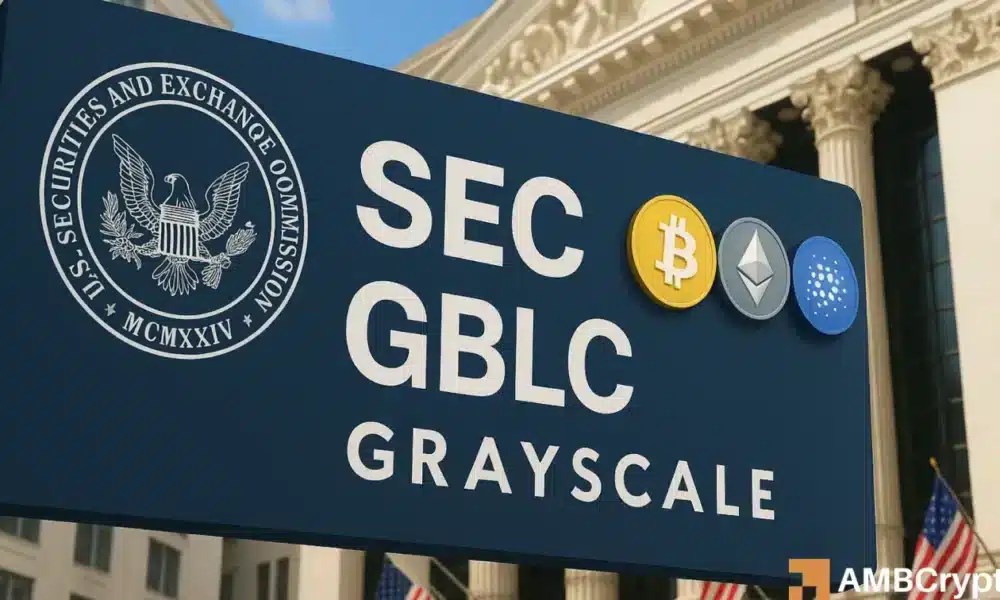
The post Grayscale’s ‘first multi-crypto asset ETP’ in the works: Will BTC, ETH win? appeared on BitcoinEthereumNews.com. Key Takeaways What does this approval mean for investors? It allows traditional investors to access diversified exposure to major cryptocurrencies without buying tokens directly. Which cryptocurrencies are included in GDLC? Bitcoin, Ether, XRP, Solana, and Cardano. The U.S. Securities and Exchange Commission (SEC) has greenlit the Grayscale Digital Large Cap Fund (GDLC) for stock exchange trading.  The approval, coinciding with relaxed ETF listing standards, opens the door for traditional investors to access the crypto market more easily and signals growing institutional support. Grayscale CEO Peter Mintzberg weighs in Grayscale CEO Peter Mintzberg confirmed the development on X (formerly Twitter), praising the SEC’s Crypto Task Force for providing much-needed clarity to the sector. He said,  “The Grayscale team is working expeditiously to bring the FIRST multi #crypto asset ETP to market with Bitcoin, Ethereum, XRP, Solana, and Cardano.” He further added,  “Thank you to the SEC #Crypto Task Force for their continued, unmatched efforts in bringing the regulatory clarity our industry deserves.” The newly approved Grayscale Digital Large Cap Fund (GDLC) offers investors exposure to five of the world’s largest cryptocurrencies: Bitcoin [BTC], Ethereum [ETH], Ripple [XRP], Solana [SOL], and Cardano [ADA]. Impact on included tokens Following the announcement, markets reacted positively. BTC traded at $117,153.61 after a 0.69% rise in the past 24 hours, Ether climbed 2.02% to $4,579.73, XRP at $3.10 up by 3.07%, Solana at $245.94 up by 4.78%, and Cardano reached $0.9130 up by 4.85%, per CoinMarketCap. By packaging multiple cryptocurrencies into a single ETP, GDLC allows traditional investors to gain diversified crypto exposure without the need to open exchange accounts or purchase individual tokens. This green light comes just months after the SEC had delayed Grayscale’s plan to convert GDLC from an over-the-counter fund to an ETP listed on NYSE Arca. With approval now granted, the fund is…
Share
BitcoinEthereumNews2025/09/19 12:53

Trade GOLD, Share 1,000,000 USDT

Trade GOLD, Share 1,000,000 USDTTrade GOLD, Share 1,000,000 USDT

0 fees, up to 1,000x leverage, deep liquidity