The Ethereum ETF landscape just shifted in a way few saw coming. Grayscale Investments has officially introduced staking to its Ethereum Exchange-Traded Funds, a first in the U.S. market. This move, announced on October 6, signals a new era where traditional investors can finally earn staking rewards directly through regulated ETF structures. In simple terms, Grayscale is blending Wall Street’s favorite vehicle, ETFs, with one of blockchain’s core reward mechanisms. That combination could redefine how institutional capital interacts with Ethereum. Ethereum ETFs Just Got an Upgrade Grayscale confirmed that both its Ethereum Mini Trust (ETH) and Ethereum Trust (ETHE) now include staking features. Investors can either have rewards automatically reinvested to compound gains or receive them as cash payouts. The firm also extended staking to its Solana Trust (GSOL), pending regulatory clearance to list it as a spot product. Once approved, it will be among the first Solana-based ETFs in the United States to support staking. According to Grayscale, this dual-option model was crafted to give investors flexibility, from those seeking long-term growth to others prioritizing short-term liquidity. The move comes as Ethereum’s staking yield averages around 3.2%, giving ETF issuers an avenue to offset management fees and pass on savings to investors. Regulatory Shift Opens the Door For years, U.S. regulators treated staking as a gray zone. Under the previous SEC chair, some staking programs were classified as unregistered securities. That stance led to enforcement actions and forced several exchanges to shut down or restructure their staking services. But tides are changing. Over the past year, regulators have softened their tone. Liquid staking, when properly structured, is no longer automatically considered a securities offering. The shift, coupled with friendlier crypto rhetoric under the Trump administration, gave firms like Grayscale the green light to innovate. Ethereum’s proof-of-stake design rewards validators who help secure the network. By integrating that directly into ETFs, Grayscale is essentially bridging DeFi yields with the comfort of traditional finance. Institutional Stakes Rise Market analysts believe this could reshape competition in the Ethereum ETF sector. Lower fees, coupled with yield potential, make ETH-based funds more attractive than ever. As of early October, about 36 million ETH, roughly 30% of the total supply, is staked, with liquid staking protocols like Lido leading the pack. Institutional involvement through ETFs could push that number even higher. “Ethereum staking through ETFs introduces a new standard for yield exposure in regulated markets,” wrote market analyst Ryan Selkis on X, calling it “a long-awaited bridge between crypto utility and traditional asset management.” If major players like BlackRock or Fidelity follow Grayscale’s lead, the competition could compress fees industry-wide, a win for investors and a potential catalyst for fresh inflows into ETH. Risks and Realities Despite optimism, experts warn that staking isn’t risk-free. Validator concentration could create centralization risks, and yield fluctuations may impact fund performance. Redemption management is another challenge; ETFs must maintain enough liquid ETH to process withdrawals while staking a meaningful portion to earn rewards. Still, Grayscale’s institutional staking setup, using vetted validator networks and custodians, is designed to balance compliance with yield generation. It marks a careful but confident step into a more mature era of crypto finance. Conclusion Grayscale’s integration of staking into Ethereum ETFs is more than a corporate tweak; it’s a statement. It suggests that crypto yield products can exist inside the rules, not around them. For Ethereum, it could mean new layers of liquidity, demand, and long-term network stability. For investors, it’s a taste of passive income without leaving the comfort zone of regulated markets. As the race for ETF innovation heats up, Grayscale may have just given Ethereum a new growth narrative, one where staking isn’t just for crypto natives anymore. Frequently Asked Questions 1. What does staking in an ETF mean?It allows investors to earn yield from blockchain validation directly within an ETF structure, without managing tokens themselves. 2. Is staking in ETFs safe?While it adds yield potential, risks like validator performance, network slashing, and liquidity constraints remain. 3. How does this affect Ethereum’s price?More staking can reduce circulating supply, which may support long-term price stability if demand grows. 4. Will other asset managers follow?Yes, many analysts expect competitors like BlackRock or Fidelity to explore similar staking integrations. Glossary of Key Terms ETF (Exchange-Traded Fund):A pooled investment vehicle traded on stock exchanges, offering exposure to assets like crypto. Staking:The process of locking up crypto to validate transactions on proof-of-stake networks and earn rewards. ETH:The native cryptocurrency of the Ethereum network, used for transactions and staking. Validator:A network participant who helps confirm transactions and maintain blockchain security in exchange for rewards. Read More: Why Grayscale’s Ethereum ETF Staking Could Spark the Next Institutional Wave">Why Grayscale’s Ethereum ETF Staking Could Spark the Next Institutional WaveThe Ethereum ETF landscape just shifted in a way few saw coming. Grayscale Investments has officially introduced staking to its Ethereum Exchange-Traded Funds, a first in the U.S. market. This move, announced on October 6, signals a new era where traditional investors can finally earn staking rewards directly through regulated ETF structures. In simple terms, Grayscale is blending Wall Street’s favorite vehicle, ETFs, with one of blockchain’s core reward mechanisms. That combination could redefine how institutional capital interacts with Ethereum. Ethereum ETFs Just Got an Upgrade Grayscale confirmed that both its Ethereum Mini Trust (ETH) and Ethereum Trust (ETHE) now include staking features. Investors can either have rewards automatically reinvested to compound gains or receive them as cash payouts. The firm also extended staking to its Solana Trust (GSOL), pending regulatory clearance to list it as a spot product. Once approved, it will be among the first Solana-based ETFs in the United States to support staking. According to Grayscale, this dual-option model was crafted to give investors flexibility, from those seeking long-term growth to others prioritizing short-term liquidity. The move comes as Ethereum’s staking yield averages around 3.2%, giving ETF issuers an avenue to offset management fees and pass on savings to investors. Regulatory Shift Opens the Door For years, U.S. regulators treated staking as a gray zone. Under the previous SEC chair, some staking programs were classified as unregistered securities. That stance led to enforcement actions and forced several exchanges to shut down or restructure their staking services. But tides are changing. Over the past year, regulators have softened their tone. Liquid staking, when properly structured, is no longer automatically considered a securities offering. The shift, coupled with friendlier crypto rhetoric under the Trump administration, gave firms like Grayscale the green light to innovate. Ethereum’s proof-of-stake design rewards validators who help secure the network. By integrating that directly into ETFs, Grayscale is essentially bridging DeFi yields with the comfort of traditional finance. Institutional Stakes Rise Market analysts believe this could reshape competition in the Ethereum ETF sector. Lower fees, coupled with yield potential, make ETH-based funds more attractive than ever. As of early October, about 36 million ETH, roughly 30% of the total supply, is staked, with liquid staking protocols like Lido leading the pack. Institutional involvement through ETFs could push that number even higher. “Ethereum staking through ETFs introduces a new standard for yield exposure in regulated markets,” wrote market analyst Ryan Selkis on X, calling it “a long-awaited bridge between crypto utility and traditional asset management.” If major players like BlackRock or Fidelity follow Grayscale’s lead, the competition could compress fees industry-wide, a win for investors and a potential catalyst for fresh inflows into ETH. Risks and Realities Despite optimism, experts warn that staking isn’t risk-free. Validator concentration could create centralization risks, and yield fluctuations may impact fund performance. Redemption management is another challenge; ETFs must maintain enough liquid ETH to process withdrawals while staking a meaningful portion to earn rewards. Still, Grayscale’s institutional staking setup, using vetted validator networks and custodians, is designed to balance compliance with yield generation. It marks a careful but confident step into a more mature era of crypto finance. Conclusion Grayscale’s integration of staking into Ethereum ETFs is more than a corporate tweak; it’s a statement. It suggests that crypto yield products can exist inside the rules, not around them. For Ethereum, it could mean new layers of liquidity, demand, and long-term network stability. For investors, it’s a taste of passive income without leaving the comfort zone of regulated markets. As the race for ETF innovation heats up, Grayscale may have just given Ethereum a new growth narrative, one where staking isn’t just for crypto natives anymore. Frequently Asked Questions 1. What does staking in an ETF mean?It allows investors to earn yield from blockchain validation directly within an ETF structure, without managing tokens themselves. 2. Is staking in ETFs safe?While it adds yield potential, risks like validator performance, network slashing, and liquidity constraints remain. 3. How does this affect Ethereum’s price?More staking can reduce circulating supply, which may support long-term price stability if demand grows. 4. Will other asset managers follow?Yes, many analysts expect competitors like BlackRock or Fidelity to explore similar staking integrations. Glossary of Key Terms ETF (Exchange-Traded Fund):A pooled investment vehicle traded on stock exchanges, offering exposure to assets like crypto. Staking:The process of locking up crypto to validate transactions on proof-of-stake networks and earn rewards. ETH:The native cryptocurrency of the Ethereum network, used for transactions and staking. Validator:A network participant who helps confirm transactions and maintain blockchain security in exchange for rewards. Read More: Why Grayscale’s Ethereum ETF Staking Could Spark the Next Institutional Wave">Why Grayscale’s Ethereum ETF Staking Could Spark the Next Institutional Wave

Why Grayscale’s Ethereum ETF Staking Could Spark the Next Institutional Wave

The Ethereum ETF landscape just shifted in a way few saw coming. Grayscale Investments has officially introduced staking to its Ethereum Exchange-Traded Funds, a first in the U.S. market. This move, announced on October 6, signals a new era where traditional investors can finally earn staking rewards directly through regulated ETF structures.

In simple terms, Grayscale is blending Wall Street’s favorite vehicle, ETFs, with one of blockchain’s core reward mechanisms. That combination could redefine how institutional capital interacts with Ethereum.

Ethereum ETFs Just Got an Upgrade

Grayscale confirmed that both its Ethereum Mini Trust (ETH) and Ethereum Trust (ETHE) now include staking features. Investors can either have rewards automatically reinvested to compound gains or receive them as cash payouts.

The firm also extended staking to its Solana Trust (GSOL), pending regulatory clearance to list it as a spot product. Once approved, it will be among the first Solana-based ETFs in the United States to support staking.

According to Grayscale, this dual-option model was crafted to give investors flexibility, from those seeking long-term growth to others prioritizing short-term liquidity. The move comes as Ethereum’s staking yield averages around 3.2%, giving ETF issuers an avenue to offset management fees and pass on savings to investors.
Grayscale Ethereum ETF

Regulatory Shift Opens the Door

For years, U.S. regulators treated staking as a gray zone. Under the previous SEC chair, some staking programs were classified as unregistered securities. That stance led to enforcement actions and forced several exchanges to shut down or restructure their staking services.

But tides are changing. Over the past year, regulators have softened their tone. Liquid staking, when properly structured, is no longer automatically considered a securities offering. The shift, coupled with friendlier crypto rhetoric under the Trump administration, gave firms like Grayscale the green light to innovate.

Ethereum’s proof-of-stake design rewards validators who help secure the network. By integrating that directly into ETFs, Grayscale is essentially bridging DeFi yields with the comfort of traditional finance.

Institutional Stakes Rise

Market analysts believe this could reshape competition in the Ethereum ETF sector. Lower fees, coupled with yield potential, make ETH-based funds more attractive than ever.

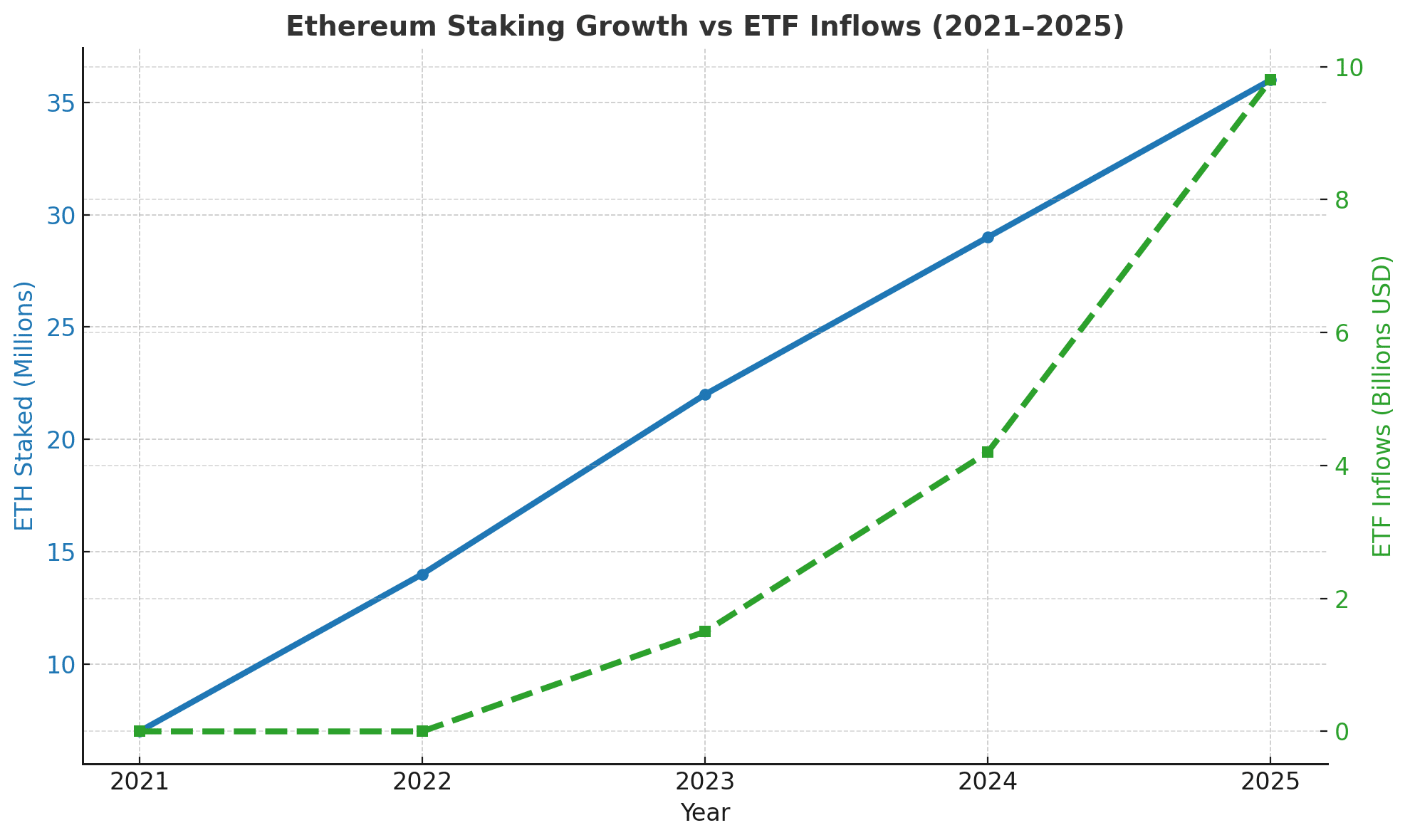
As of early October, about 36 million ETH, roughly 30% of the total supply, is staked, with liquid staking protocols like Lido leading the pack. Institutional involvement through ETFs could push that number even higher.

“Ethereum staking through ETFs introduces a new standard for yield exposure in regulated markets,” wrote market analyst Ryan Selkis on X, calling it “a long-awaited bridge between crypto utility and traditional asset management.”

If major players like BlackRock or Fidelity follow Grayscale’s lead, the competition could compress fees industry-wide, a win for investors and a potential catalyst for fresh inflows into ETH.

Risks and Realities

Despite optimism, experts warn that staking isn’t risk-free. Validator concentration could create centralization risks, and yield fluctuations may impact fund performance. Redemption management is another challenge; ETFs must maintain enough liquid ETH to process withdrawals while staking a meaningful portion to earn rewards.

Still, Grayscale’s institutional staking setup, using vetted validator networks and custodians, is designed to balance compliance with yield generation. It marks a careful but confident step into a more mature era of crypto finance.

Conclusion

Grayscale’s integration of staking into Ethereum ETFs is more than a corporate tweak; it’s a statement. It suggests that crypto yield products can exist inside the rules, not around them. For Ethereum, it could mean new layers of liquidity, demand, and long-term network stability. For investors, it’s a taste of passive income without leaving the comfort zone of regulated markets.

As the race for ETF innovation heats up, Grayscale may have just given Ethereum a new growth narrative, one where staking isn’t just for crypto natives anymore.

Frequently Asked Questions

1. What does staking in an ETF mean?
It allows investors to earn yield from blockchain validation directly within an ETF structure, without managing tokens themselves.

2. Is staking in ETFs safe?
While it adds yield potential, risks like validator performance, network slashing, and liquidity constraints remain.

3. How does this affect Ethereum’s price?
More staking can reduce circulating supply, which may support long-term price stability if demand grows.

4. Will other asset managers follow?
Yes, many analysts expect competitors like BlackRock or Fidelity to explore similar staking integrations.

Glossary of Key Terms

ETF (Exchange-Traded Fund):
A pooled investment vehicle traded on stock exchanges, offering exposure to assets like crypto.

Staking:
The process of locking up crypto to validate transactions on proof-of-stake networks and earn rewards.

ETH:
The native cryptocurrency of the Ethereum network, used for transactions and staking.

Validator:
A network participant who helps confirm transactions and maintain blockchain security in exchange for rewards.

Read More: Why Grayscale’s Ethereum ETF Staking Could Spark the Next Institutional Wave">Why Grayscale’s Ethereum ETF Staking Could Spark the Next Institutional Wave

Market Opportunity
Illusion of Life Logo
Illusion of Life Price(SPARK)
$0.002444
$0.002444$0.002444
-6.03%
USD
Illusion of Life (SPARK) Live Price Chart
Disclaimer: The articles reposted on this site are sourced from public platforms and are provided for informational purposes only. They do not necessarily reflect the views of MEXC. All rights remain with the original authors. If you believe any content infringes on third-party rights, please contact service@support.mexc.com for removal. MEXC makes no guarantees regarding the accuracy, completeness, or timeliness of the content and is not responsible for any actions taken based on the information provided. The content does not constitute financial, legal, or other professional advice, nor should it be considered a recommendation or endorsement by MEXC.

You May Also Like

BFX Presale Raises $7.5M as Solana Holds $243 and Avalanche Eyes $1B Treasury — Best Cryptos to Buy in 2025

BFX Presale Raises $7.5M as Solana Holds $243 and Avalanche Eyes $1B Treasury — Best Cryptos to Buy in 2025

BFX presale hits $7.5M with tokens at $0.024 and 30% bonus code BLOCK30, while Solana holds $243 and Avalanche builds a $1B treasury to attract institutions.
Share
Blockchainreporter2025/09/18 01:07
Trading time: Tonight, the US GDP and the upcoming non-farm data will become the market focus. Institutions are bullish on BTC to $120,000 in the second quarter.

Trading time: Tonight, the US GDP and the upcoming non-farm data will become the market focus. Institutions are bullish on BTC to $120,000 in the second quarter.

Daily market key data review and trend analysis, produced by PANews.
Share
PANews2025/04/30 13:50
Franklin Templeton CEO Dismisses 50bps Rate Cut Ahead FOMC

Franklin Templeton CEO Dismisses 50bps Rate Cut Ahead FOMC

The post Franklin Templeton CEO Dismisses 50bps Rate Cut Ahead FOMC appeared on BitcoinEthereumNews.com. Franklin Templeton CEO Jenny Johnson has weighed in on whether the Federal Reserve should make a 25 basis points (bps) Fed rate cut or 50 bps cut. This comes ahead of the Fed decision today at today’s FOMC meeting, with the market pricing in a 25 bps cut. Bitcoin and the broader crypto market are currently trading flat ahead of the rate cut decision. Franklin Templeton CEO Weighs In On Potential FOMC Decision In a CNBC interview, Jenny Johnson said that she expects the Fed to make a 25 bps cut today instead of a 50 bps cut. She acknowledged the jobs data, which suggested that the labor market is weakening. However, she noted that this data is backward-looking, indicating that it doesn’t show the current state of the economy. She alluded to the wage growth, which she remarked is an indication of a robust labor market. She added that retail sales are up and that consumers are still spending, despite inflation being sticky at 3%, which makes a case for why the FOMC should opt against a 50-basis-point Fed rate cut. In line with this, the Franklin Templeton CEO said that she would go with a 25 bps rate cut if she were Jerome Powell. She remarked that the Fed still has the October and December FOMC meetings to make further cuts if the incoming data warrants it. Johnson also asserted that the data show a robust economy. However, she noted that there can’t be an argument for no Fed rate cut since Powell already signaled at Jackson Hole that they were likely to lower interest rates at this meeting due to concerns over a weakening labor market. Notably, her comment comes as experts argue for both sides on why the Fed should make a 25 bps cut or…
Share
BitcoinEthereumNews2025/09/18 00:36