This article validates the MENT-Flow model in 2:1 phase space tomography by comparing its performance against the MENT algorithm and an unregularized neural network.This article validates the MENT-Flow model in 2:1 phase space tomography by comparing its performance against the MENT algorithm and an unregularized neural network.

2D Phase Space Tomography: Validating MENT-Flow Against MENT Using 1D Projections

2025/10/07 09:40
3 min read
For feedback or concerns regarding this content, please contact us at crypto.news@mexc.com

I. Introduction

II. Maximum Entropy Tomography

  • A. Ment
  • B. Ment-Flow

III. Numerical Experiments

  • A. 2D reconstructions from 1D projections
  • B. 6D reconstructions from 1D projections

IV. Conclusion and Extensions

V. Acknowledgments and References

A. 2D reconstructions from 1D projections

Our first experiment tests the model performance in 2:1 phase space tomography. We assume an accelerator composed of drifts and quadrupole magnets, such that a symplectic transfer matrix M approximates the dynamics. The transfer matrix can be decomposed as

\
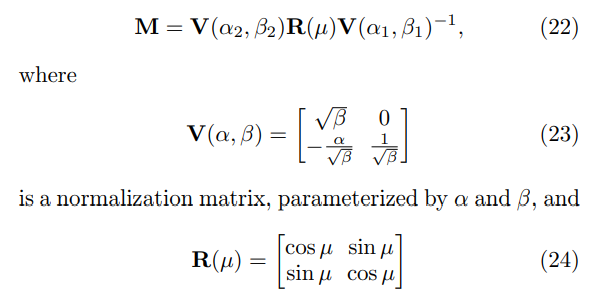
\ is a rotation by the phase advance µ. The projection angle, and hence the reconstruction quality, depends only on the phase advance. Various constraints can limit the projection angle range, but we assume the projection angles are evenly spaced over the maximum 180-degree range.

\ Fig. 2 shows reconstructions from a varying number of projections, comparing MENT, MENT-Flow, and the unregularized neural network (NN). It is clear that maximizing the stochastic estimate in Eq. (16) pushes the distribution’s entropy close to its constrained maximum. (Recall that MENT maximizes entropy by construction). Although the MENT solutions are of higher quality, the differences are not visible from afar.

\ Fig. 2 illustrates that entropy maximization is a conservative approach to the reconstruction problem. All reconstructed features are implied by the data. In contrast, the distributions in the bottom rows fit the data but are unnecessarily complex. Of course, reconstructions from one or two projections are bound to fail if the prior is uninformative, but these cases are still useful because they demonstrate MENT’s logical consistency: given only the marginal distributions and an uncorrelated prior, the posterior is the product of the marginals. On the other extreme, with enough data, the feasible distributions differ only in minor details. MENT shines in intermediate cases where the measurements contain just enough information to constrain the distribution’s primary features. For example, the continuous spiral structure develops rapidly with the number of views in Fig. 2.

\ Fig. 2 also illustrates the flow’s capacity to represent complicated distributions despite the restriction to invertible transformations. This example focuses on spiral patterns, which are characteristic of nonlinear dynamics. (Additional examples are included in the supplemental material.) It is important to note that, while our analysis focuses on the beam core, low-density regions can also impact accelerator performance [33]. Flows can struggle to model distribution tails [34]. Our ground-truth distribution does not have significant halo and we do not report the agreement at this level; however, preliminary studies indicate the Kullback-Leibler (KL) divergence may enhance dynamic range relative to, i.e., the mean absolute error when fitting data.

\
\

:::info Authors:

(1) Austin Hoover, Oak Ridge National Laboratory, Oak Ridge, Tennessee 37830, USA (hooveram@ornl.gov);

(2) Jonathan C. Wong, Institute of Modern Physics, Chinese Academy of Sciences, Lanzhou 730000, China.

:::


:::info This paper is available on arxiv under CC BY 4.0 DEED license.

:::

\

Market Opportunity
Spacecoin Logo
Spacecoin Price(SPACE)
$0.008591
$0.008591$0.008591
-0.93%
USD
Spacecoin (SPACE) Live Price Chart
Disclaimer: The articles reposted on this site are sourced from public platforms and are provided for informational purposes only. They do not necessarily reflect the views of MEXC. All rights remain with the original authors. If you believe any content infringes on third-party rights, please contact crypto.news@mexc.com for removal. MEXC makes no guarantees regarding the accuracy, completeness, or timeliness of the content and is not responsible for any actions taken based on the information provided. The content does not constitute financial, legal, or other professional advice, nor should it be considered a recommendation or endorsement by MEXC.

You May Also Like

Bitcoin ETFs Surge with 20,685 BTC Inflows, Marking Strongest Week

Bitcoin ETFs Surge with 20,685 BTC Inflows, Marking Strongest Week

TLDR Bitcoin ETFs recorded their strongest weekly inflows since July, reaching 20,685 BTC. U.S. Bitcoin ETFs contributed nearly 97% of the total inflows last week. The surge in Bitcoin ETF inflows pushed holdings to a new high of 1.32 million BTC. Fidelity’s FBTC product accounted for 36% of the total inflows, marking an 18-month high. [...] The post Bitcoin ETFs Surge with 20,685 BTC Inflows, Marking Strongest Week appeared first on CoinCentral.
Share
Coincentral2025/09/18 02:30
Kalshi debuts ecosystem hub with Solana and Base

Kalshi debuts ecosystem hub with Solana and Base

The post Kalshi debuts ecosystem hub with Solana and Base appeared on BitcoinEthereumNews.com. Kalshi, the US-regulated prediction market exchange, rolled out a new program on Wednesday called KalshiEco Hub. The initiative, developed in partnership with Solana and Coinbase-backed Base, is designed to attract builders, traders, and content creators to a growing ecosystem around prediction markets. By combining its regulatory footing with crypto-native infrastructure, Kalshi said it is aiming to become a bridge between traditional finance and onchain innovation. The hub offers grants, technical assistance, and marketing support to selected projects. Kalshi also announced that it will support native deposits of Solana’s SOL token and USDC stablecoin, making it easier for users already active in crypto to participate directly. Early collaborators include Kalshinomics, a dashboard for market analytics, and Verso, which is building professional-grade tools for market discovery and execution. Other partners, such as Caddy, are exploring ways to expand retail-facing trading experiences. Kalshi’s move to embrace blockchain partnerships comes at a time when prediction markets are drawing fresh attention for their ability to capture sentiment around elections, economic policy, and cultural events. Competitor Polymarket recently acquired QCEX — a derivatives exchange with a CFTC license — to pave its way back into US operations under regulatory compliance. At the same time, platforms like PredictIt continue to push for a clearer regulatory footing. The legal terrain remains complex, with some states issuing cease-and-desist orders over whether these event contracts count as gambling, not finance. This is a developing story. This article was generated with the assistance of AI and reviewed by editor Jeffrey Albus before publication. Get the news in your inbox. Explore Blockworks newsletters: Source: https://blockworks.co/news/kalshi-ecosystem-hub-solana-base
Share
BitcoinEthereumNews2025/09/18 04:40
Urgent Warning For US Banks To Avoid Payments Market Collapse

Urgent Warning For US Banks To Avoid Payments Market Collapse

The post Urgent Warning For US Banks To Avoid Payments Market Collapse appeared on BitcoinEthereumNews.com. Crypto Regulatory Clarity: Urgent Warning For US Banks
Share
BitcoinEthereumNews2026/03/09 12:02