

Sanctioned Russian Stablecoin A7A5 Becomes Largest Non-Dollar Digital Currency

A7A5, issued through a company in Kyrgyzstan, saw its value jump 250% in a single day on September 25, 2025, reaching nearly $500 million. This surge pushed it past Circle’s euro-pegged EURC to claim the top spot among stablecoins not tied to the US dollar. The token now represents 43% of the entire non-dollar stablecoin market.
The Sanctions Problem That Won’t Go Away
The timing raises eyebrows. The massive growth happened just days before A7A5 executives appeared at Token2049, a major crypto conference in Singapore. After media inquiries, organizers quickly removed all mentions of A7A5 from their website and speaker list.
Yet the damage was done. The stablecoin had already proven it could operate—and grow—despite facing sanctions from the US Treasury, UK, and European Union.
The US government sanctioned A7A5’s issuer, Old Vector LLC, along with its parent company A7 LLC in August 2025. These actions followed earlier moves against Garantex, a Russian crypto exchange that processed over $100 million in transactions linked to ransomware and illegal darknet markets since 2019.
Blockchain analysts discovered something troubling: Garantex wallets started moving funds into A7A5 in January 2025, weeks before law enforcement shut down the exchange. This suggests the people behind Garantex knew what was coming and planned ahead.
Following the Money Trail
The numbers tell a story of rapid adoption. Since launching in January 2025, A7A5 has processed over $70 billion in total transactions, according to blockchain research firm Elliptic. By July, the stablecoin was handling $1 billion in daily transfers.
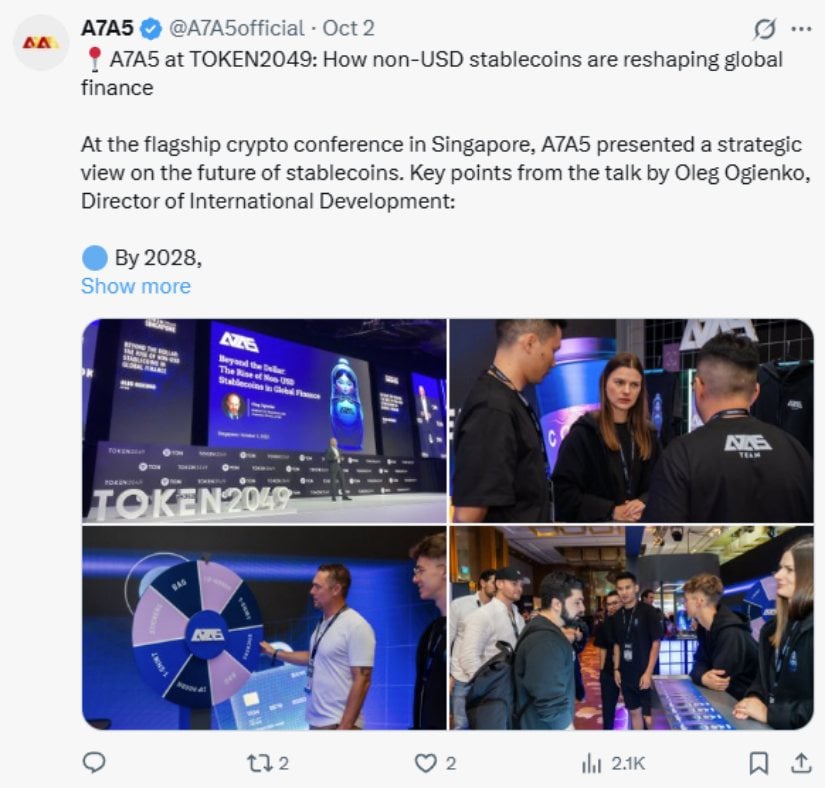
Source: @A7A5official
After US sanctions hit in August, operators made a bold move. They destroyed and reissued more than 80% of all A7A5 tokens to break connections with sanctioned wallet addresses. The new tokens continued moving billions of dollars across borders.
A7A5 works differently than most stablecoins. Each token is supposed to be backed by Russian rubles sitting in accounts at Promsvyazbank, a state-owned Russian bank already under sanctions for financing the country’s defense industry. The token promises to pay holders 50% of the interest earned on those deposits—an unusual feature that makes it attractive to users.
The stablecoin’s ownership structure connects directly to sanctioned individuals. Moldovan businessman Ilan Shor, who was convicted of fraud and faces election interference charges, owns the majority of A7. Promsvyazbank owns the rest.
China and Africa Expansion
Recent analysis reveals where A7A5 activity concentrates. The Centre for Information Resilience reported that 78% of A7 transactions flowed through Chinese jurisdictions as of August 2025. The company has also opened offices in Nigeria and Zimbabwe, expanding its reach into African markets.
Trading patterns support the idea that A7A5 serves businesses rather than individual crypto traders. Most activity happens Monday through Friday during business hours—not the 24/7 pattern typical of retail cryptocurrency trading.
Russia’s government has embraced the token. Authorities granted A7A5 formal status as a digital financial asset, allowing Russian exporters and importers to use it officially for trade settlements through Promsvyazbank’s platform.
Why Traditional Sanctions Fail
The A7A5 case shows how difficult it is to enforce financial restrictions in the crypto world. When Garantex was shut down and $26 million in Tether stablecoins were frozen, its operators simply created Grinex—a new exchange that picked up where the old one left off.
Grinex became the primary venue for A7A5 trading. When US authorities sanctioned Grinex in August, the stablecoin kept growing anyway.
The technology makes this possible. A7A5 runs on Ethereum and Tron blockchains, which means it exists across thousands of computers worldwide. Unlike traditional banks that governments can raid or shut down, there’s no single point of failure.
Jurisdictional gaps create additional problems. Token2049 could host A7A5 representatives because a Hong Kong company organizes the conference. Hong Kong follows China’s policies on Russia, which remain far more lenient than Western sanctions.
Several other crypto exchanges with Russian connections still list A7A5 for trading. These include peer-to-peer platforms and decentralized exchanges where no single company controls the trading.
The Bigger Picture
A7A5’s rise reflects broader trends in non-dollar stablecoins. Countries facing Western sanctions or seeking alternatives to dollar dominance have shown growing interest in cryptocurrency-based payment systems.
Russia’s Finance Minister previously stated the country was using Bitcoin and digital currencies with international trade partners to counter sanctions. The A7A5 project takes this strategy further by creating a ruble-backed token specifically designed for cross-border payments.
Experts worry about connections to political interference schemes. Moldovan police have documented how Shor and Promsvyazbank used illicit funding, including cryptocurrency, to influence elections in Moldova. The shared infrastructure between A7A5 and Shor’s previous political operations raises questions about the token’s potential role in future schemes.
The stablecoin market continues expanding despite these concerns. Total stablecoin value has surpassed $200 billion globally, with some analysts projecting growth to $400 billion by year’s end. Most of that value remains in dollar-backed tokens like USDT and USDC, but alternatives are gaining ground.
When Rules Don’t Apply
A7A5 stablecoin processes billions in transactions, pays interest to holders, and maintains operations across multiple exchanges—all while its creators and backers face comprehensive international sanctions.
This creates a challenge for governments trying to enforce economic restrictions. Traditional sanctions work by cutting off access to the global banking system. But cryptocurrency operates in parallel, creating payment rails that don’t rely on banks, SWIFT transfers, or correspondent banking relationships.
Whether this marks the beginning of a new era in sanctions evasion or a temporary exploit of regulatory gaps remains an open question. What’s clear is that A7A5 has fundamentally changed from a small experimental token to the dominant force in non-dollar stablecoins—despite every effort to stop it.
You May Also Like

The Channel Factories We’ve Been Waiting For

Riot Platforms Reports December 2025 Bitcoin Production, Plans Quarterly Updates
