

Ethereum Faces Plagiarism Jabs as Hoskinson and Adam Back Weigh In On UTXO Proposal
Key highlights:
- Ethereum researchers are mulling the introduction of native UTXOs for payments on the network
- Charles Hoskinson slams Ethereum for failing to credit Cardano for rolling out EUTXO
- Ethereum is bracing for a raft of network changes over the next four years
As Ethereum tries to reinvent itself, a new proposal from an Ethereum Foundation researcher to introduce native UTXOs for payments has sparked criticism from prominent ecosystem players. Cardano founder Charles Hoskinson and cryptographer Adam Back argue that the idea rehashes concepts pioneered years ago by Bitcoin and Cardano.
Ethereum proposes native UTXOs for payments
In a post, Ethereum Foundation researcher Toni Wahrstatter proposed a plan to reduce Ethereum’s long-term state growth by making simple payments “one-shot objects.” According to the proposal, the objects will be removed after being used rather than permanently stored.
The proposal borrows a key property from Bitcoin’s UTXO model, where payments exist only until they are spent. Rather than keeping permanent account balances for simple transfers, the researcher proposed creating native UTXOs, reducing payment workloads by 99.8%.
“Payments should be one-shot objects, not permanent state,” said Toni. “Bitcoin got this right. Ethereum can bring the same idea to payments.”
Hoskinson responded to the proposal by arguing that it closely resembles Cardano’s Extended UTXO (EUTXO) model, which has underpinned the network since its launch. Furthermore, the Cardano founder argued that EUTXO is the most profound innovation for smart contracts, chiding Ethereum for not giving credit to Cardano.
“EUTXO is the biggest innovation of the smart contract world, and Ethereum cannot mention it as they literally try to copy it,” wrote Hoskinson on X.
Adam Back, whose work influenced Bitcoin’s early development, took the criticism further by pointing to Bitcoin as the source of the concept. Back revealed that he told Ethereum developers that the UTXO model is superior before they wrote any code, but his advice was largely ignored.
A wave of fundamental changes for Ethereum
Toni’s proposal comes against the backdrop of several changes to the Ethereum network. Early in the week, Ethereum co-founder Vitalik Buterin unveiled plans for Lean Ethereum, touted as the “third major iteration” for the network.
Tipped to span four years, Lean Ethereum will replace every part of the network, introducing quantum-resistant properties. Furthermore, the seismic changes will lean on recursive STARKs and multidimensional gas pricing.
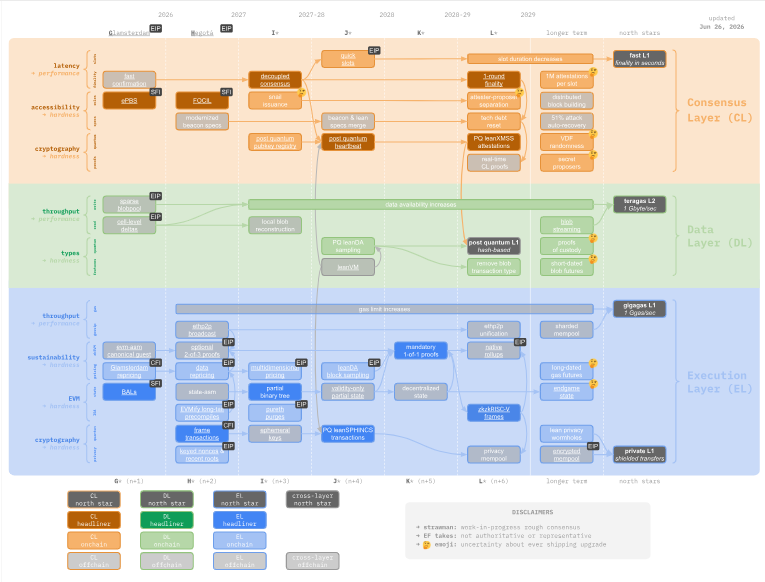
Source: Strawmap.org
Meanwhile, Buterin is tinkering with an “extremely lean chain” vision, stripping down the Ethereum consensus layer to the barest. His ambitious plan will see validators generate STARK proof of their participation and balance changes, reducing the burden on the network by a large margin.
Ahead of the incoming changes, several Ethereum research organizations have launched to prepare the network for mainstream institutional use. Both Ethlabs and Ethereum Institutional, operating as research-focused nonprofits, have the backing of Ethereum whales.


You May Also Like

Fed Governor Calls For Strong Stablecoin Oversight As CLARITY Act’s Final Text Gets Delayed

Live markets: Bitcoin ETFs slip back to outflows while ether funds extend their streak

Siren (SIREN) Plunges 29.9% as Trading Volume Surges 800% Amid Market Correction



