

Nvidia stock catalyst the market is missing
Investors seem to be missing or misunderstanding the key details of Nvidia’s long-term strategy. We can see this in the stock's performance.
Nvidia (NVDA) stock is up 5.94% year to date at the time of writing, Thursday morning, July 2. Meanwhile, the SPDR S&P 500 index (SPY) is up about 9.36% in the same period.
The S&P 500 outpacing the king of AI is a peculiar situation, even as semiconductor stocks face a prolonged sell-off.
Nvidia closed the July 1 trading session at $197.58, a 16.18% drop from its highest closing price of $235.74 on May 14.
When it comes to Broadcom (AVGO), which is one of Nvidia’s two main competitors, the situation is roughly similar. Broadcom is up 6.71% year to date, and it closed the last session at $369.34, down 23.30% from its highest closing price of $481.57 on June 2.
The other main competitor, Advanced Micro Devices (AMD), is in a completely different situation. AMD is up 152.56% year to date, and it closed the last session at $540.88, down 6.89% from its highest closing price of $580.91 on June 30.
AMD’s rally is very different, notably fueled by expectations for Helios racks launching this year, and an additional boost coming from the sentiment that CPUs are important for agentic AI. The fact that AMD is priced at such a premium is quite puzzling.
Nevertheless, Nvidia has come out with a potential solution to the only remaining problem in its long-term strategy, and it is nuclear.
Nvidia teams up with Valar Atomics to evaporate the water problem
Valar Atomics, a nuclear power startup, confirmed on July 1 that it is partnering with Nvidia to develop a small data center in Utah, Reuters reported.
This project aims to demonstrate how AI data centers can conserve water.
The data center will be powered by Valar’s microreactor, which is essentially a small nuclear plant. The companies demonstrated Nvidia Blackwell chips being powered by the small reactor.
More tech stocks:
- Bank of America resets Intel stock price target
- Apple’s gamble just exposed the AI bubble’s fatal flaw
- Bank of America resets Broadcom stock price target after earnings
On May 23 2025, President Donald Trump issued four executive orders tasking the U.S. Department of Energy (DOE) with unleashing the American nuclear renaissance and launching its DOE Reactor Pilot Program.
The main point of this program is to fast-track commercial licensing, with the goal of reaching criticality for at least three advanced nuclear reactor concepts by July 4, 2026.
This is why this demonstration is a very important milestone for Valar.
As for Nvidia, it nicely completes its AI factory strategy.
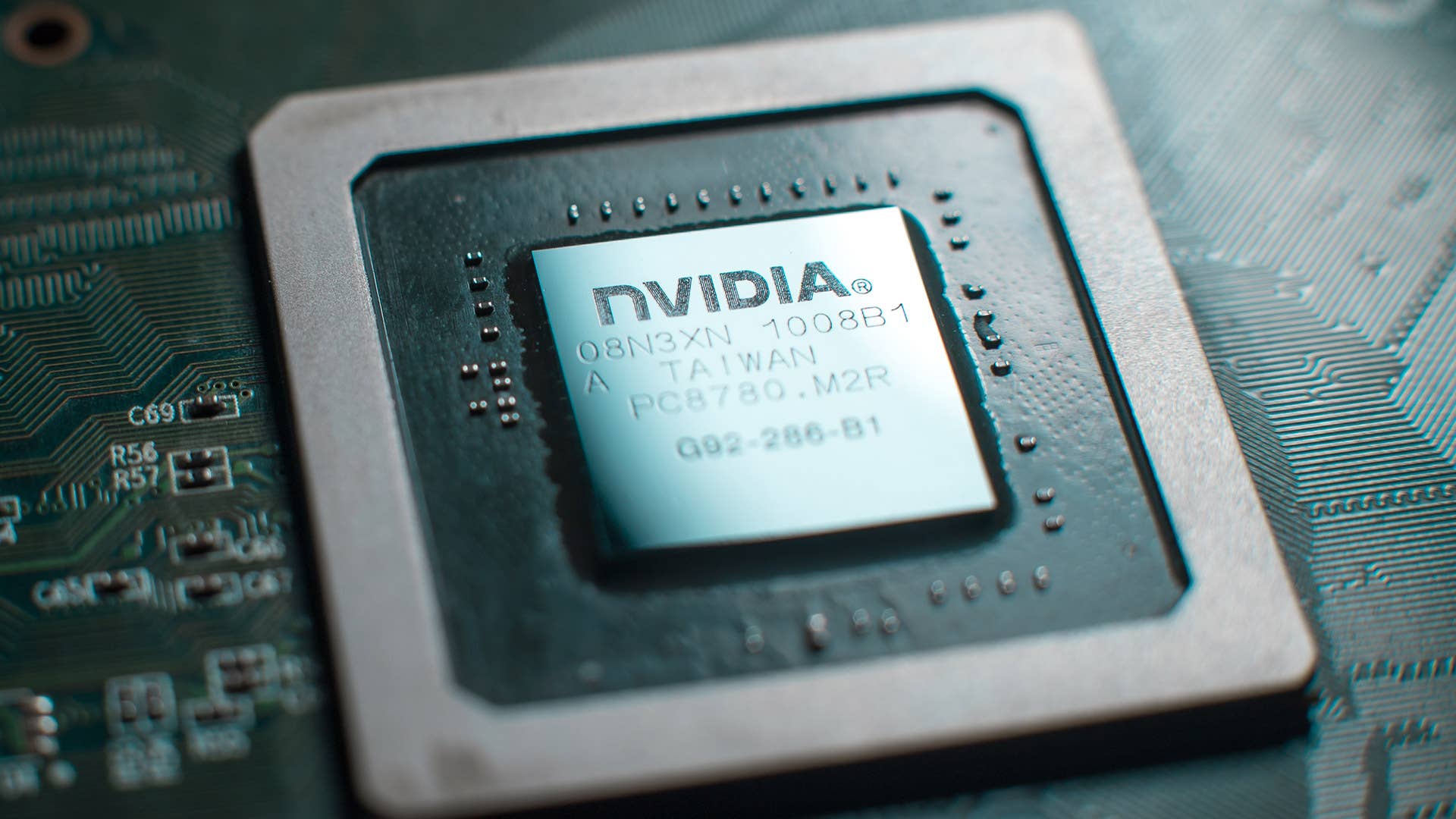 Nvidia and Valar Atomics demonstrated Nvidia Blackwell chips being powered by the small nuclear reactor.
Shutterstock
The AI factory blind spot
Now we can understand why valuing Nvidia solely as a GPU or CPU manufacturer, or as a networking manufacturer, makes no sense. The whole point of its AI factory strategy is to have a complete solution.
No competitor has a complete sovereign AI package from hardware, software, and now power.
According to Hanwha Data Centers, grid interconnection queues now stretch five to seven years in major markets.
Microreactor-based data centers can bypass this issue entirely.
Another huge problem for the AI industry is water.
Nvidia is combining Valar’s helium-cooled reactor with its recently announced closed-loop liquid-cooled data center design to dramatically reduce water usage.
Related: Bank of America revamps Sandisk stock price target
By having a one-stop solution, Nvidia is also protecting itself from any issues faced by OpenAI or Anthropic.
Despite the current sentiment, the vast majority of analysts remain bullish on Nvidia.
What Morgan Stanley thinks about Nvidia
In a June 3, 2026, research note shared with me, Morgan Stanley analyst Joseph Moore said “Nvidia stands out as the best value in the processor group.”
He reiterated an overweight (buy) rating for Nvidia stock and a target price of $288, based on a 22x multiple.
Moore noted that the price is a discount compared to peers in the compute semiconductor space, such as Advanced Micro Devices (AMD), Broadcom (AVGO), and Intel (INTC), noting that Nvidia’s high market share and gross margins leave “limited levers for multiple expansion in the near term.”
Morgan Stanley analysts noted downside risks for Nvidia:
- AI end markets don’t materialize as expected, and customers sharply reduce GPU purchases.
- AMD reemerges as a viable GPU competitor.
- Cloud customers outside Google can develop competitive custom hardware.
What do other analysts think, and how does Morgan Stanley’s opinion compare? According to MarketBeat, 51 of the 54 analysts covering Nvidia stock rate it a buy. Three give a hold rating. The average price target is $303.84.
More on Nvidia & its stock:
- History of Nvidia: Company timeline and facts
- Who owns Nvidia? Top insiders & institutional investors
- Does Nvidia pay dividends? Payouts & yield amid the AI boom
- Nvidia’s stock split history: Everything you need to know
- How many employees does Nvidia have? From R&D to sales


You May Also Like

Brazil Industrial Output Misses Forecasts, Contracts 0.2% in May

Young voters, out-of-state Johoreans will decide polls, says Zaliha


