

Crude Markets Decline Third Day Amid Diplomatic Progress and Surging US Output
Key Takeaways
- Crude benchmarks declined for a third consecutive session, WTI approaching $68 while Brent dropped under $72
- Doha negotiations between Washington and Tehran concluded without agreement but with commitment to continue dialogue
- Oil transit through the Strait of Hormuz surpassed 10 million barrels daily
- American crude production reached an all-time peak of 13.93 million barrels per day in April
- Cartel members may implement additional output hikes in August, intensifying downward price momentum
Oil prices extended their downward trajectory on Thursday as market participants digested increased supply levels and tentative diplomatic developments from the Doha meetings between American and Iranian representatives.
West Texas Intermediate benchmark crude decreased approximately 1.4%, settling around $67.64 per barrel. Brent crude declined 1.3% to reach $70.67 per barrel. This marks the third consecutive trading session of losses for both major oil benchmarks.
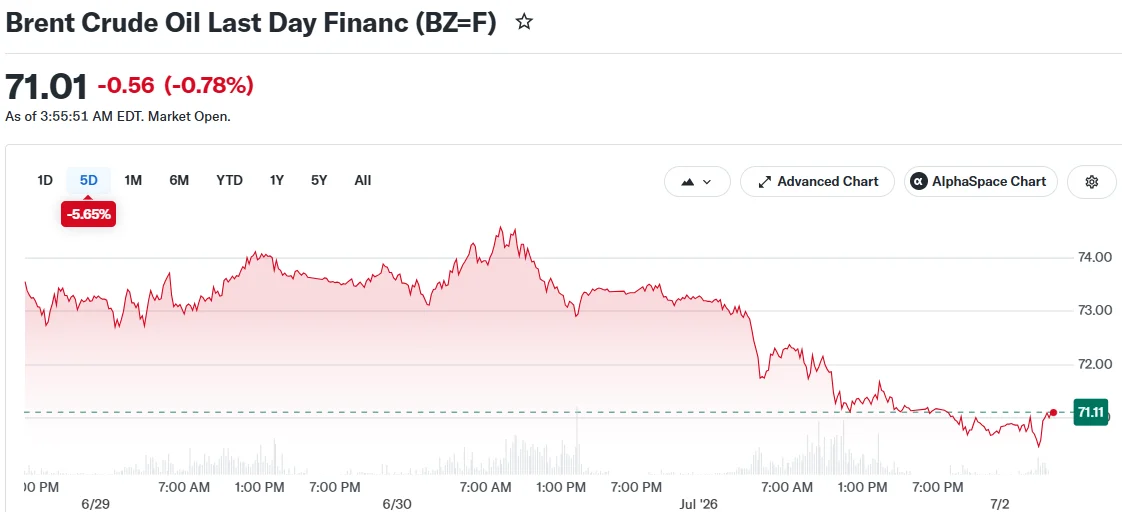 Brent Crude Oil Last Day Financ (BZ=F)
The decline follows what proved to be oil’s most challenging quarter since the pandemic year of 2020.
Doha Diplomatic Discussions Conclude Without Formal Agreement
Indirect diplomatic exchanges between Washington and Tehran concluded in Doha following two days of technical consultations. Negotiators did not achieve a comprehensive peace framework during this round.
Nevertheless, Qatari mediators characterized the discussions as constructive. Both nations committed to ongoing dialogue, with the subsequent meeting anticipated after memorial services for Iran’s deceased Supreme Leader Ali Khamenei, who perished in an aerial attack during the conflict’s initial phase.
Memorial services are projected to commence July 4 and extend multiple days, per Iranian government media outlets.
Discussions centered on maritime security through the Strait of Hormuz and additional trust-building initiatives. President Donald Trump acknowledged advancement in the negotiation process.
While no formal agreement materialized, the constructive atmosphere has diminished market anxiety regarding potential supply interruptions in the region.
Regional Supply Routes Remain Operational
Crude shipments transiting the Strait of Hormuz have increased beyond 10 million barrels daily. This strategic waterway serves as the vital connection between Persian Gulf producers and international markets, representing one of the planet’s most essential oil transportation corridors.
An American government official indicated that Tehran’s capacity to disrupt shipping through the strait has significantly diminished. The United Arab Emirates has simultaneously restored export volumes to pre-conflict levels, utilizing tanker fleets and pipeline infrastructure to maintain regional oil movement.
American Production Peak Intensifies Market Pressure
Recent statistics from the US Energy Information Administration revealed domestic crude extraction achieved an unprecedented 13.93 million barrels daily during April. This milestone strengthens expectations of abundant worldwide supply.
ANZ banking analysts observed that diminishing regional tensions have alleviated supply disruption concerns. The institution’s China Commodity Index increased 0.5%, with energy components similarly advancing 0.5%, suggesting sustained Chinese demand despite recent price corrections.
Market Outlook and Price Drivers
Traders are monitoring multiple variables that could influence pricing trends in upcoming weeks.
OPEC+ members are anticipated to deliberate another potential production expansion for August. Forthcoming American inventory reports will receive careful scrutiny.
Additional developments or complications in US-Iran diplomatic channels remain the primary geopolitical uncertainty. Any interruption to Strait of Hormuz traffic would continue representing significant risk to worldwide energy supplies.
Currently, the convergence of record American production, rebounding Gulf region exports, and diplomatic progress maintains downward momentum on crude valuations.
The post Crude Markets Decline Third Day Amid Diplomatic Progress and Surging US Output appeared first on Blockonomi.


You May Also Like

Ethereum is splitting into three power centers and ETH treasury firms are paying for two

Mizuho’s $130 Robinhood Price Target Says Crypto Is Underpriced


