

Bitcoin Miner Capitulation Confirmed: Difficulty Drops 20% From Peak
Bitcoin Miner Capitulation: What the 20% Difficulty Drop Means
When miners start switching machines off, the network tells you before any analyst does.
Galaxy Research confirmed on June 21, 2026 that Bitcoin miners have entered a capitulation phase — the term used when operators are forced off the network by losses rather than choosing to exit strategically. The trigger is documented in the data: Bitcoin mining difficulty has dropped more than 20% from its all-time high. Galaxy Research called it the largest peak-to-trough decline in mining difficulty since China's 2021 mining ban.
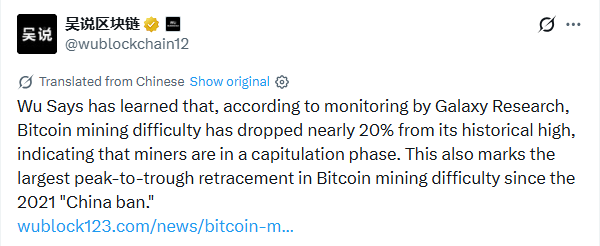 Source: X(formerly Twitter)
That comparison matters. The 2021 China ban removed roughly 50% of global hashrate overnight. The current BTC miner capitulation is getting there through a different route — not a single regulatory event, but months of sustained margin pressure crushing operators one electricity bill at a time.
Bitcoin Miner Capitulation: What the 20% Difficulty Drop Means
Mining difficulty is the network's self-correcting mechanism. Bitcoin adjusts it every 2,016 blocks — roughly every two weeks — to keep block production close to the 10-minute target. When miners shut down equipment, blocks arrive more slowly, and the next adjustment lowers difficulty for the operators still running.
The numbers tell a precise story. On June 15, 2026, at block 953,568, BTC difficulty fell from 138.96 trillion to 124.93 trillion — a single-session drop of 10.09%. That ranked as the 11th-largest downward adjustment in the protocol's entire history and the second-biggest of 2026.
Cumulatively, difficulty is now more than 20% below its November 2025 peak. The next adjustment is projected for June 27, 2026, with CoinWarz data showing a modest +4.3% increase — meaning some hashrate is returning, but not enough to reverse the broader picture.
The hashrate data confirms the scale of the exit. Total network hashrate sits at approximately 886 exahashes per second (EH/s) — down 12% in June alone and down 23% from the October 2025 peak. These are not minor fluctuations. They represent meaningful amounts of mining infrastructure going dark.
Bitcoin Miner Capitulation: JPMorgan and Galaxy Research Data
Galaxy Research and JPMorgan both published analysis this week and their conclusions converge on the same picture.
JPMorgan analysts led by managing director Nikolaos Panigirtzoglou stated that Bitcoin mining economics have "worsened" in 2026. JPMorgan places the all-in production cost of Bitcoin at approximately $78,000 — covering electricity, hardware depreciation, and overhead for publicly listed miners. With Bitcoin trading near $63,970, the gap between spot price and breakeven is approximately 19%. Bitcoin has traded below that production cost for five consecutive months.
That sustained squeeze has pushed roughly 20% of the global mining industry into unprofitable territory, per CoinShares' Q1 2026 BTC Mining Report cited in the JPMorgan note.
The financial pressure shows up most clearly in coin sales. Six publicly listed mining operators — MARA, CleanSpark, Riot Platforms, Cango, Core Scientific, and Bitdeer — collectively sold 32,000 Bitcoin in Q1 2026 alone to fund operating expenses. That figure exceeds their combined total BTC sales for all of 2025. It also sets a new quarterly record, surpassing the previous high of 20,000 BTC set in Q2 2022 during the Terra-Luna bear market.
Hashprice — the metric capturing mining revenue per unit of computing power — sits at roughly $33 per petahash per second per day, according to Hashrate Index. That is the direct pressure point converting unprofitable rigs into offline equipment.
U.S. spot BTC ETFs added to the selling context. Net outflows over the trailing 30 days reached $6.35 billion — the heaviest rolling redemption window since the ETF products launched in January 2024, according to Galaxy Research.
Bitcoin Miner Capitulation: What Happens Next for BTC Price
JPMorgan's analysts stopped short of a bearish conclusion despite the grim data. The team noted that weak market sentiment of this kind has, in past cycles, served as a contrarian indicator for future price appreciation.
The logic follows a documented pattern. When miners capitulate at scale, several things happen in sequence:
-
Forced selling dries up. The miners who were selling BTC to cover electricity costs have now shut down or reduced operations. That supply pressure disappears.
-
Difficulty resets lower. Surviving miners become more profitable at the same Bitcoin price because they face less competition for each block.
-
Production cost floors reset. As high-cost operators exit, the average all-in cost across remaining miners drops, which lowers the sustained price floor the market needs to hold.
-
Hash rate recovers. As price stabilises or rises, dormant rigs come back online, confirming the capitulation phase is ending.
Galaxy Research noted the next difficulty adjustment around June 27 may show a small increase. If that adjustment comes in flat or higher while hashrate keeps declining, it would suggest the selling is structural rather than temporary — meaning the recovery timeline extends further.
The 2021 China ban comparison is instructive here. After the largest single hashrate removal in Bitcoin's history, the network recovered fully within six months and BTC went on to reach its then all-time high of $69,000 by November 2021.
Whether this current Bitcoin miner capitulation follows a similar recovery arc depends on what BTC price does from the $63,970 level. JPMorgan's production cost floor of $78,000 remains well above spot — meaning the pressure has not yet resolved. But the difficulty data confirms the weakest operators are already exiting. That is historically the precondition, not the aftermath, of a recovery.
Conclusion
Bitcoin miner capitulation is confirmed and documented. Mining difficulty dropped 20% from its all-time high — the largest decline since China's 2021 ban. JPMorgan says 20% of miners are unprofitable at $63,970. Six public miners sold a record 32,000 BTC in Q1 alone. History says capitulation events of this scale precede recoveries. The June 27 difficulty adjustment is the next data point to watch.
YMYL Disclaimer
This article is for informational purposes only and does not constitute financial or investment advice. All data is based on public market sources. Cryptocurrency investments carry significant risk including total loss of capital.


You May Also Like

The latest smelly episode in Trump’s embarrassing Reflecting Pool saga

Mexican Peso Slides as Dollar Strengthens on Fed Repricing Ahead of Banxico Decision

If Japan’s Interest Rates Hit 6%, 100% of Tax Revenue Goes to Debt Interest. America Could Be Next.


Trending News
More24/7 Live News
MoreQuick Reads
More
