

Binance’s MiCA challenge sparks debate over ECB regulatory role
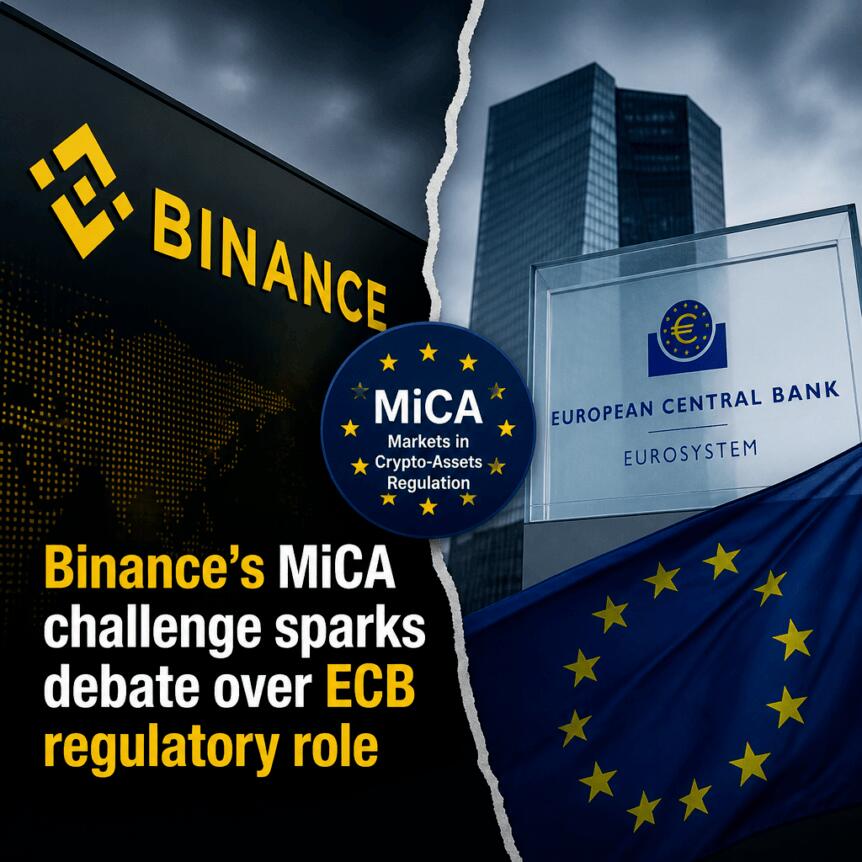
Binance’s attempt to secure a Markets in Crypto-Assets Regulation (MiCA) license in Greece has triggered fresh scrutiny about how much influence the European Central Bank (ECB) could have during the review process—even though MiCA licensing authority is held by national regulators, not EU institutions.
The situation gained momentum after reports claimed the ECB signaled that Binance would be unwelcome in Europe, following indications that Greece’s market regulator was moving toward rejection before MiCA’s July 1 transitional deadline. Legal experts responding to Cointelegraph say MiCA’s framework does not bar the ECB from sharing views with national authorities, raising questions about how political priorities and regulatory review intersect.
Key takeaways
- Under MiCA, crypto-asset service provider (CASP) licenses are issued by national competent authorities (NCAs) such as Greece’s Hellenic Capital Market Commission (HCMC), not directly by the ECB.
- MiCA’s wording permits other EU institutions to communicate with NCAs, according to lawyers speaking to Cointelegraph, even though licensing decisions remain national.
- Reports linked the ECB’s involvement to broader concerns about privately issued stablecoins—an area where the ECB has been especially outspoken.
- Binance has said it believes its application is being advanced through ESMA-level review, but Greece’s regulator has not publicly issued a decision.
- With MiCA’s transitional period ending July 1, timing is critical for firms seeking authorization to continue operating EU-wide under the new rules.
How MiCA licensing is supposed to work
MiCA establishes a licensing pathway for CASPs through national regulators, with the European Securities and Markets Authority (ESMA) playing an oversight and coordination role rather than acting as the licensing authority itself.
In the Binance case, Greece’s Hellenic Capital Market Commission (HCMC) is the body that would determine whether the exchange meets MiCA requirements for approval in Greece. Binance previously stated it had applied for a MiCA license in Greece.
MiCA’s approach is explicitly tied to the NCAs for authorization decisions, a point that matters for readers because the ECB cannot formally issue a CASP license. Still, experts argue that the regulation does not prevent an EU institution from offering input to the relevant national authority during review.
According to David Lesperance, founder at Lesperance & Associates, MiCA does not restrict a third party—such as the ECB—from providing its opinion to a national regulator assessing an application.
What reports claim—and the legal argument around “informal” influence
Cointelegraph reported that the new wave of concern followed two related developments: an earlier Reuters report indicated Greece’s market regulator was expected to reject Binance’s MiCA application, and a subsequent report from The Big Whale claimed ECB President Christine Lagarde had conveyed to Greek Prime Minister Kyriakos Mitsotakis that Binance was not welcome in Europe.
The timing is especially sensitive: the reports emerged less than two weeks before the end of MiCA’s transitional period on July 1, which affects which firms can continue operating across the EU under the licensing regime.
But the key question for market participants is not only what has been said publicly—it’s what is procedurally permissible. Lawyers told Cointelegraph that MiCA’s text does not bar other EU bodies from engaging with national regulators, even if those bodies are not the final decision-makers.
Yuriy Brisov, a lawyer at Digital & Analogue Partners, said nothing in MiCA prevents the ECB from talking to, advising, or raising concerns with an NCA. However, he noted that the ECB’s role is clearly spelled out in other parts of MiCA—particularly rules governing stablecoin issuers—rather than in the exchange licensing chapter that covers CASPs like Binance.
Binance itself, in a blog post published after the Reuters coverage, said it understood HCMC had completed its review for compliance and that the application was also subject to review at the ESMA level. The exchange later told Cointelegraph it believed ESMA intended to move the application forward and authorize it at an upcoming board meeting.
Separately, Brisov said HCMC has not published a decision on Binance’s application. Cointelegraph also noted that ESMA does not authorize CASP licenses under MiCA, reinforcing that the core licensing decision ultimately rests with the national regulator.
Why stablecoins are at the center of the dispute
The broader political context appears to be stablecoins. The ECB has repeatedly argued that privately issued stablecoins should not replace tokenized financial infrastructure anchored by central bank money. According to The Big Whale’s reporting, Lagarde’s intervention—if accurate—was linked to this stablecoin position.
Cointelegraph previously covered the ECB’s stance that Europe should prioritize regulated settlement systems over reliance on private stablecoins. The ECB has also raised concerns that stablecoins could further entrench US dollar dominance in global finance. Executives within the ECB have framed these risks in structural terms, suggesting stablecoins are not only a technical or market issue but also a strategic one.
For Binance, the stablecoin angle is particularly consequential. Market data cited in the report indicates that Binance has been a dominant liquidity hub for stablecoins on centralized exchanges.
According to CryptoQuant data reported in February, Binance held approximately $47.5 billion in stablecoins, representing about 65% of total stablecoin reserves across centralized exchanges. The same dataset indicated the figure was higher than roughly $35.9 billion a year earlier.
This helps explain why investors may view Binance’s licensing outcome as more than a single-company regulatory event. If the ECB’s priorities influence how NCAs approach CASP risk considerations—directly or indirectly—then large stablecoin “rails” may face heightened scrutiny, especially during fast-approaching deadlines.
Binance’s importance to stablecoin liquidity is also reflected in how regulators and analysts track market structure: when a firm serves as a major exchange venue for stablecoin trading and reserves, its compliance pathway can become a proxy battleground for Europe’s broader position on tokenized money and settlement.
What happens next before July 1
With the MiCA transitional period set to end on July 1, the immediate focus for market participants is whether HCMC issues a decision in Binance’s case and, if authorization is denied or delayed, what alternative routes remain for the exchange to operate lawfully across the EU under MiCA.
Cointelegraph also reported that ESMA and HCMC did not provide immediate comment to its inquiries. Meanwhile, the ECB and the French regulator AMF declined to comment in connection with the claims.
There were also claims about possible other regulatory pathways, including France being mentioned as a potential remaining route in coverage by The Big Whale; however, Cointelegraph’s reporting did not indicate that any formal French MiCA application had been filed at the time of publication.
For readers, the practical takeaway is that MiCA’s deadline structure can compress uncertainty into a narrow window. Even if MiCA licensing authority is formally national, the scope and timing of ESMA-level review—and any policy input from EU institutions—could shape outcomes that determine whether large trading venues can keep serving European customers.
Until HCMC publishes a decision and the regulatory process becomes clearer, investors and operators should watch for two signals: whether the Greek authorization timeline moves toward approval or rejection, and how stablecoin-focused concerns translate into CASP-level licensing expectations across EU member states as the July 1 cutoff approaches.
This article was originally published as Binance’s MiCA challenge sparks debate over ECB regulatory role on Crypto Breaking News – your trusted source for crypto news, Bitcoin news, and blockchain updates.


You May Also Like

Eltropy Named to Inc. Regionals Pacific 2026 List of Fastest-Growing Private Companies

Franklin Templeton CEO Dismisses 50bps Rate Cut Ahead FOMC

Navigating Termination: Your Essential Guide to Severance Pay Lawyers in Toronto



