

Tether and Dubai Trade Authority Partner on Tokenization Education and Real-World Asset Frameworks
The institutional adoption of Blockchain Technology is accelerating through both capital deployment and strategic partnerships designed to embed digital assets into existing financial systems. Two parallel developments underscore how traditional finance and blockchain infrastructure are consolidating rather than remaining separate ecosystems: a $355 million funding round for a blockchain technology provider serving financial institutions, and a formal memorandum of understanding between Tether and Dubai’s premier trade and commodities authority.
Digital Asset, a New York-based blockchain technology company founded in 2014, raised $355 million in a later-stage financing round led by Andreessen Horowitz’s crypto fund, a16z crypto. The company develops distributed ledger infrastructure specifically designed for financial institutions seeking to settle, clear, and manage digital assets with institutional-grade operational standards. The funding round, announced this week, brings Digital Asset’s known total funding to at least $847 million, positioning it among the most well-capitalized blockchain infrastructure providers in the sector.
This deployment of capital reflects a broader institutional appetite for blockchain rails that can handle both legacy and native digital asset workflows. Financial institutions have moved beyond experimental blockchain pilots toward production-grade infrastructure investments, a shift driven by regulatory clarity, operational maturity, and measurable cost advantages for wholesale settlement.
 Blockchain networks now support institutional financial flows
Dubai’s Trade Authority Partners With Tether on Tokenization Infrastructure
In the Middle East, the Dubai Multi Commodities Centre (DMCC), an international business district hosting over 26,000 companies and accounting for 15 percent of Dubai’s foreign direct investment, has signed a memorandum of understanding with Tether to explore blockchain education, tokenization frameworks, and digital asset integration across DMCC’s trade network. The partnership signals how commodities hubs and trade authorities are positioning themselves as nodes in tokenized financial infrastructure.
DMCC and Tether plan to develop specialized workshops, tailored blockchain advisory sessions, and pilot programs that would allow DMCC member companies to experiment with digital asset use cases and real-world asset tokenization. The memorandum also includes exploration of peer-to-peer digital communication and payment systems that could reduce friction in cross-border trade settlement.
Paolo Ardoino, CEO of Tether, framed the partnership as an acceleration of blockchain’s practical application in areas such as tokenization and education. Ahmed Bin Sulayem, Executive Chairman and CEO of DMCC, noted that global trade infrastructure is “increasingly moving onto digital rails” and that stablecoins already process trillions of dollars in transaction value annually. He positioned Dubai’s regulatory clarity and infrastructure as foundational to this shift, with DMCC serving as a bridge between blockchain technology and global commerce.
Capital and Partnership Converging on Institutional Adoption
The two developments reflect a maturation in how institutions approach blockchain adoption. Rather than treating digital assets as speculative instruments or isolated technology experiments, institutional finance is now deploying capital and signing formal agreements to build interoperable infrastructure. Institutional finance is embracing on-chain tokenization infrastructure as a necessary layer for future financial operations, not an optional alternative.
The Digital Asset funding round signals investor confidence that wholesale financial infrastructure will migrate to blockchain-based settlement, provided that the underlying technology meets institutional requirements for security, regulatory compliance, and operational resilience. The presence of a16z crypto as lead investor also reflects how traditional venture capital has integrated blockchain infrastructure into its portfolio thesis, treating it as critical financial technology rather than a speculative bet on cryptocurrency prices.
The DMCC-Tether partnership demonstrates that trade authorities and commodity exchanges view tokenization not as a distant possibility but as an immediate operational opportunity. By establishing formal partnerships with stablecoin issuers and blockchain educators, DMCC is positioning its member network to adopt tokenized workflows before competitive pressure forces the transition. The partnership includes focus on real-world asset tokenization, a use case that has attracted institutional interest because it can reduce settlement friction and expand market access for traditionally illiquid assets.
Constraints and Open Questions
Both initiatives depend on regulatory frameworks that continue to evolve. Dubai’s advanced crypto-friendly regulation provides a tailwind for DMCC’s tokenization efforts, but other global markets remain uncertain about liability, custody standards, and cross-border token settlement. Digital Asset’s success depends on financial institutions choosing proprietary blockchain settlement over existing central-bank networks and private ledgers, a transition that will take years rather than months.
Additionally, neither the funding round nor the memorandum of understanding guarantees that blockchain-based infrastructure will supplant existing financial rails at scale. Legacy financial systems have entrenched network effects and regulatory advantages that blockchain must overcome through measurable cost reduction or functionality gains that centralized systems cannot deliver.
What distinguishes the current moment is that this transition is no longer hypothetical. Institutions are allocating capital and signing binding agreements to participate in it. Decentralized finance is reshaping how institutions approach long-term digital asset strategies, and wholesale financial infrastructure is following. The combination of a $355 million institutional funding round and a formal partnership between a global trade authority and a major stablecoin issuer suggests that blockchain adoption is now an operational priority, not a future scenario.


You May Also Like

Circle Mints $250M USDC Amid Rising Stablecoin Demand and Market Liquidity Surge
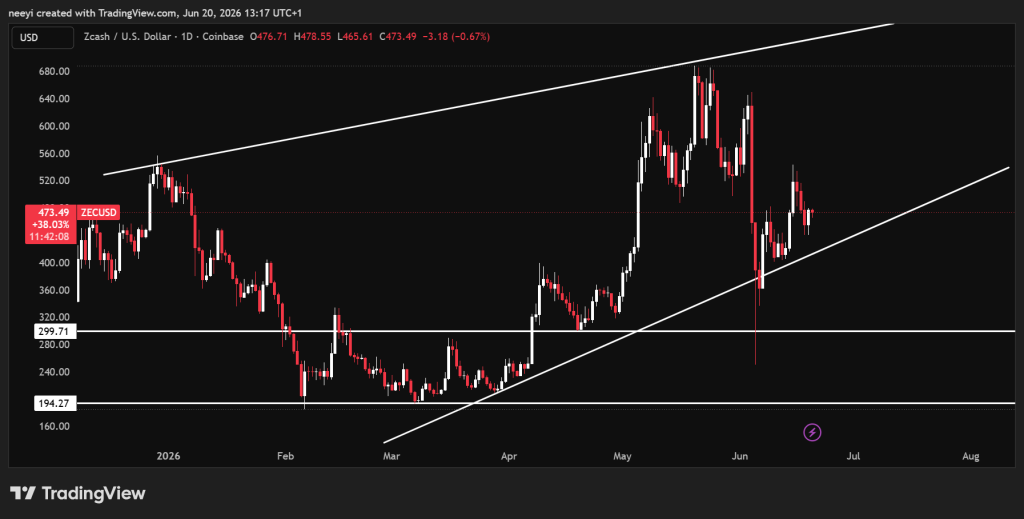
Zcash (ZEC) Price Outlook: Why a New Cycle High Is Possible Very Soon

Crypto Market Update - 20 June 2026: Institutions File While ETF Outflows Mount



