Deutsche Börse Group has signed a Memorandum of Understanding (MoU) with Circle Internet Financial to integrate regulated stablecoins into European capital markets. According to the announcement, the collaboration will focus on Circle’s USDC and EURC, connecting token-based payment networks with traditional financial infrastructure. The partnership marks the first time a major European market infrastructure provider has formally teamed up with a global stablecoin issuer. Both parties said the initiative represents a milestone for regulated digital finance in Europe, made possible by the EU’s Markets in Crypto-Assets Regulation (MiCA), the bloc’s new comprehensive framework for digital assets. Partnership Bridges Traditional Finance and Crypto Settlement in Europe Under the agreement, the initial rollout will take place through Deutsche Börse’s subsidiaries. Trading will be facilitated on 360T’s digital exchange, 3DX, and through the institutional crypto provider Crypto Finance. Custody services will be provided via Clearstream, Deutsche Börse’s post-trade business, with Crypto Finance’s German entity serving as sub-custodian. Jeremy Allaire, Circle’s co-founder and CEO, said the collaboration would reduce settlement risk, lower costs, and improve efficiency across banks, asset managers, and other market participants. “As clear rules take hold across Europe, aligning our regulated stablecoins, EURC and USDC, with trusted venues will unlock new products and streamline workflows across trading, settlement, and custody,” Allaire said. Executives at Deutsche Börse noted the potential of stablecoins to reshape European finance. Stephanie Eckermann, who oversees post-trading at the group, said the deal advances the company’s ambition to digitize securities issuance and post-trade processes. Thomas Book, who is responsible for trading and clearing, added that the partnership positions Deutsche Börse to bridge traditional and digital markets by providing an integrated value chain across execution, settlement, and custody. The agreement follows Circle’s regulatory breakthrough earlier this year. On July 1, Circle became the first global stablecoin issuer to secure an Electronic Money Institution (EMI) license under MiCA, issued by French regulators. The license allows the company to issue both USDC and EURC across the European Union. Circle described the approval as a major milestone for mainstream adoption, noting that MiCA sets the conditions for long-term growth in digital finance by ensuring stablecoin issuers meet strict consumer protection and reserve requirements. The MiCA framework, passed by the European Parliament in April 2023, has been gradually implemented since June. Circle’s head of policy, Dante Disparte, said the regulation closes the door on unregulated operations, while Allaire noted that it legitimizes the sector after years of skepticism from mainstream finance. European Banking Giants Form Consortium for Euro Stablecoin Amid Deutsche Börse Group’s efforts, nine of Europe’s largest lenders are joining forces to launch a euro-backed stablecoin in the second half of 2026, seeking to challenge the dominance of U.S. dollar-pegged tokens. The consortium, which includes ING, UniCredit, CaixaBank, Danske Bank, KBC, DekaBank, SEB, Raiffeisen Bank International, and Italy’s Banca Sella, has set up a new company in the Netherlands to oversee the project. It plans to seek a license from the Dutch Central Bank as an e-money institution under the European Union’s MiCA framework. According to a joint statement, the stablecoin will provide near-instant cross-border payments, lower transaction costs, and round-the-clock access to settlements. “This development requires an industry-wide approach, and it’s imperative that banks adopt the same standards,” said Floris Lugt, digital assets lead at ING. The move shows growing European efforts to reduce reliance on dollar-based stablecoins, which currently account for 99% of global supply.Source: ECB Euro-pegged tokens remain a small fraction of the market, with less than €350 million in circulation, European Central Bank (ECB) data shows. The initiative comes as the ECB advances its digital euro project, with Executive Board member Piero Cipollone suggesting a rollout could happen by mid-2029. EU lawmakers are expected to weigh in on the legal framework later this year. Together, the bank-led stablecoin and the ECB’s digital euro mark Europe’s bid to secure greater autonomy in digital payments and limit the influence of non-EU issuers in the region’s financial systemDeutsche Börse Group has signed a Memorandum of Understanding (MoU) with Circle Internet Financial to integrate regulated stablecoins into European capital markets. According to the announcement, the collaboration will focus on Circle’s USDC and EURC, connecting token-based payment networks with traditional financial infrastructure. The partnership marks the first time a major European market infrastructure provider has formally teamed up with a global stablecoin issuer. Both parties said the initiative represents a milestone for regulated digital finance in Europe, made possible by the EU’s Markets in Crypto-Assets Regulation (MiCA), the bloc’s new comprehensive framework for digital assets. Partnership Bridges Traditional Finance and Crypto Settlement in Europe Under the agreement, the initial rollout will take place through Deutsche Börse’s subsidiaries. Trading will be facilitated on 360T’s digital exchange, 3DX, and through the institutional crypto provider Crypto Finance. Custody services will be provided via Clearstream, Deutsche Börse’s post-trade business, with Crypto Finance’s German entity serving as sub-custodian. Jeremy Allaire, Circle’s co-founder and CEO, said the collaboration would reduce settlement risk, lower costs, and improve efficiency across banks, asset managers, and other market participants. “As clear rules take hold across Europe, aligning our regulated stablecoins, EURC and USDC, with trusted venues will unlock new products and streamline workflows across trading, settlement, and custody,” Allaire said. Executives at Deutsche Börse noted the potential of stablecoins to reshape European finance. Stephanie Eckermann, who oversees post-trading at the group, said the deal advances the company’s ambition to digitize securities issuance and post-trade processes. Thomas Book, who is responsible for trading and clearing, added that the partnership positions Deutsche Börse to bridge traditional and digital markets by providing an integrated value chain across execution, settlement, and custody. The agreement follows Circle’s regulatory breakthrough earlier this year. On July 1, Circle became the first global stablecoin issuer to secure an Electronic Money Institution (EMI) license under MiCA, issued by French regulators. The license allows the company to issue both USDC and EURC across the European Union. Circle described the approval as a major milestone for mainstream adoption, noting that MiCA sets the conditions for long-term growth in digital finance by ensuring stablecoin issuers meet strict consumer protection and reserve requirements. The MiCA framework, passed by the European Parliament in April 2023, has been gradually implemented since June. Circle’s head of policy, Dante Disparte, said the regulation closes the door on unregulated operations, while Allaire noted that it legitimizes the sector after years of skepticism from mainstream finance. European Banking Giants Form Consortium for Euro Stablecoin Amid Deutsche Börse Group’s efforts, nine of Europe’s largest lenders are joining forces to launch a euro-backed stablecoin in the second half of 2026, seeking to challenge the dominance of U.S. dollar-pegged tokens. The consortium, which includes ING, UniCredit, CaixaBank, Danske Bank, KBC, DekaBank, SEB, Raiffeisen Bank International, and Italy’s Banca Sella, has set up a new company in the Netherlands to oversee the project. It plans to seek a license from the Dutch Central Bank as an e-money institution under the European Union’s MiCA framework. According to a joint statement, the stablecoin will provide near-instant cross-border payments, lower transaction costs, and round-the-clock access to settlements. “This development requires an industry-wide approach, and it’s imperative that banks adopt the same standards,” said Floris Lugt, digital assets lead at ING. The move shows growing European efforts to reduce reliance on dollar-based stablecoins, which currently account for 99% of global supply.Source: ECB Euro-pegged tokens remain a small fraction of the market, with less than €350 million in circulation, European Central Bank (ECB) data shows. The initiative comes as the ECB advances its digital euro project, with Executive Board member Piero Cipollone suggesting a rollout could happen by mid-2029. EU lawmakers are expected to weigh in on the legal framework later this year. Together, the bank-led stablecoin and the ECB’s digital euro mark Europe’s bid to secure greater autonomy in digital payments and limit the influence of non-EU issuers in the region’s financial system

TradFi Giant Deutsche Börse Taps Circle for Major European Stablecoin Push

2025/10/01 01:51
4 min read
For feedback or concerns regarding this content, please contact us at crypto.news@mexc.com

Deutsche Börse Group has signed a Memorandum of Understanding (MoU) with Circle Internet Financial to integrate regulated stablecoins into European capital markets.

According to the announcement, the collaboration will focus on Circle’s USDC and EURC, connecting token-based payment networks with traditional financial infrastructure.

The partnership marks the first time a major European market infrastructure provider has formally teamed up with a global stablecoin issuer.

Both parties said the initiative represents a milestone for regulated digital finance in Europe, made possible by the EU’s Markets in Crypto-Assets Regulation (MiCA), the bloc’s new comprehensive framework for digital assets.

Partnership Bridges Traditional Finance and Crypto Settlement in Europe

Under the agreement, the initial rollout will take place through Deutsche Börse’s subsidiaries. Trading will be facilitated on 360T’s digital exchange, 3DX, and through the institutional crypto provider Crypto Finance.

Custody services will be provided via Clearstream, Deutsche Börse’s post-trade business, with Crypto Finance’s German entity serving as sub-custodian.

Jeremy Allaire, Circle’s co-founder and CEO, said the collaboration would reduce settlement risk, lower costs, and improve efficiency across banks, asset managers, and other market participants.

“As clear rules take hold across Europe, aligning our regulated stablecoins, EURC and USDC, with trusted venues will unlock new products and streamline workflows across trading, settlement, and custody,” Allaire said.

Executives at Deutsche Börse noted the potential of stablecoins to reshape European finance. Stephanie Eckermann, who oversees post-trading at the group, said the deal advances the company’s ambition to digitize securities issuance and post-trade processes.

Thomas Book, who is responsible for trading and clearing, added that the partnership positions Deutsche Börse to bridge traditional and digital markets by providing an integrated value chain across execution, settlement, and custody.

The agreement follows Circle’s regulatory breakthrough earlier this year. On July 1, Circle became the first global stablecoin issuer to secure an Electronic Money Institution (EMI) license under MiCA, issued by French regulators.

The license allows the company to issue both USDC and EURC across the European Union.

Circle described the approval as a major milestone for mainstream adoption, noting that MiCA sets the conditions for long-term growth in digital finance by ensuring stablecoin issuers meet strict consumer protection and reserve requirements.

The MiCA framework, passed by the European Parliament in April 2023, has been gradually implemented since June.

Circle’s head of policy, Dante Disparte, said the regulation closes the door on unregulated operations, while Allaire noted that it legitimizes the sector after years of skepticism from mainstream finance.

European Banking Giants Form Consortium for Euro Stablecoin

Amid Deutsche Börse Group’s efforts, nine of Europe’s largest lenders are joining forces to launch a euro-backed stablecoin in the second half of 2026, seeking to challenge the dominance of U.S. dollar-pegged tokens.

The consortium, which includes ING, UniCredit, CaixaBank, Danske Bank, KBC, DekaBank, SEB, Raiffeisen Bank International, and Italy’s Banca Sella, has set up a new company in the Netherlands to oversee the project.

It plans to seek a license from the Dutch Central Bank as an e-money institution under the European Union’s MiCA framework.

According to a joint statement, the stablecoin will provide near-instant cross-border payments, lower transaction costs, and round-the-clock access to settlements.

“This development requires an industry-wide approach, and it’s imperative that banks adopt the same standards,” said Floris Lugt, digital assets lead at ING.

The move shows growing European efforts to reduce reliance on dollar-based stablecoins, which currently account for 99% of global supply.
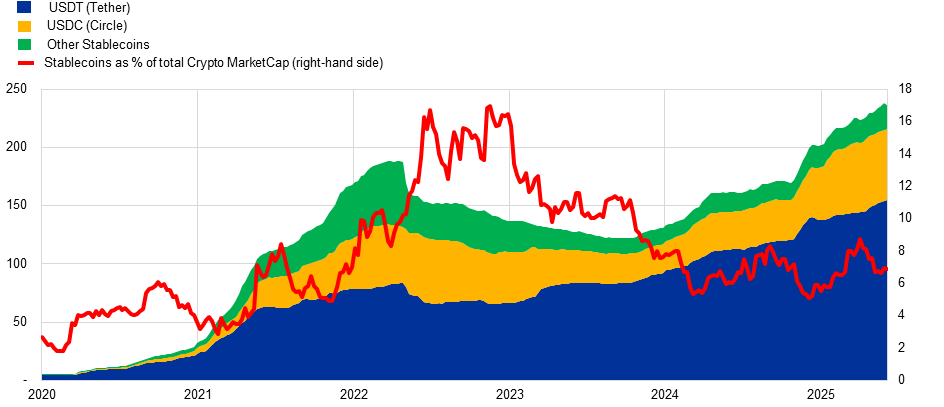
Source: ECB

Euro-pegged tokens remain a small fraction of the market, with less than €350 million in circulation, European Central Bank (ECB) data shows.

The initiative comes as the ECB advances its digital euro project, with Executive Board member Piero Cipollone suggesting a rollout could happen by mid-2029.

EU lawmakers are expected to weigh in on the legal framework later this year.

Together, the bank-led stablecoin and the ECB’s digital euro mark Europe’s bid to secure greater autonomy in digital payments and limit the influence of non-EU issuers in the region’s financial system.

Market Opportunity
Major Logo
Major Price(MAJOR)
$0.06301
$0.06301$0.06301
-1.80%
USD
Major (MAJOR) Live Price Chart
Disclaimer: The articles reposted on this site are sourced from public platforms and are provided for informational purposes only. They do not necessarily reflect the views of MEXC. All rights remain with the original authors. If you believe any content infringes on third-party rights, please contact crypto.news@mexc.com for removal. MEXC makes no guarantees regarding the accuracy, completeness, or timeliness of the content and is not responsible for any actions taken based on the information provided. The content does not constitute financial, legal, or other professional advice, nor should it be considered a recommendation or endorsement by MEXC.

You May Also Like

Three AI Models Just Predicted A Shocking XRP Price For 2026

Three AI Models Just Predicted A Shocking XRP Price For 2026

Crypto markets thrive on forward-looking narratives, and few tools amplify those narratives more than artificial intelligence. As investors increasingly turn to
Share
Timestabloid2026/03/29 02:05
U.S. Futures Rise After Trump Appears To Soften Tone On China
U.S. Futures Rise After Trump Appears To Soften Tone On China

The post U.S. Futures Rise After Trump Appears To Soften Tone On China appeared on BitcoinEthereumNews.com. Topline U.S. stock futures rose early on Monday as President Donald Trump and Vice President JD Vance signaled they are open to a deal with China to de-escalate trade tensions, after the president threatened to impose an additional 100% tariff on Chinese goods on Friday in response to Beijing’s expansion of export controls on critical rare earth minerals. U.S. President Donald Trump speaks to the press before boarding Air Force One for a trip to the Middle East. Getty Images Key Facts In premarket trading early on Monday, Dow Futures rose nearly 1% to 46,143 points, while the benchmark S&P 500 Futures climbed more than 1.3% to 6,682.50 points. The tech-centric Nasdaq Futures index saw the biggest bump, rising 1.85% to 24,840 points. Shares of chipmaker Nvidia rose 3.49% to $189.55 in the premarket, while rivals AMD and Broadcom were up 4.17% and 3.42% respectively. However, the prospect of renewed trade tensions weighed on Asian stocks on Monday morning as Trump’s tariff announcement was made after markets closed for the week in Asia on Friday. Hong Kong’s benchmark Hang Seng index closed 1.52% down on Monday, while the Shenzhen Composite and Shanghai Composite indices dropped 0.93% and 0.19% respectively. What Did Trump Say About A Deal With China? In a Truth Social post on Sunday afternoon, Trump appeared to soften his tone on China, saying: “Don’t worry about China, it will all be fine! Highly respected President Xi just had a bad moment. He doesn’t want Depression for his country, and neither do I. The U.S.A. wants to help China, not hurt it!!!” What Did Vice President Vance Say About A Deal With China? While appearing on Fox News’s Sunday Morning Futures, Vance suggested Trump’s latest tariff threat was a negotiating tactic. “It’s going to be a delicate dance, and…

Share
BitcoinEthereumNews2025/10/13 19:33
Sends Strengthens Industry Connections at Pay360 2026

Sends Strengthens Industry Connections at Pay360 2026

Sends, a UK-based fintech and authorised Electronic Money Institution (EMI), announced a successful presence as exhibitor and sponsor at PAY360 2026, held at ExCeL
Share
Techbullion2026/03/29 02:42