

U.S. Dollar Falls as Iran Peace Deal Talks Push Oil Below $100
TLDR
- The U.S. dollar index fell 0.3% to around 99.0 on Monday as hopes of a U.S.-Iran peace deal grew.
- Oil prices dropped sharply, with Brent crude falling nearly 6% to below $100 a barrel.
- The euro, British pound, and Australian dollar all gained against the dollar.
- A framework deal between the U.S. and Iran has reportedly been discussed, but no agreement has been signed.
- Analysts say the dollar may weaken short-term if a deal is reached, but could recover based on stronger fundamentals.
The U.S. dollar fell against most major currencies on Monday as investors grew hopeful that the U.S. and Iran may be moving toward a peace deal. That deal could reopen the Strait of Hormuz, a key shipping route for global oil.
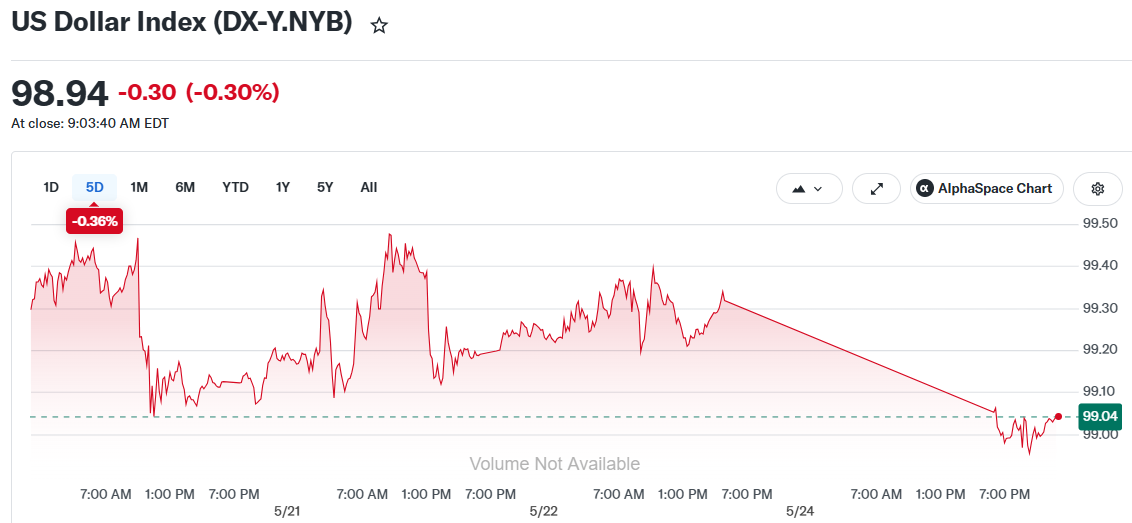 US Dollar Index (DX-Y.NYB)
Trading was thin. U.S. markets were closed for a public holiday, and most of Europe was also offline. That meant fewer traders were active, making price moves more pronounced.
The dollar index, which measures the greenback against a basket of currencies, dropped about 0.3% to 98.97. That put it near a 10-day low.
The euro rose 0.4% to $1.1649. The British pound climbed 0.55% to $1.3504. The Australian dollar, often seen as a barometer for global risk appetite, was up 0.64%.
The yen also strengthened slightly against the dollar. Japan’s Prime Minister Sanae Takaichi announced a $19 billion fuel subsidy package to help households deal with rising energy costs. She said the move would not require extra government borrowing.
Oil Drops on Hormuz Deal Hopes
Oil markets moved sharply lower. Brent crude, the international benchmark, fell nearly 6% to $97.61 a barrel. U.S. West Texas Intermediate dropped 5.3% to $88.15 a barrel. Both fell below the $100 mark on expectations that the strait could reopen to tanker traffic.
The Strait of Hormuz carries roughly one-fifth of the world’s oil. It has been largely closed to tanker traffic for weeks following the start of the Iran war, pushing energy prices higher and raising inflation fears globally.
Reports over the weekend suggested a framework deal between Washington and Tehran had been largely put together. A senior White House official indicated it would include a reopening of the strait and a lifting of the U.S. naval blockade on Iranian ports.
However, mixed signals followed. U.S. President Donald Trump posted on Truth Social on Sunday that the naval blockade would stay in place until a deal is “reached, certified, and signed.” He also told his team not to rush.
Iran’s foreign ministry added its own caution. A spokesperson said conclusions had been reached on several issues in a potential memorandum of understanding but that signing one was not imminent.
One point of clarity came from the Iranian side: Tehran said it would not charge tolls for ships passing through the strait, walking back an earlier threat to do so. The spokesperson did note, however, that certain services in the waterway would come with a cost.
What Analysts Are Saying
Strategists broadly agree the dollar would dip further if a deal is finalized. Samara Hammoud, an economist at Commonwealth Bank of Australia, wrote that a peace deal would weaken the dollar initially. She added that it would likely recover afterward based on stronger economic fundamentals compared to other major currencies.
Analysts at BCA Research said the dollar should stay firm in the near term, but their medium- and long-term outlook remains bearish.
Chris Weston at Pepperstone said markets have grown patient waiting for a deal but still expect one. He added that if Brent crude falls toward $90 per barrel, it could ease inflation expectations and reduce pressure on the Federal Reserve to raise interest rates.
Traders are also watching U.S. economic data due later in the week, including an ADP jobs report on Tuesday and eurozone confidence data on Thursday.
The post U.S. Dollar Falls as Iran Peace Deal Talks Push Oil Below $100 appeared first on CoinCentral.


You May Also Like

Sustainable Fitch rates DBP’s sustainability bond framework as ‘good’

RBNZ July Rate Hike Risk Intensifies as Inflation Lingers, MUFG Warns

Marcos off to Japan to secure investment, trade pledges



