

AI-first CX infrastructure: Exotel Reorganizes Leadership to Scale Enterprise AI Operations
AI-first CX infrastructure is becoming the next competitive battleground for enterprises as Exotel strengthens leadership, expands orchestration capabilities, and prepares for autonomous AI-powered customer operations at enterprise scale.
Exotel is no longer behaving like a communications platform company.
Its latest leadership restructuring suggests something larger: a deliberate move toward becoming an enterprise operational AI layer built around customer interaction orchestration at scale.
The announcement comes at a pivotal moment for the AI-for-customer-service industry. Enterprises are rapidly moving beyond chatbot experimentation toward integrated AI systems capable of autonomously handling customer conversations, workflows, transactions, and escalation logic across channels.
This is where Exotel’s AI-first CX infrastructure strategy becomes strategically significant.
Following its acqui-hire of , the company elevated Rohan Shanbagh to COO, brought back Sanjeeth R as CPO, appointed Ananda Kumar as CFO, elevated Udit Agarwal to lead global partnerships and marketing, and promoted Sumithra Sivaramakrishnan to Head of People & Culture.
At first glance, these appear to be executive changes. Structurally, however, they represent operational preparation for a different category of enterprise AI competition.
AI-first CX infrastructure Is Becoming an Enterprise Imperative
For years, enterprise AI in customer service revolved around automation overlays—chatbots, workflow triggers, ticket routing, and scripted support augmentation.
That model is beginning to fail under enterprise-scale expectations.
Customers now expect continuity across voice, messaging, apps, and digital channels. They expect interactions to persist contextually. They expect resolution instead of escalation loops.
Operationally, most enterprises still run fragmented architectures where telephony, CRM systems, support workflows, analytics, and messaging infrastructures operate independently.
The result is friction masquerading as digital transformation.
This becomes critical when AI systems scale into millions of real-world interactions. Fragmented environments create inconsistent customer experiences, operational inefficiencies, governance risks, and rising support costs.
From a CX standpoint, the market is shifting toward AI-first CX infrastructure where orchestration—not isolated automation—becomes the defining capability.
Exotel’s latest moves suggest the company wants to own that transition.
Why Exotel’s Leadership Realignment Matters
The deeper implication behind these appointments is operational maturity.
Rohan Shanbagh’s elevation to COO signals that Exotel is entering a phase where execution discipline, operational leverage, profitability alignment, and enterprise delivery reliability become strategically essential.
“We have built a stand-out company that truly puts the customer at the center of AI innovation. It is now imperative to achieve equal excellence in operating rhythm and showcase our leverage.” — Rohan Shanbagh, COO, Exotel
This is not a typical scaling statement.
It reflects a broader market reality: AI companies increasingly fail not because models underperform, but because operational systems cannot reliably support enterprise-grade deployment.
Similarly, Sanjeeth R’s return as Chief Product Officer indicates product convergence is becoming central to Exotel’s roadmap.
“Product management is being rewritten. The Product Managers who will win the next decade will ship, not just spec. Exotel is building the infrastructure for the agentic era and makes them work in Harmony.” — Sanjeeth R, CPO, Exotel
That statement captures the industry’s strategic pivot from conversational AI toward operational AI.
At a structural level, Exotel appears to be consolidating Voice AI, CCaaS, and CPaaS into a unified orchestration layer designed for autonomous execution environments.
Competition Is Moving Beyond APIs
The customer-experience infrastructure market is rapidly reorganizing.
Global leaders like and dominate enterprise contact-center orchestration, while players like and built strength through communications APIs and developer ecosystems.
But the competitive center of gravity is shifting.
Enterprises are no longer buying communication channels alone. They increasingly want integrated AI-native operating systems capable of orchestrating interactions, workflows, compliance, analytics, and automation together.
This is where India presents a unique competitive environment.
Multilingual complexity, voice-centric customer behavior, regulatory intensity, and population-scale operational requirements create conditions where local AI CX infrastructure providers may hold structural advantages.
The Dubverse acqui-hire strengthens Exotel’s position because speech localization and multilingual intelligence are becoming foundational enterprise requirements.
Strategically, Exotel is attempting to move higher in the enterprise value chain—from communications enablement toward AI operational ownership.
The Technology Shift Behind the Strategy
Exotel’s positioning centers on orchestration architecture.
Its evolving stack combines:
- Voice AI
- CCaaS
- CPaaS
- Workflow integration
- AI reasoning systems
- Enterprise communications infrastructure
Individually, these technologies already exist across the market.
What matters now is coordination.
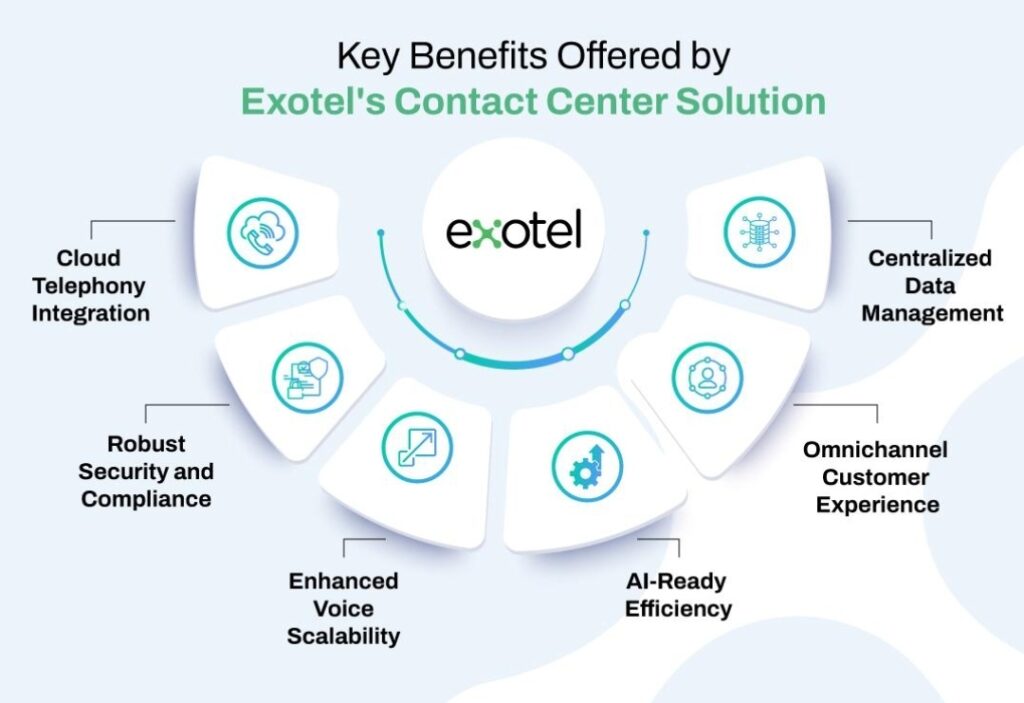
Traditional enterprise systems treat voice infrastructure, messaging, automation, analytics, and workflows as separate operational layers. AI-first CX infrastructure attempts to unify them into an intelligent operational fabric.
This becomes especially visible in Exotel’s upcoming EngageX event where the company plans to showcase India’s first live public demonstration of an autonomous AI-powered customer interaction using ’s Claude integrated through MCP alongside Exotel’s telephony stack.
The demonstration matters because it represents a transition from AI-assisted service toward AI-executed workflows.
Strategically, this indicates where enterprise CX markets are heading next.
Customer Experience Is Becoming Operational Intelligence
From the customer perspective, the benefits appear straightforward: faster responses, reduced friction, continuity across channels, and improved personalization.
But the larger transformation is operational.
AI-native CX systems generate enormous amounts of real-time interaction intelligence. Enterprises gain visibility into behavioral patterns, escalation risks, sentiment shifts, workflow bottlenecks, and operational inefficiencies continuously.
This creates a feedback loop where customer interaction systems become decision systems.
“Across our largest customers, AI is already operating at production scale in customer experience, handling millions of real interactions across voice and digital channels.” — Shivakumar Ganesan, Co-Founder and CEO, Exotel
That statement is particularly important because it reframes AI from experimentation into infrastructure.
Operationally, this translates into measurable business outcomes:
- Lower support costs
- Higher first-contact resolution
- Better workforce efficiency
- Scalable multilingual engagement
- Faster workflow completion
- Reduced service latency
At a structural level, enterprises increasingly treat customer operations as a core competitive capability rather than a support function.
AI-first CX infrastructure Still Faces a Governance Challenge
Despite the momentum, the transition remains incomplete.
Enterprise AI systems handling autonomous customer interactions introduce governance complexity involving:
- Escalation reliability
- Compliance enforcement
- Data security
- AI accountability
- Operational transparency
- Human oversight frameworks
This is where financial and people leadership become strategically relevant.
Ananda Kumar’s appointment as CFO suggests Exotel is preparing for the operational economics of AI scaling, including infrastructure costs, deployment efficiency, and enterprise accountability.
Meanwhile, Sumithra Sivaramakrishnan’s elevation reflects recognition that organizational culture and leadership development remain essential even within highly automated operational environments.
“AI may change how companies build, but people will determine how companies scale.” — Sumithra Sivaramakrishnan, Head of People & Culture, Exotel
The statement highlights an increasingly overlooked reality in enterprise AI transformation: autonomous systems still require highly aligned human organizations behind them.
The Broader Industry Signal
Exotel’s restructuring reflects a broader industry transition already underway.
The next phase of enterprise AI competition will likely center on:
- Reliability
- Operational integration
- Governance
- Orchestration
- Enterprise trust
- Outcome accountability
This means communications providers, cloud platforms, and AI vendors are all converging toward the same strategic battleground: operational customer infrastructure.
“Enterprise AI is moving from experimentation to operational reality.” — Udit Agarwal, SVP and Global Head of Partnerships & Marketing, Exotel
That may ultimately be the most important takeaway from the announcement.
The AI race is no longer about who can build models.
It is increasingly about who can operationalize them reliably at enterprise scale.
The post AI-first CX infrastructure: Exotel Reorganizes Leadership to Scale Enterprise AI Operations appeared first on CX Quest.


You May Also Like

Not a loophole: Singapore AI export controls let China tap US AI legally

CME Group to launch Solana and XRP futures options in October

Iran’s army chief warns of ‘total destruction’ for ground invasion



