Asia Pacific (APAC) is pulling ahead in the crypto market because policy is tilting toward clarity while consumer rails scale fast. From late 2023 through mid 2025, the region’s on-chain value received rose sharply, climbing from about $81b a month in mid 2022 to a peak near $244b in Dec. 2024, and holding above $185b per month this year, according to a Chainalysis report published Wednesday. Japan is now the standout. On-chain value received rose 120% in the 12 months to June 2025, outpacing South Korea, India and Vietnam. Growth follows rule changes that treat more tokens as investment instruments, planned updates to crypto taxation, and the licensing of the first yen-backed stablecoin issuer. With stablecoin listings beginning to loosen, traders channeled heavy volumes into XRP, then BTC and ETH, while markets watch how USDC and JPYC gain traction. India’s Oversight Tightens Without Choking Fintech, Supporting Sustained Crypto Use India follows with scale and depth. It leads APAC in total on-chain value at about $338b dollars, supported by UPI rails, a large diaspora that uses crypto for remittances, and young investors who trade for supplementary income. Industry groups are helping normalize usage, while authorities build clearer oversight without stifling fintech growth. South Korea’s market looks distinctly professional. Nearly half of on-chain activity sits in the $10,000 to $1m band. The 2024 Virtual Asset User Protection Act is reshaping exchange practices, and growing USDT and KRW stablecoin pairs have lifted volumes. Image Source: Chainalysis Policymakers are debating KRW-backed stablecoins, with rules expected to address issuance, distribution and secondary trading. Tighter Supervision In Australia Sets The Stage For Institutional Entry Vietnam shows everyday utility. Crypto supports remittances, gaming and savings, reflecting wide grassroots adoption. Activity has matured, which explains slower percentage growth compared with Japan, yet usage remains deeply embedded in daily flows. Australia is laying foundations. Steps to modernize AML and CFT rules and to clean up inactive exchange licences point to tighter supervision and a more durable market structure. That groundwork matters as institutions seek clearer counterparties. Hong Kong and Singapore continue to shape policy in different ways. Hong Kong’s Policy Statement 2.0 accelerated local activity by signalling a path for regulated trading. Singapore’s measured stance has shifted flows toward stablecoins, which now surpass bitcoin pairs as institutions use them for payments, liquidity and hedging. Across APAC, monthly on-chain value received climbed from about $81b in July 2022 to that Dec. 2024 peak. Volumes eased afterward but stayed high through mid-2025. The region frequently ranks second to Europe and at times outpaces North America, underscoring its growing influence on global flows. Beyond Trading, New Use Cases Keep Volumes Elevated Into 2025 Market triggers were clear. Late 2023 and early 2024 produced the first months above $100b as prices recovered. Q4 2024 delivered the top prints, helped by a global risk rally. The trend persisted into 2025 even as prices cooled, pointing to broader use cases beyond trading alone. APAC’s diversity is the driver. Japan’s reform cycle, India’s digital public infrastructure, Korea’s trader centric market, Vietnam’s everyday use, Australia’s compliance push, and the twin hubs of Hong Kong and Singapore together create multiple paths to adoption. That mix also buffers the region. When trading slows in one market, remittances, payments or treasury activity sustain volumes elsewhere. As rules continue to harden, APAC’s role as a bellwether for how crypto will be used at scale looks set to growAsia Pacific (APAC) is pulling ahead in the crypto market because policy is tilting toward clarity while consumer rails scale fast. From late 2023 through mid 2025, the region’s on-chain value received rose sharply, climbing from about $81b a month in mid 2022 to a peak near $244b in Dec. 2024, and holding above $185b per month this year, according to a Chainalysis report published Wednesday. Japan is now the standout. On-chain value received rose 120% in the 12 months to June 2025, outpacing South Korea, India and Vietnam. Growth follows rule changes that treat more tokens as investment instruments, planned updates to crypto taxation, and the licensing of the first yen-backed stablecoin issuer. With stablecoin listings beginning to loosen, traders channeled heavy volumes into XRP, then BTC and ETH, while markets watch how USDC and JPYC gain traction. India’s Oversight Tightens Without Choking Fintech, Supporting Sustained Crypto Use India follows with scale and depth. It leads APAC in total on-chain value at about $338b dollars, supported by UPI rails, a large diaspora that uses crypto for remittances, and young investors who trade for supplementary income. Industry groups are helping normalize usage, while authorities build clearer oversight without stifling fintech growth. South Korea’s market looks distinctly professional. Nearly half of on-chain activity sits in the $10,000 to $1m band. The 2024 Virtual Asset User Protection Act is reshaping exchange practices, and growing USDT and KRW stablecoin pairs have lifted volumes. Image Source: Chainalysis Policymakers are debating KRW-backed stablecoins, with rules expected to address issuance, distribution and secondary trading. Tighter Supervision In Australia Sets The Stage For Institutional Entry Vietnam shows everyday utility. Crypto supports remittances, gaming and savings, reflecting wide grassroots adoption. Activity has matured, which explains slower percentage growth compared with Japan, yet usage remains deeply embedded in daily flows. Australia is laying foundations. Steps to modernize AML and CFT rules and to clean up inactive exchange licences point to tighter supervision and a more durable market structure. That groundwork matters as institutions seek clearer counterparties. Hong Kong and Singapore continue to shape policy in different ways. Hong Kong’s Policy Statement 2.0 accelerated local activity by signalling a path for regulated trading. Singapore’s measured stance has shifted flows toward stablecoins, which now surpass bitcoin pairs as institutions use them for payments, liquidity and hedging. Across APAC, monthly on-chain value received climbed from about $81b in July 2022 to that Dec. 2024 peak. Volumes eased afterward but stayed high through mid-2025. The region frequently ranks second to Europe and at times outpaces North America, underscoring its growing influence on global flows. Beyond Trading, New Use Cases Keep Volumes Elevated Into 2025 Market triggers were clear. Late 2023 and early 2024 produced the first months above $100b as prices recovered. Q4 2024 delivered the top prints, helped by a global risk rally. The trend persisted into 2025 even as prices cooled, pointing to broader use cases beyond trading alone. APAC’s diversity is the driver. Japan’s reform cycle, India’s digital public infrastructure, Korea’s trader centric market, Vietnam’s everyday use, Australia’s compliance push, and the twin hubs of Hong Kong and Singapore together create multiple paths to adoption. That mix also buffers the region. When trading slows in one market, remittances, payments or treasury activity sustain volumes elsewhere. As rules continue to harden, APAC’s role as a bellwether for how crypto will be used at scale looks set to grow

APAC Leads Global Crypto Uptick, Japan Records Strongest Growth

Asia Pacific (APAC) is pulling ahead in the crypto market because policy is tilting toward clarity while consumer rails scale fast.

From late 2023 through mid 2025, the region’s on-chain value received rose sharply, climbing from about $81b a month in mid 2022 to a peak near $244b in Dec. 2024, and holding above $185b per month this year, according to a Chainalysis report published Wednesday.

Japan is now the standout. On-chain value received rose 120% in the 12 months to June 2025, outpacing South Korea, India and Vietnam. Growth follows rule changes that treat more tokens as investment instruments, planned updates to crypto taxation, and the licensing of the first yen-backed stablecoin issuer.

With stablecoin listings beginning to loosen, traders channeled heavy volumes into XRP, then BTC and ETH, while markets watch how USDC and JPYC gain traction.

India’s Oversight Tightens Without Choking Fintech, Supporting Sustained Crypto Use

India follows with scale and depth. It leads APAC in total on-chain value at about $338b dollars, supported by UPI rails, a large diaspora that uses crypto for remittances, and young investors who trade for supplementary income. Industry groups are helping normalize usage, while authorities build clearer oversight without stifling fintech growth.

South Korea’s market looks distinctly professional. Nearly half of on-chain activity sits in the $10,000 to $1m band. The 2024 Virtual Asset User Protection Act is reshaping exchange practices, and growing USDT and KRW stablecoin pairs have lifted volumes.
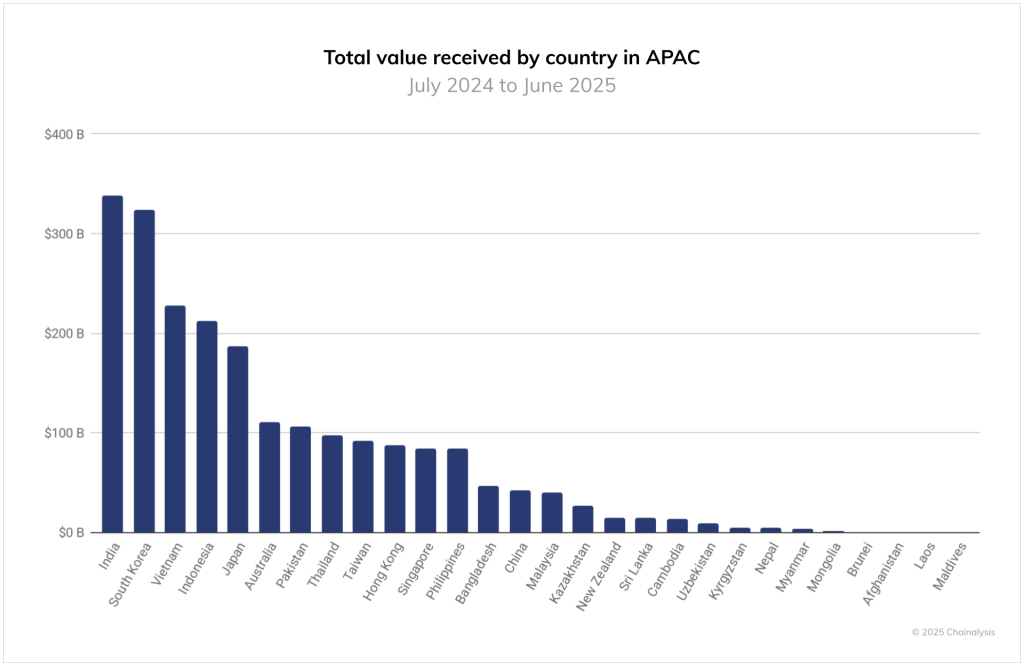
Image Source: Chainalysis

Policymakers are debating KRW-backed stablecoins, with rules expected to address issuance, distribution and secondary trading.

Tighter Supervision In Australia Sets The Stage For Institutional Entry

Vietnam shows everyday utility. Crypto supports remittances, gaming and savings, reflecting wide grassroots adoption. Activity has matured, which explains slower percentage growth compared with Japan, yet usage remains deeply embedded in daily flows.

Australia is laying foundations. Steps to modernize AML and CFT rules and to clean up inactive exchange licences point to tighter supervision and a more durable market structure. That groundwork matters as institutions seek clearer counterparties.

Hong Kong and Singapore continue to shape policy in different ways. Hong Kong’s Policy Statement 2.0 accelerated local activity by signalling a path for regulated trading. Singapore’s measured stance has shifted flows toward stablecoins, which now surpass bitcoin pairs as institutions use them for payments, liquidity and hedging.

Across APAC, monthly on-chain value received climbed from about $81b in July 2022 to that Dec. 2024 peak. Volumes eased afterward but stayed high through mid-2025. The region frequently ranks second to Europe and at times outpaces North America, underscoring its growing influence on global flows.

Beyond Trading, New Use Cases Keep Volumes Elevated Into 2025

Market triggers were clear. Late 2023 and early 2024 produced the first months above $100b as prices recovered. Q4 2024 delivered the top prints, helped by a global risk rally. The trend persisted into 2025 even as prices cooled, pointing to broader use cases beyond trading alone.

APAC’s diversity is the driver. Japan’s reform cycle, India’s digital public infrastructure, Korea’s trader centric market, Vietnam’s everyday use, Australia’s compliance push, and the twin hubs of Hong Kong and Singapore together create multiple paths to adoption.

That mix also buffers the region. When trading slows in one market, remittances, payments or treasury activity sustain volumes elsewhere. As rules continue to harden, APAC’s role as a bellwether for how crypto will be used at scale looks set to grow.


Disclaimer: The articles reposted on this site are sourced from public platforms and are provided for informational purposes only. They do not necessarily reflect the views of MEXC. All rights remain with the original authors. If you believe any content infringes on third-party rights, please contact service@support.mexc.com for removal. MEXC makes no guarantees regarding the accuracy, completeness, or timeliness of the content and is not responsible for any actions taken based on the information provided. The content does not constitute financial, legal, or other professional advice, nor should it be considered a recommendation or endorsement by MEXC.

You May Also Like

Microsoft Corp. $MSFT blue box area offers a buying opportunity

Microsoft Corp. $MSFT blue box area offers a buying opportunity

The post Microsoft Corp. $MSFT blue box area offers a buying opportunity appeared on BitcoinEthereumNews.com. In today’s article, we’ll examine the recent performance of Microsoft Corp. ($MSFT) through the lens of Elliott Wave Theory. We’ll review how the rally from the April 07, 2025 low unfolded as a 5-wave impulse followed by a 3-swing correction (ABC) and discuss our forecast for the next move. Let’s dive into the structure and expectations for this stock. Five wave impulse structure + ABC + WXY correction $MSFT 8H Elliott Wave chart 9.04.2025 In the 8-hour Elliott Wave count from Sep 04, 2025, we saw that $MSFT completed a 5-wave impulsive cycle at red III. As expected, this initial wave prompted a pullback. We anticipated this pullback to unfold in 3 swings and find buyers in the equal legs area between $497.02 and $471.06 This setup aligns with a typical Elliott Wave correction pattern (ABC), in which the market pauses briefly before resuming its primary trend. $MSFT 8H Elliott Wave chart 7.14.2025 The update, 10 days later, shows the stock finding support from the equal legs area as predicted allowing traders to get risk free. The stock is expected to bounce towards 525 – 532 before deciding if the bounce is a connector or the next leg higher. A break into new ATHs will confirm the latter and can see it trade higher towards 570 – 593 area. Until then, traders should get risk free and protect their capital in case of a WXY double correction. Conclusion In conclusion, our Elliott Wave analysis of Microsoft Corp. ($MSFT) suggested that it remains supported against April 07, 2025 lows and bounce from the blue box area. In the meantime, keep an eye out for any corrective pullbacks that may offer entry opportunities. By applying Elliott Wave Theory, traders can better anticipate the structure of upcoming moves and enhance risk management in volatile markets. Source: https://www.fxstreet.com/news/microsoft-corp-msft-blue-box-area-offers-a-buying-opportunity-202509171323
Share
BitcoinEthereumNews2025/09/18 03:50
Academic Publishing and Fairness: A Game-Theoretic Model of Peer-Review Bias

Academic Publishing and Fairness: A Game-Theoretic Model of Peer-Review Bias

Exploring how biases in the peer-review system impact researchers' choices, showing how principles of fairness relate to the production of scientific knowledge based on topic importance and hardness.
Share
Hackernoon2025/09/17 23:15
Hadron Labs Launches Bitcoin Summer on Neutron, Offering 5–10% BTC Yield

Hadron Labs Launches Bitcoin Summer on Neutron, Offering 5–10% BTC Yield

Hadron Labs launches 'Bitcoin Summer' on Neutron, BTC vaults for WBTC, eBTC, solvBTC, uniBTC and USDC. Earn 5–10% BTC via maxBTC, with up to 10x looping.
Share
Blockchainreporter2025/09/18 02:00