Call Centers Philippines: The death of hourly billing and the rise of outcome-based pricing
If your BPO partner is still billing you by the hour in 2026, they are charging you for their own technical obsolescence. This is the CFO-ready case for Outcome-Based Pricing — the structural shift that makes agentic AI financially rational for both parties.
In 2026, the global BPO industry is crossing an irreversible threshold. The billable hour — a 40-year pricing convention built on the economics of human labor — has become structurally incompatible with the technology leading call centers in the Philippines are already running in production. When a single Filipino AI Pilot simultaneously governs a fleet of up to 10 autonomous agents, resolving customer contacts in a fraction of the time and at a fraction of the per-interaction cost, the hour is no longer the relevant unit of measurement. The outcome is.
This is not an ideological position. It is an arithmetic one. And the Philippine contact center sector — empowered by an AI-ready workforce, a legislative compute subsidy, and two decades of operational excellence — is uniquely positioned to lead the transition from Labor Arbitrage to Outcome Arbitrage.
4x Productivity Lost: Why Hourly-Billed Philippine BPOs Are Financially Incentivized to Under-Deploy Agentic AI
Hourly billing is a conflict of interest in the age of agentic AI: when vendors bill by time, every efficiency gain from AI reduces their revenue — creating a rational financial incentive to under-deploy the technology clients are paying them to run.
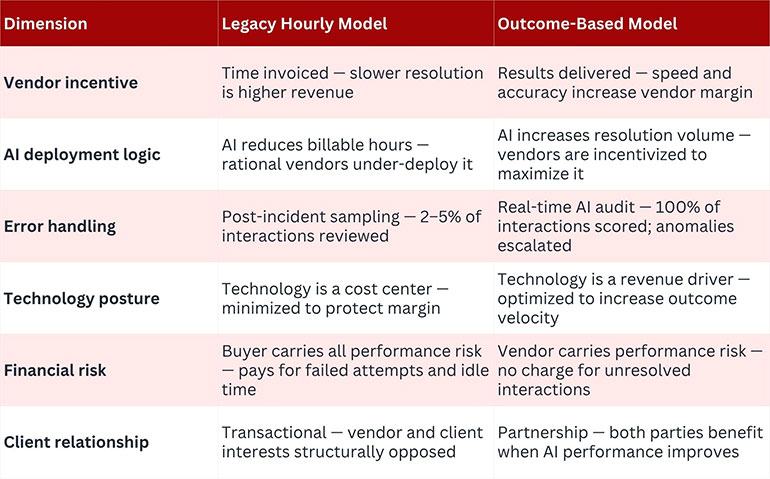
The billable hour contains a structural flaw that has always existed but was tolerable when human labor was the primary input. In a world of agentic AI, it becomes a direct conflict of interest. When vendors bill by time, efficiency reduces their revenue. An AI agent that resolves a service request in 120 seconds that once took a human 20 minutes does not generate 10x more revenue — it generates 10x less. The rational response for a vendor trapped in hourly billing is to not deploy AI at its full capacity. The client pays for this rational response every month.
This is the Efficiency Paradox: the pricing model designed to reward productivity now rewards its opposite. Philippine operations shifting to Outcome-Based Pricing — where billing is anchored to resolved tickets, retained subscribers, and verified transactions — eliminate this contradiction entirely.
 According to John Maczynski, CEO of PITON-Global and former Global EVP of the world’s largest contact center outsourcing provider, “The billable hour was never a neutral pricing mechanism. It was always a proxy for effort, not value. In 2026, when AI can deliver 10x the throughput per headcount at a fraction of the cost, paying by the hour is not just inefficient — it is a structural guarantee that your vendor will never fully invest in the technology you need them to run. Outcome-Based Pricing removes that guarantee. It replaces conflict of interest with aligned interest.”
100% Power Deduction: How the CREATE MORE Act Gives Philippine Agentic AI Clusters a 30–40% Cost Edge Over Western Facilities
The CREATE MORE Act’s 100% power expense deduction for high-compute AI infrastructure is the single most underreported competitive advantage in Philippine outsourcing — reducing the total cost of running GPU-heavy agentic AI clusters by an estimated 30–40% versus equivalent US or European facilities.
The second structural advantage of call center operations in the Philippines in 2026 is legislative. The CREATE MORE Act’s 100% power expense deduction is the enabling infrastructure behind high-compute agentic AI deployment in the country. GPU clusters capable of running autonomous customer service agents, real-time prior authorization, and multi-modal interaction analysis require energy costs that are prohibitively expensive at US or European operating rates.
By subsidizing these infrastructure costs, the Philippine government has effectively funded the compute layer for enterprise agentic AI — allowing Philippine hubs to run GPU-heavy LLM workloads at a total cost of ownership that no Western onshore facility can match. This is not a marginal pricing advantage. It is an architectural one. And it is why Outcome-Based Pricing, which requires high-volume agentic AI to be economically viable, is achievable in the Philippines when it is not achievable at equivalent quality and scale elsewhere.
From $4.80 to $1.20 per Resolution: The CFO-Ready Case for Outcome-Based Service Pricing in Philippine Call Centers
At $12–16/hr with an 18-minute average handle time, a Philippine customer support representative costs $3.60–$4.80 per resolved interaction under an hourly contract. The same interaction resolved by an AI agent governed by a Filipino AI Pilot costs $0.50–$1.50 — a 65–88% reduction that hourly billing structurally prevents clients from capturing.
Outcome-Based Pricing is not a vendor-friendly pricing reform. It is a client-protective one. Under the hourly model, the client pays for idle capacity, transition periods, failed resolution attempts, and the vendor’s unwillingness to invest in efficiency. Under an Outcome-Based model, the client pays only for value delivered.
From Hourly Billing to Outcome-Based Pricing: A 180-Day Transition
Case Study: A global e-commerce platform paying $14/hr for Philippine call center support engaged PITON-Global to restructure their outsourcing contract from a per-FTE hourly model to an Outcome-Based Pricing arrangement. The platform processed 1.2 million monthly contacts, of which 67% were tier-1 queries suitable for agentic AI resolution.
PITON-Global designed a phased transition: hybrid hourly/performance in Months 1–2, per-resolution billing from Month 3, and a value-share arrangement from Month 6. At the 180-day mark: tier-1 resolution rose from 41% to 63%, cost per resolved interaction fell from $4.80 to $1.20, and vendor AI investment increased 340% — a direct result of the changed incentive structure.
 Ralf Ellspermann, CSO of PITON-Global and a 25-year veteran of Philippine BPO operations, said, “Outcome-Based Pricing is not a pricing decision. It is a business model decision. It requires the vendor to redesign how they measure performance, how they deploy technology, and how they hold themselves accountable for results. The vendors who resist it are not protecting their margins — they are protecting their inability to deliver. The ones who embrace it are building the only sustainable competitive position in this market.”
4 Conditions Required: When Outcome-Based Pricing Fails in Philippine Call Centers — and What Must Be True First
Outcome-Based Pricing fails when four conditions are unmet: real-time outcome measurement infrastructure, precisely defined resolution criteria, 12+ months of structured interaction data, and high-volume repeatable workflow types. Attempting the transition without all four is the fastest route to a contractual dispute.
Outcome-Based Pricing is not a universal prescription. PITON-Global advises against it in the following circumstances:
- No measurement infrastructure: OBP requires real-time outcome tracking, clear resolution definitions, and auditable attribution. If neither party has the data systems to verify what was delivered, the contract becomes a dispute mechanism, not a partnership.
- Undefined or contested outcome definitions: “Resolved” must be precisely defined — does it mean first-contact resolution? No reopen within 72 hours? Was it confirmed by the customer? Ambiguity creates perverse incentives on the vendor side.
- SME organizations without historical interaction Effective agentic AI requires a massive amount of training data. Companies without 12+ months of structured interaction logs cannot build the AI systems needed that make per-resolution economics viable. For these organizations, hourly billing with performance bonuses remains the appropriate model for at least the next 2–5 years.
- Highly variable or bespoke interaction types: OBP works best on high-volume, repeatable workflows. Complex or emotionally intensive interactions — senior care, mental health support, high-value financial disputes — require human judgment that does not lend itself to per-resolution billing at scale.
The Structural Verdict
Labor Arbitrage — paying less for the same work — is no longer the value proposition of Philippine call center operations. Outcome Arbitrage — delivering superior results at a fraction of the per-resolution cost, through AI-augmented Filipino specialists working under an aligned incentive model — is. The enterprises restructuring their outsourcing contracts around outcomes in 2026 are not just reducing costs. They are removing the structural ceiling on how good their operations can get.
Spotlight is BusinessWorld’s sponsored section that allows advertisers to amplify their brand and connect with BusinessWorld’s audience by publishing their stories on the BusinessWorld Web site. For more information, send an email to online@bworldonline.com.
Join us on Viber at https://bit.ly/3hv6bLA to get more updates and subscribe to BusinessWorld’s titles and get exclusive content through www.bworld-x.com.


You May Also Like

TikTok Shop Philippines bullish over sales growth this year

Trump family member drops sobering warning about president's new 'chilling' move