Bitcoin and Ethereum exchange-traded funds (ETFs) recorded a combined $244 million in outflows on September 23, marking the second consecutive day of investor withdrawals. This follows a sharp $439 million exit the previous day, as investors repositioned around the Federal Reserve’s recent rate cut and upcoming U.S. inflation data. ETF Flows Highlight Investor Caution With Bitcoin and Ethereum Facing Daily According to data from SoSoValue, Bitcoin spot ETFs saw net outflows of $103.6 million on Monday.BTC ETFs Analytics September 23 Source: SoSoValue Fidelity’s FBTC led the withdrawals with $75.6 million, followed by ARK 21Shares’ ARKB, which shed $27.9 million. In contrast, BlackRock’s flagship IBIT managed to secure a modest $2.5 million inflow, while Invesco’s BTCO recorded the highest inflow of the day at $10 million. Grayscale’s GBTC, along with VanEck’s HODL and Valkyrie’s BRRR, reported no major net flows. Ethereum ETFs, on the other hand, experienced even sharper redemptions, with $140.7 million flowing out in a single day. Fidelity’s FETH accounted for the bulk of losses with $63.4 million in outflows, followed by Grayscale’s ETH fund, which lost $36.4 million.ETH ETFs Analytics September 23 Source: SoSoValue Bitwise’s ETHW also saw heavy withdrawals of $23.9 million, while Grayscale’s ETHE posted $17.1 million in redemptions. BlackRock’s ETHA and VanEck’s ETHV remained flat, while smaller funds from Franklin, 21Shares, and Invesco showed no notable changes. A day prior On September 22, Bitcoin products had lost $363 million in a single session, led by Fidelity’s FBTC with $276.7 million in redemptions. Ethereum funds saw $76 million withdrawn the same day, led again by Fidelity’s FETH, alongside redemptions from Bitwise and BlackRock’s ETHA. As of September 23, Bitcoin spot ETFs hold $147.2 billion in net assets, representing 6.6% of the cryptocurrency’s total market capitalization. Cumulative inflows stand at $57.25 billion. Ethereum spot ETFs now hold $27.5 billion in net assets, representing 5.45% of the total ETH market, with cumulative inflows reaching $13.7 billion. The outflows come just one week after digital asset products recorded nearly $1.9 billion in inflows, according to CoinShares data. That surge followed the Federal Reserve’s first interest rate cut of 2025, which drew renewed investor demand for crypto exposure despite cautious signals from policymakers. Bitcoin funds had attracted $977 million during the week, while Ethereum products recorded $772 million, setting a year-to-date record of $12.6 billion for Ether-backed products. Market data shows that investor positioning remains sensitive to macroeconomic signals. Analysts note that ETF flows and derivatives leverage remain key indicators to watch as markets absorb both the Fed’s policy outlook and upcoming inflation readings. BlackRock’s Bitcoin ETFs Lead $260M Revenue Surge, Ethereum Adds $42M Bitcoin and Ethereum ETFs have gained widespread success in the past few years. BlackRock’s Bitcoin and Ethereum exchange-traded funds are now generating more than $260 million annually, showing that digital asset products have become a major profit engine for the world’s largest asset manager. According to Leon Waidmann, head of research at the Onchain Foundation, BlackRock’s Bitcoin ETFs account for $218 million of that figure, while Ethereum products contribute $42 million. “This isn’t experimentation anymore,” Waidmann said, noting that the firm has turned crypto ETFs into a revenue stream on par with established financial products. Analysts suggest that BlackRock’s success will set a benchmark for pension funds, sovereign wealth funds, and insurance companies considering exposure to digital assets. Bloomberg’s senior ETF analyst Eric Balchunas highlighted the structural advantages of crypto ETFs, which combine instant access, low costs, and yield potential with regulatory protection and anonymity, benefits not typically associated with direct token ownership. Market conditions remain mixed. Bitcoin traded at $113,717 on Monday, up 0.9% in the past 24 hours but moving within a tight range between $111,369 and $113,301. Ethereum slipped 0.4% to $4,173.88, marking a 7.1% decline over the past week. Despite short-term volatility, some industry leaders see rising institutional demand as a long-term price driver. Strategy’s Michael Saylor told CNBC that ETFs and corporations are collectively buying far more Bitcoin than miners produce daily, creating sustained upward pressure. Citigroup, however, is cautious on Ethereum, projecting a year-end target of $4,300, well below its $4,953 all-time high reached in AugustBitcoin and Ethereum exchange-traded funds (ETFs) recorded a combined $244 million in outflows on September 23, marking the second consecutive day of investor withdrawals. This follows a sharp $439 million exit the previous day, as investors repositioned around the Federal Reserve’s recent rate cut and upcoming U.S. inflation data. ETF Flows Highlight Investor Caution With Bitcoin and Ethereum Facing Daily According to data from SoSoValue, Bitcoin spot ETFs saw net outflows of $103.6 million on Monday.BTC ETFs Analytics September 23 Source: SoSoValue Fidelity’s FBTC led the withdrawals with $75.6 million, followed by ARK 21Shares’ ARKB, which shed $27.9 million. In contrast, BlackRock’s flagship IBIT managed to secure a modest $2.5 million inflow, while Invesco’s BTCO recorded the highest inflow of the day at $10 million. Grayscale’s GBTC, along with VanEck’s HODL and Valkyrie’s BRRR, reported no major net flows. Ethereum ETFs, on the other hand, experienced even sharper redemptions, with $140.7 million flowing out in a single day. Fidelity’s FETH accounted for the bulk of losses with $63.4 million in outflows, followed by Grayscale’s ETH fund, which lost $36.4 million.ETH ETFs Analytics September 23 Source: SoSoValue Bitwise’s ETHW also saw heavy withdrawals of $23.9 million, while Grayscale’s ETHE posted $17.1 million in redemptions. BlackRock’s ETHA and VanEck’s ETHV remained flat, while smaller funds from Franklin, 21Shares, and Invesco showed no notable changes. A day prior On September 22, Bitcoin products had lost $363 million in a single session, led by Fidelity’s FBTC with $276.7 million in redemptions. Ethereum funds saw $76 million withdrawn the same day, led again by Fidelity’s FETH, alongside redemptions from Bitwise and BlackRock’s ETHA. As of September 23, Bitcoin spot ETFs hold $147.2 billion in net assets, representing 6.6% of the cryptocurrency’s total market capitalization. Cumulative inflows stand at $57.25 billion. Ethereum spot ETFs now hold $27.5 billion in net assets, representing 5.45% of the total ETH market, with cumulative inflows reaching $13.7 billion. The outflows come just one week after digital asset products recorded nearly $1.9 billion in inflows, according to CoinShares data. That surge followed the Federal Reserve’s first interest rate cut of 2025, which drew renewed investor demand for crypto exposure despite cautious signals from policymakers. Bitcoin funds had attracted $977 million during the week, while Ethereum products recorded $772 million, setting a year-to-date record of $12.6 billion for Ether-backed products. Market data shows that investor positioning remains sensitive to macroeconomic signals. Analysts note that ETF flows and derivatives leverage remain key indicators to watch as markets absorb both the Fed’s policy outlook and upcoming inflation readings. BlackRock’s Bitcoin ETFs Lead $260M Revenue Surge, Ethereum Adds $42M Bitcoin and Ethereum ETFs have gained widespread success in the past few years. BlackRock’s Bitcoin and Ethereum exchange-traded funds are now generating more than $260 million annually, showing that digital asset products have become a major profit engine for the world’s largest asset manager. According to Leon Waidmann, head of research at the Onchain Foundation, BlackRock’s Bitcoin ETFs account for $218 million of that figure, while Ethereum products contribute $42 million. “This isn’t experimentation anymore,” Waidmann said, noting that the firm has turned crypto ETFs into a revenue stream on par with established financial products. Analysts suggest that BlackRock’s success will set a benchmark for pension funds, sovereign wealth funds, and insurance companies considering exposure to digital assets. Bloomberg’s senior ETF analyst Eric Balchunas highlighted the structural advantages of crypto ETFs, which combine instant access, low costs, and yield potential with regulatory protection and anonymity, benefits not typically associated with direct token ownership. Market conditions remain mixed. Bitcoin traded at $113,717 on Monday, up 0.9% in the past 24 hours but moving within a tight range between $111,369 and $113,301. Ethereum slipped 0.4% to $4,173.88, marking a 7.1% decline over the past week. Despite short-term volatility, some industry leaders see rising institutional demand as a long-term price driver. Strategy’s Michael Saylor told CNBC that ETFs and corporations are collectively buying far more Bitcoin than miners produce daily, creating sustained upward pressure. Citigroup, however, is cautious on Ethereum, projecting a year-end target of $4,300, well below its $4,953 all-time high reached in August

Bitcoin and Ethereum ETFs Suffer Massive $244M Outflow Amid Second Straight Day of Outflows

Bitcoin and Ethereum exchange-traded funds (ETFs) recorded a combined $244 million in outflows on September 23, marking the second consecutive day of investor withdrawals.

This follows a sharp $439 million exit the previous day, as investors repositioned around the Federal Reserve’s recent rate cut and upcoming U.S. inflation data.

ETF Flows Highlight Investor Caution With Bitcoin and Ethereum Facing Daily

According to data from SoSoValue, Bitcoin spot ETFs saw net outflows of $103.6 million on Monday.
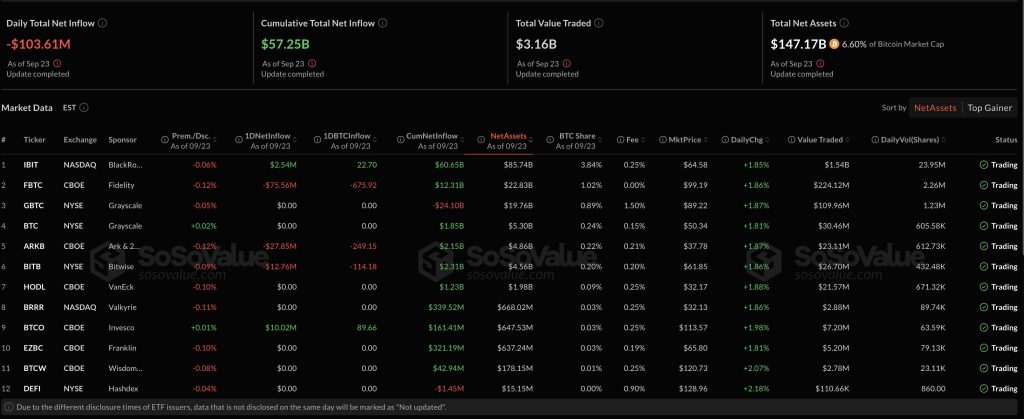
BTC ETFs Analytics September 23 Source: SoSoValue

Fidelity’s FBTC led the withdrawals with $75.6 million, followed by ARK 21Shares’ ARKB, which shed $27.9 million.

In contrast, BlackRock’s flagship IBIT managed to secure a modest $2.5 million inflow, while Invesco’s BTCO recorded the highest inflow of the day at $10 million.

Grayscale’s GBTC, along with VanEck’s HODL and Valkyrie’s BRRR, reported no major net flows.

Ethereum ETFs, on the other hand, experienced even sharper redemptions, with $140.7 million flowing out in a single day. Fidelity’s FETH accounted for the bulk of losses with $63.4 million in outflows, followed by Grayscale’s ETH fund, which lost $36.4 million.

ETH ETFs Analytics September 23 Source: SoSoValue

Bitwise’s ETHW also saw heavy withdrawals of $23.9 million, while Grayscale’s ETHE posted $17.1 million in redemptions.

BlackRock’s ETHA and VanEck’s ETHV remained flat, while smaller funds from Franklin, 21Shares, and Invesco showed no notable changes.

A day prior On September 22, Bitcoin products had lost $363 million in a single session, led by Fidelity’s FBTC with $276.7 million in redemptions.

Ethereum funds saw $76 million withdrawn the same day, led again by Fidelity’s FETH, alongside redemptions from Bitwise and BlackRock’s ETHA.

As of September 23, Bitcoin spot ETFs hold $147.2 billion in net assets, representing 6.6% of the cryptocurrency’s total market capitalization. Cumulative inflows stand at $57.25 billion.

Ethereum spot ETFs now hold $27.5 billion in net assets, representing 5.45% of the total ETH market, with cumulative inflows reaching $13.7 billion.

The outflows come just one week after digital asset products recorded nearly $1.9 billion in inflows, according to CoinShares data.

That surge followed the Federal Reserve’s first interest rate cut of 2025, which drew renewed investor demand for crypto exposure despite cautious signals from policymakers.

Bitcoin funds had attracted $977 million during the week, while Ethereum products recorded $772 million, setting a year-to-date record of $12.6 billion for Ether-backed products.

Market data shows that investor positioning remains sensitive to macroeconomic signals.

Analysts note that ETF flows and derivatives leverage remain key indicators to watch as markets absorb both the Fed’s policy outlook and upcoming inflation readings.

BlackRock’s Bitcoin ETFs Lead $260M Revenue Surge, Ethereum Adds $42M

Bitcoin and Ethereum ETFs have gained widespread success in the past few years.

BlackRock’s Bitcoin and Ethereum exchange-traded funds are now generating more than $260 million annually, showing that digital asset products have become a major profit engine for the world’s largest asset manager.

According to Leon Waidmann, head of research at the Onchain Foundation, BlackRock’s Bitcoin ETFs account for $218 million of that figure, while Ethereum products contribute $42 million.

“This isn’t experimentation anymore,” Waidmann said, noting that the firm has turned crypto ETFs into a revenue stream on par with established financial products.

Analysts suggest that BlackRock’s success will set a benchmark for pension funds, sovereign wealth funds, and insurance companies considering exposure to digital assets.

Bloomberg’s senior ETF analyst Eric Balchunas highlighted the structural advantages of crypto ETFs, which combine instant access, low costs, and yield potential with regulatory protection and anonymity, benefits not typically associated with direct token ownership.

Market conditions remain mixed. Bitcoin traded at $113,717 on Monday, up 0.9% in the past 24 hours but moving within a tight range between $111,369 and $113,301.

Ethereum slipped 0.4% to $4,173.88, marking a 7.1% decline over the past week. Despite short-term volatility, some industry leaders see rising institutional demand as a long-term price driver.

Strategy’s Michael Saylor told CNBC that ETFs and corporations are collectively buying far more Bitcoin than miners produce daily, creating sustained upward pressure. Citigroup, however, is cautious on Ethereum, projecting a year-end target of $4,300, well below its $4,953 all-time high reached in August.

Disclaimer: The articles reposted on this site are sourced from public platforms and are provided for informational purposes only. They do not necessarily reflect the views of MEXC. All rights remain with the original authors. If you believe any content infringes on third-party rights, please contact service@support.mexc.com for removal. MEXC makes no guarantees regarding the accuracy, completeness, or timeliness of the content and is not responsible for any actions taken based on the information provided. The content does not constitute financial, legal, or other professional advice, nor should it be considered a recommendation or endorsement by MEXC.

You May Also Like

BFX Presale Raises $7.5M as Solana Holds $243 and Avalanche Eyes $1B Treasury — Best Cryptos to Buy in 2025

BFX Presale Raises $7.5M as Solana Holds $243 and Avalanche Eyes $1B Treasury — Best Cryptos to Buy in 2025

BFX presale hits $7.5M with tokens at $0.024 and 30% bonus code BLOCK30, while Solana holds $243 and Avalanche builds a $1B treasury to attract institutions.
Share
Blockchainreporter2025/09/18 01:07
Trading time: Tonight, the US GDP and the upcoming non-farm data will become the market focus. Institutions are bullish on BTC to $120,000 in the second quarter.

Trading time: Tonight, the US GDP and the upcoming non-farm data will become the market focus. Institutions are bullish on BTC to $120,000 in the second quarter.

Daily market key data review and trend analysis, produced by PANews.
Share
PANews2025/04/30 13:50
Franklin Templeton CEO Dismisses 50bps Rate Cut Ahead FOMC

Franklin Templeton CEO Dismisses 50bps Rate Cut Ahead FOMC

The post Franklin Templeton CEO Dismisses 50bps Rate Cut Ahead FOMC appeared on BitcoinEthereumNews.com. Franklin Templeton CEO Jenny Johnson has weighed in on whether the Federal Reserve should make a 25 basis points (bps) Fed rate cut or 50 bps cut. This comes ahead of the Fed decision today at today’s FOMC meeting, with the market pricing in a 25 bps cut. Bitcoin and the broader crypto market are currently trading flat ahead of the rate cut decision. Franklin Templeton CEO Weighs In On Potential FOMC Decision In a CNBC interview, Jenny Johnson said that she expects the Fed to make a 25 bps cut today instead of a 50 bps cut. She acknowledged the jobs data, which suggested that the labor market is weakening. However, she noted that this data is backward-looking, indicating that it doesn’t show the current state of the economy. She alluded to the wage growth, which she remarked is an indication of a robust labor market. She added that retail sales are up and that consumers are still spending, despite inflation being sticky at 3%, which makes a case for why the FOMC should opt against a 50-basis-point Fed rate cut. In line with this, the Franklin Templeton CEO said that she would go with a 25 bps rate cut if she were Jerome Powell. She remarked that the Fed still has the October and December FOMC meetings to make further cuts if the incoming data warrants it. Johnson also asserted that the data show a robust economy. However, she noted that there can’t be an argument for no Fed rate cut since Powell already signaled at Jackson Hole that they were likely to lower interest rates at this meeting due to concerns over a weakening labor market. Notably, her comment comes as experts argue for both sides on why the Fed should make a 25 bps cut or…
Share
BitcoinEthereumNews2025/09/18 00:36
