

AI Stocks Are Driving the S&P 500 — and Jefferies Says the Rally Has Legs
TLDR
- AI stocks account for more than 80% of S&P 500 gains in 2026; strip them out and the index is up just 2%
- Jefferies says the rally is driven by earnings growth, not inflated valuations, calling AI “the cheapest sector to own” on a PEG basis
- AI basket forward earnings estimates are up over 30% since mid-2025, with a projected EPS CAGR of 38.5% for 2026–27
- Samsung Electronics crossed $1 trillion in market cap, joining Nvidia, TSMC, and Broadcom in the AI infrastructure tier
- 86% of S&P 500 companies beat earnings in Q1 2026 — a post-COVID record — with AI and commodities leading the way
Artificial intelligence stocks are carrying the U.S. stock market in 2026. According to Jefferies, they account for more than 80% of the S&P 500’s gains so far this year. Take AI out of the equation, and the index is up just 2%.
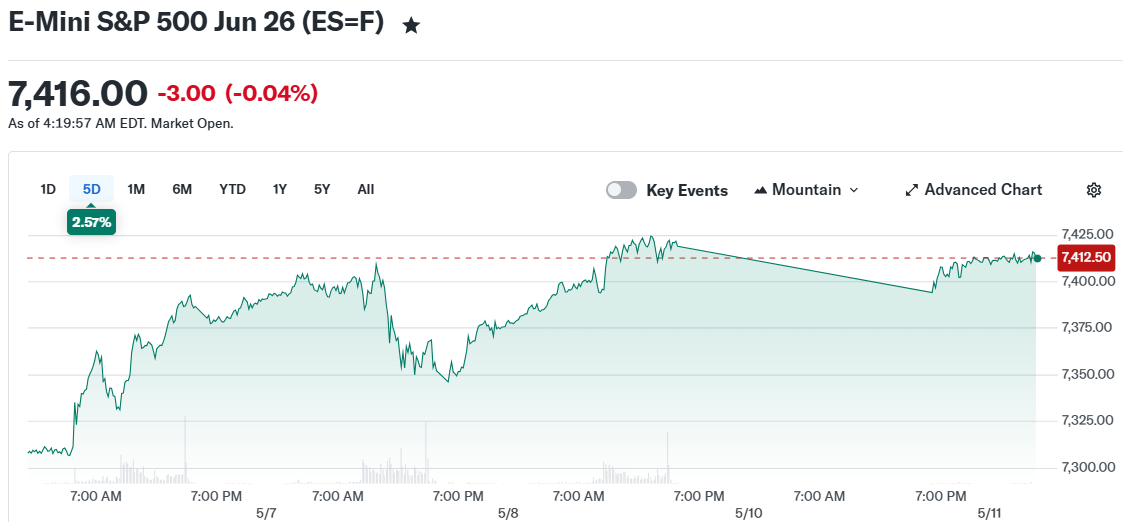 E-Mini S&P 500 Jun 26 (ES=F)
That level of concentration has made some investors nervous. But Jefferies says there’s a solid reason behind it.
The bank’s quantitative strategy team looked at what’s actually driving the gains. Their finding: it’s earnings growth, not rising valuations. That distinction matters a lot for anyone trying to figure out whether this is a bubble.
The AI basket’s 2026 forward earnings estimates have risen more than 30% since mid-2025. Analysts expect compound annual earnings growth of 38.5% for AI companies in 2026 and 2027. For non-AI sectors, that number is just 11.9%.
Despite that growth, the AI basket trades at around 25 times forward earnings. That’s below its own one standard deviation level. Its price-to-earnings-growth ratio sits at just 0.6 times.
Not All AI Stocks Are Performing the Same
Performance within the AI space has been uneven. AI servers, optical components, and memory have led returns this year. Hyperscalers and chip designers have lagged.
On valuation, memory and compute stocks look most attractive on a PEG basis. Semiconductor capital equipment and chip design appear more expensive by comparison.
Q1 2026 earnings added more context. Some 86% of S&P 500 companies beat earnings expectations — a post-COVID record, up from 75% the previous quarter. Sales beats hit 82%.
The catch: most of those beats went unrewarded. Stocks generally didn’t outperform after beating estimates, except in AI and a few other areas. Misses were punished heavily, which points to high investor expectations across the board.
Jefferies reviewed around 330 earnings calls using the AlphaSense platform. Management optimism came in at 95%. Analyst sentiment also improved, with 58% of calls showing a positive tone, up from 48% in Q4 2025.
One concern flagged on those calls: the U.S.-Iran conflict. Some 44% of companies cited it as a negative factor, pointing to supply chain disruptions and weaker consumer sentiment.
Samsung Joins the $1 Trillion Club
The AI rally isn’t just lifting software and chip designers. It’s pulling in hardware suppliers too. Samsung Electronics just crossed $1 trillion in market capitalization, becoming the latest AI-linked company to enter that tier.
Samsung joins Nvidia, TSMC, and Broadcom — companies that make the chips, memory, and infrastructure powering the AI build-out. Samsung’s entry is tied to its high-bandwidth memory, which is used directly in AI systems.
The $1 trillion club was once built around consumer platforms. Apple, Amazon, Microsoft, Alphabet, Meta, and Tesla all got there on smartphones, cloud, e-commerce, and software.
The newer wave is more hardware-focused. Nvidia crossed $1 trillion in May 2023. TSMC followed in 2024. Broadcom joined later that year. Now Samsung adds memory to that list.
Berkshire Hathaway and Walmart have also joined the club, along with Eli Lilly on drug demand and energy giants Saudi Aramco and PetroChina. But the most active cluster right now is AI infrastructure.
Earnings revisions across the S&P 500 are up 6% over the past three months. Exclude AI and commodities, and that figure drops to just 0.3%.
The post AI Stocks Are Driving the S&P 500 — and Jefferies Says the Rally Has Legs appeared first on CoinCentral.


You May Also Like

GOP in disarray as Senate seat pick-up slips away: 'It's a mess'

Is Pepecoin (PEPE) Era Ending? 19K Investors Watch This New Cheap Altcoin




