Homomorphic Polynomial Public Key Cryptography (HPPK) is the latest step in a series of cryptographic innovations that began with deterministic polynomial public key (DPPK) in 2021, evolved into multivariate polynomial public key (MPPK), and eventually matured into homomorphic schemes built on hidden ring structures. These developments, including applications in digital signatures and key encapsulation, show both promise and challenges—such as optimization and attack vectors—marking HPPK as an important frontier in modern cryptography.Homomorphic Polynomial Public Key Cryptography (HPPK) is the latest step in a series of cryptographic innovations that began with deterministic polynomial public key (DPPK) in 2021, evolved into multivariate polynomial public key (MPPK), and eventually matured into homomorphic schemes built on hidden ring structures. These developments, including applications in digital signatures and key encapsulation, show both promise and challenges—such as optimization and attack vectors—marking HPPK as an important frontier in modern cryptography.

What You Should Know About the Next Generation of Encryption

Abstract and 1. Introduction

  1. Contribution

  2. Related Work

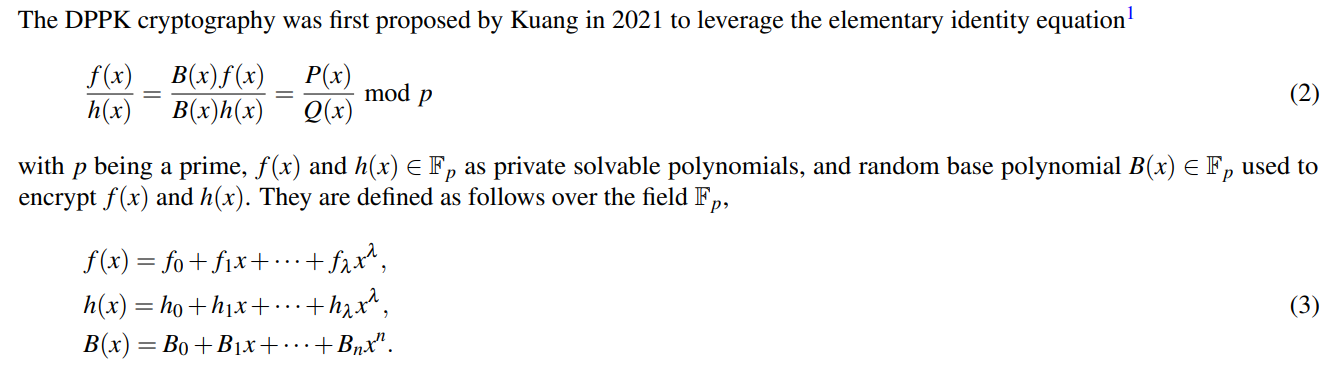
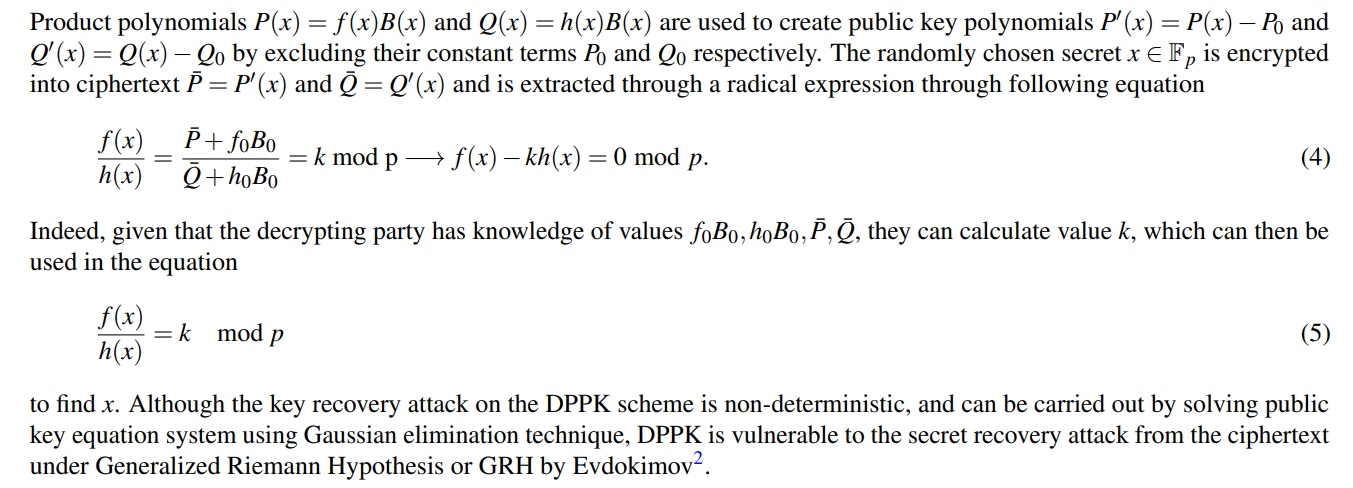
  3. Brief of Homomorphic Polynomial Public Key Cryptography and 4.1 DPPK

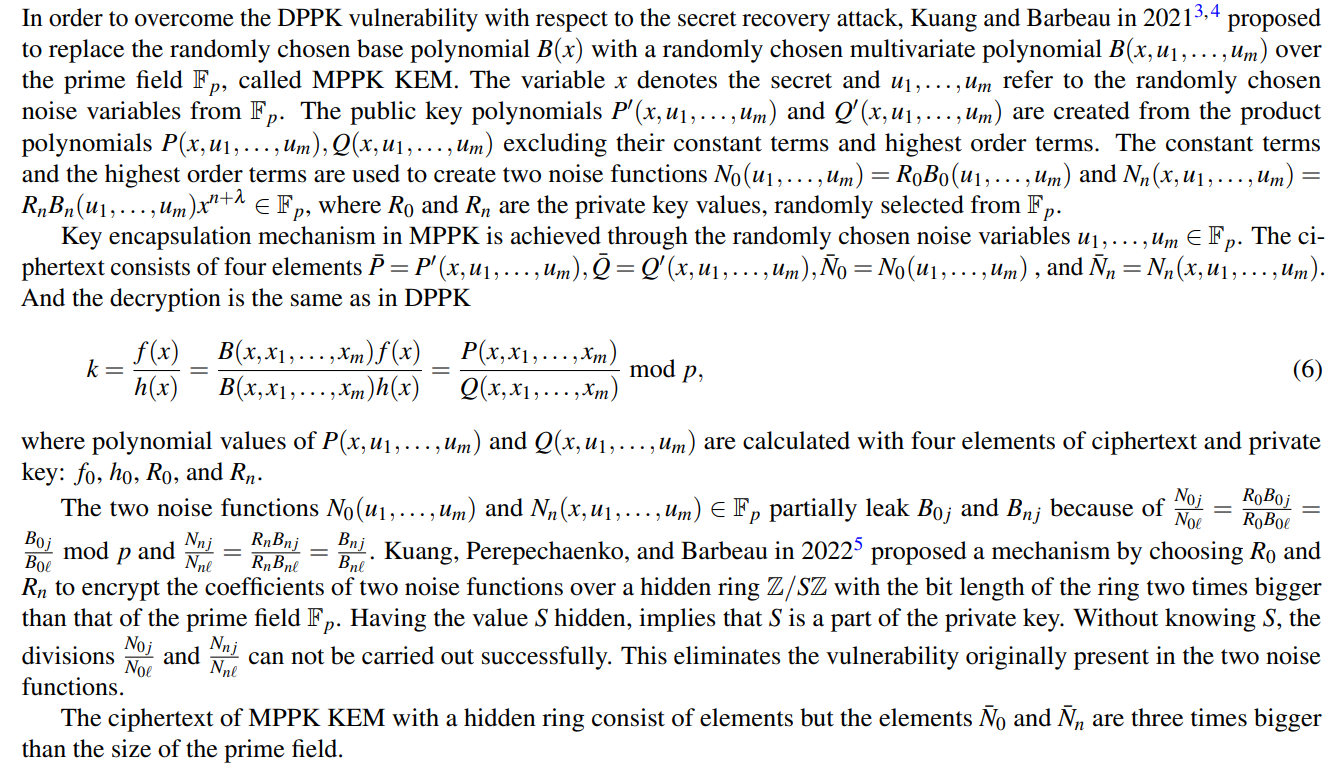
    4.2 MPPK Key Encapsulation Mechanism

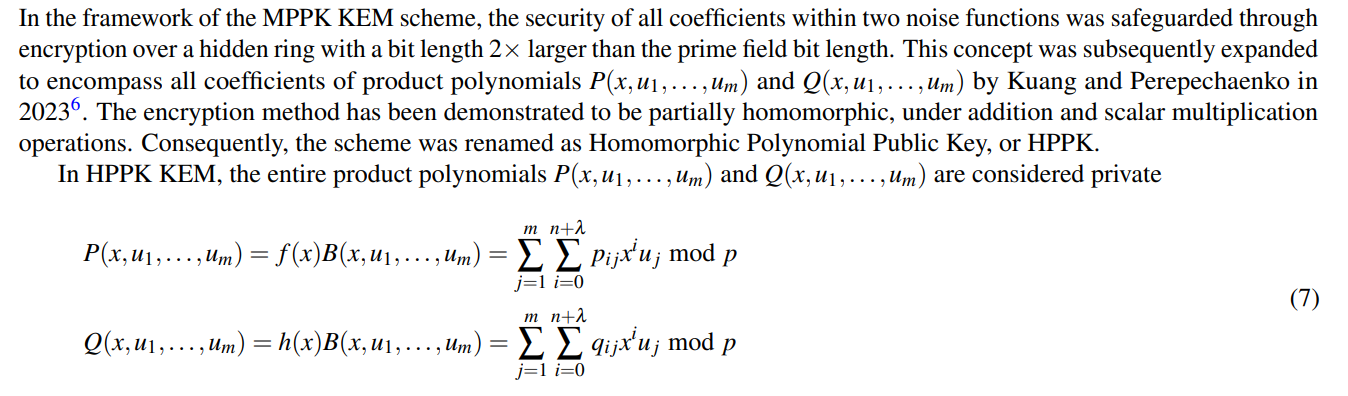
    4.3 HPPK KEM

    4.4 MPPK DS

  4. HPPK Digital Signature Scheme

    5.1 HPPK DS Algorithm

    5.2 Signing

    5.3 Verify

    5.4 A Variant of the Barrett Reduction Algorithm

    5.5 A Toy Example

  5. HPPK DS Security Analysis

  6. Conclusion, References, Acknowledgements, and Author contributions statement

4 Brief of Homomorphic Polynomial Public Key Cryptography

In this section, we are going to briefly describe the motivation behind and development of the HPPK scheme: the path from the original deterministic polynomial public key or DPPK, proposed by Kuang in 2021[1], then multivariate polynomial public key or MPPK, proposed by Kuang, Perepechaenko, and Barbeau in 2022[5], to the homomorphic polynomial public key over a single hidden ring in 2023[6], and over a dual hidden ring scheme[7]. MPPK schemes for digital signature or MPPK/DS have been proposed by Kuang, Perepechaenko, and Barbeau in 2022[8], then an optimized version was proposed by Kuang and Perepechaenko in 2023[9]. A forged signature attack was reported by Guo in 2023[10].

4.1 DPPK
\
4.2 MPPK Key Encapsulation Mechanism

\
\

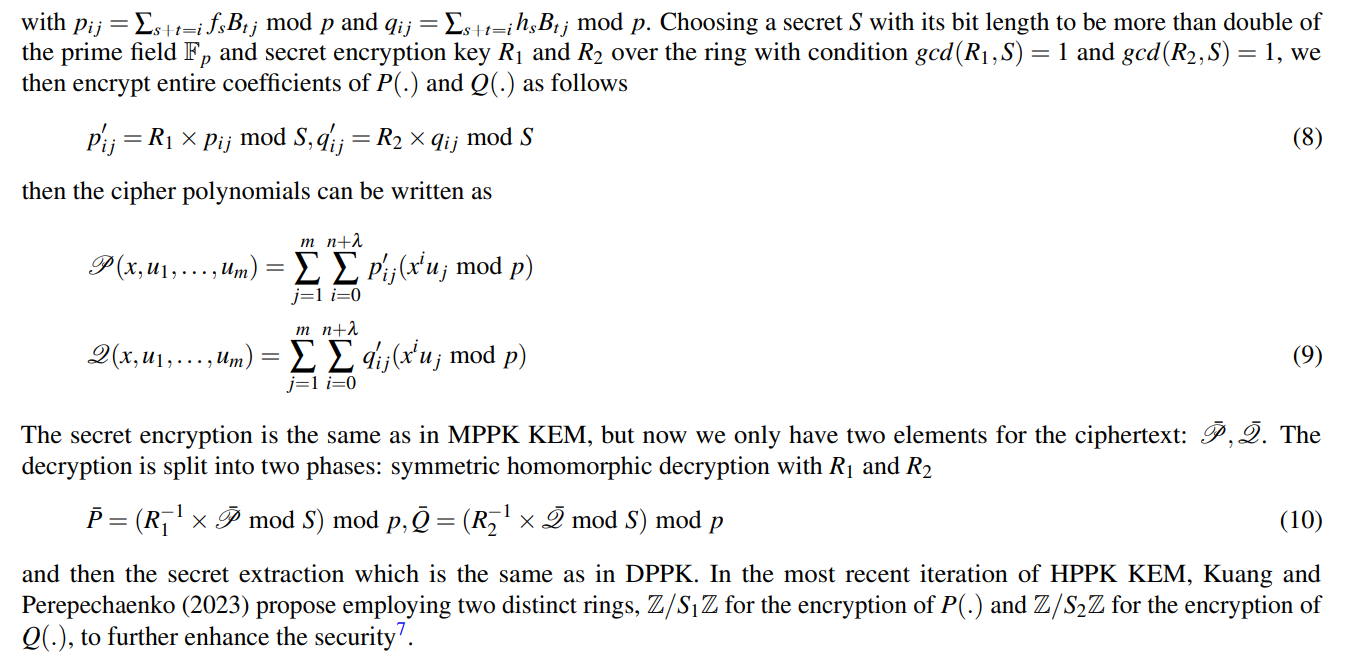
4.3 HPPK KEM

\
\ \ \
\

4.4 MPPK DS

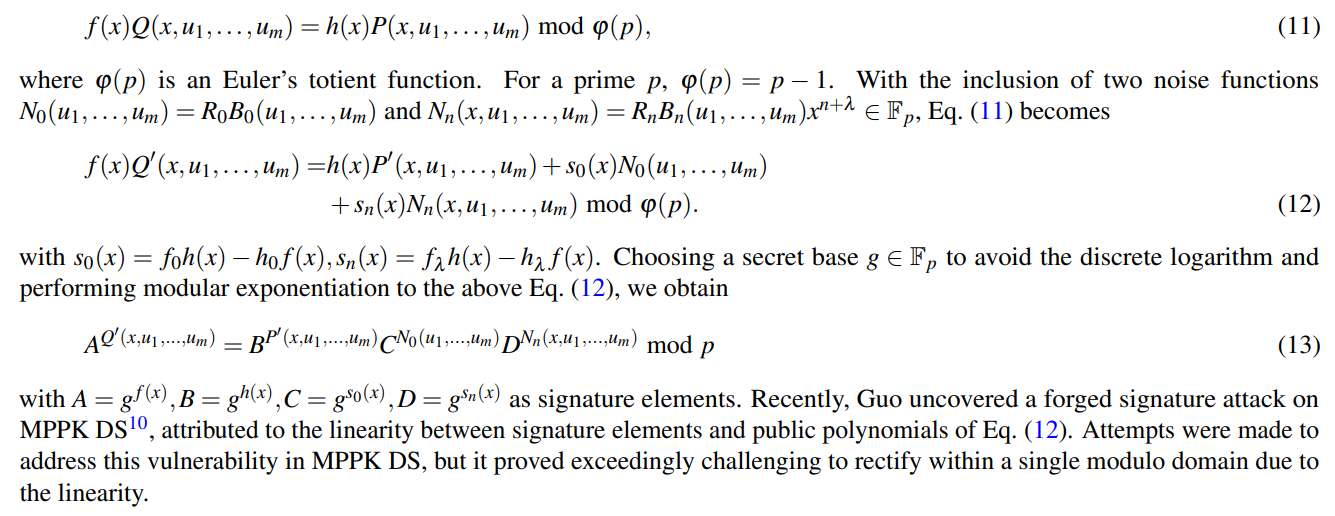
A digital signature scheme based on MPPK has been proposed by Kuang, Perepechaenko, and Barbeau in 2022[8] and later optimized variant was proposed by Kuang and Perepechaenko in 2023[9]. MPPK digital signature scheme originated from MPPK over a single prime field[3, 4]. The signature verification equation stems from the identity equation

\ \
\ \ \

:::info Authors:

(1) Randy Kuang, Quantropi Inc., Ottawa, K1Z 8P9, Canada (randy.kuang@quantropi.com);

(2) Maria Perepechaenko, Quantropi Inc., Ottawa, K1Z 8P9, Canada;

(3) Mahmoud Sayed, Systems and Computer Engineering, Carleton University, Ottawa, K1S 5B6, Canada;

(4) Dafu Lou, Quantropi Inc., Ottawa, K1Z 8P9, Canada.

:::


:::info This paper is available on arxiv under ATTRIBUTION-NONCOMMERCIAL-SHAREALIKE 4.0 INTERNATIONAL license.

:::

\

Market Opportunity
PUBLIC Logo
PUBLIC Price(PUBLIC)
$0.01673
$0.01673$0.01673
-2.50%
USD
PUBLIC (PUBLIC) Live Price Chart
Disclaimer: The articles reposted on this site are sourced from public platforms and are provided for informational purposes only. They do not necessarily reflect the views of MEXC. All rights remain with the original authors. If you believe any content infringes on third-party rights, please contact service@support.mexc.com for removal. MEXC makes no guarantees regarding the accuracy, completeness, or timeliness of the content and is not responsible for any actions taken based on the information provided. The content does not constitute financial, legal, or other professional advice, nor should it be considered a recommendation or endorsement by MEXC.

You May Also Like

The Channel Factories We’ve Been Waiting For

The Channel Factories We’ve Been Waiting For

The post The Channel Factories We’ve Been Waiting For appeared on BitcoinEthereumNews.com. Visions of future technology are often prescient about the broad strokes while flubbing the details. The tablets in “2001: A Space Odyssey” do indeed look like iPads, but you never see the astronauts paying for subscriptions or wasting hours on Candy Crush.  Channel factories are one vision that arose early in the history of the Lightning Network to address some challenges that Lightning has faced from the beginning. Despite having grown to become Bitcoin’s most successful layer-2 scaling solution, with instant and low-fee payments, Lightning’s scale is limited by its reliance on payment channels. Although Lightning shifts most transactions off-chain, each payment channel still requires an on-chain transaction to open and (usually) another to close. As adoption grows, pressure on the blockchain grows with it. The need for a more scalable approach to managing channels is clear. Channel factories were supposed to meet this need, but where are they? In 2025, subnetworks are emerging that revive the impetus of channel factories with some new details that vastly increase their potential. They are natively interoperable with Lightning and achieve greater scale by allowing a group of participants to open a shared multisig UTXO and create multiple bilateral channels, which reduces the number of on-chain transactions and improves capital efficiency. Achieving greater scale by reducing complexity, Ark and Spark perform the same function as traditional channel factories with new designs and additional capabilities based on shared UTXOs.  Channel Factories 101 Channel factories have been around since the inception of Lightning. A factory is a multiparty contract where multiple users (not just two, as in a Dryja-Poon channel) cooperatively lock funds in a single multisig UTXO. They can open, close and update channels off-chain without updating the blockchain for each operation. Only when participants leave or the factory dissolves is an on-chain transaction…
Share
BitcoinEthereumNews2025/09/18 00:09
Gold Hits $3,700 as Sprott’s Wong Says Dollar’s Store-of-Value Crown May Slip

Gold Hits $3,700 as Sprott’s Wong Says Dollar’s Store-of-Value Crown May Slip

The post Gold Hits $3,700 as Sprott’s Wong Says Dollar’s Store-of-Value Crown May Slip appeared on BitcoinEthereumNews.com. Gold is strutting its way into record territory, smashing through $3,700 an ounce Wednesday morning, as Sprott Asset Management strategist Paul Wong says the yellow metal may finally snatch the dollar’s most coveted role: store of value. Wong Warns: Fiscal Dominance Puts U.S. Dollar on Notice, Gold on Top Gold prices eased slightly to $3,678.9 […] Source: https://news.bitcoin.com/gold-hits-3700-as-sprotts-wong-says-dollars-store-of-value-crown-may-slip/
Share
BitcoinEthereumNews2025/09/18 00:33
ZKP Crypto Presale Auction: 8,000x Returns Slipping Away with Each Burned Coin

ZKP Crypto Presale Auction: 8,000x Returns Slipping Away with Each Burned Coin

Zero Knowledge Proof (ZKP) operates a 450-day crypto ICO, burning unsold coins each day. Supply drops through phases, plus a strong deflationary design might create
Share
coinlineup2026/01/23 01:00