This paper explores the limits of standard Physics-Informed Neural Networks (PINNs) in handling shock waves in hyperbolic conservation laws, where artificial diffusion is typically added to approximate solutions. Instead, the authors introduce a non-diffusive neural network (NDNN) method that directly computes entropic shock waves without artificial viscosity. The approach is derived, implemented, and validated through multiple experiments—including shock wave interaction and generation—demonstrating convergence, accuracy, and efficiency for complex PDE systems.This paper explores the limits of standard Physics-Informed Neural Networks (PINNs) in handling shock waves in hyperbolic conservation laws, where artificial diffusion is typically added to approximate solutions. Instead, the authors introduce a non-diffusive neural network (NDNN) method that directly computes entropic shock waves without artificial viscosity. The approach is derived, implemented, and validated through multiple experiments—including shock wave interaction and generation—demonstrating convergence, accuracy, and efficiency for complex PDE systems.

Can Neural Networks Capture Shock Waves Without Diffusion? This Paper Says Yes

Abstract and 1. Introduction

1.1. Introductory remarks

1.2. Basics of neural networks

1.3. About the entropy of direct PINN methods

1.4. Organization of the paper

  1. Non-diffusive neural network solver for one dimensional scalar HCLs

    2.1. One shock wave

    2.2. Arbitrary number of shock waves

    2.3. Shock wave generation

    2.4. Shock wave interaction

    2.5. Non-diffusive neural network solver for one dimensional systems of CLs

    2.6. Efficient initial wave decomposition

  2. Gradient descent algorithm and efficient implementation

    3.1. Classical gradient descent algorithm for HCLs

    3.2. Gradient descent and domain decomposition methods

  3. Numerics

    4.1. Practical implementations

    4.2. Basic tests and convergence for 1 and 2 shock wave problems

    4.3. Shock wave generation

    4.4. Shock-Shock interaction

    4.5. Entropy solution

    4.6. Domain decomposition

    4.7. Nonlinear systems

  4. Conclusion and References

1.2. Basics of neural networks
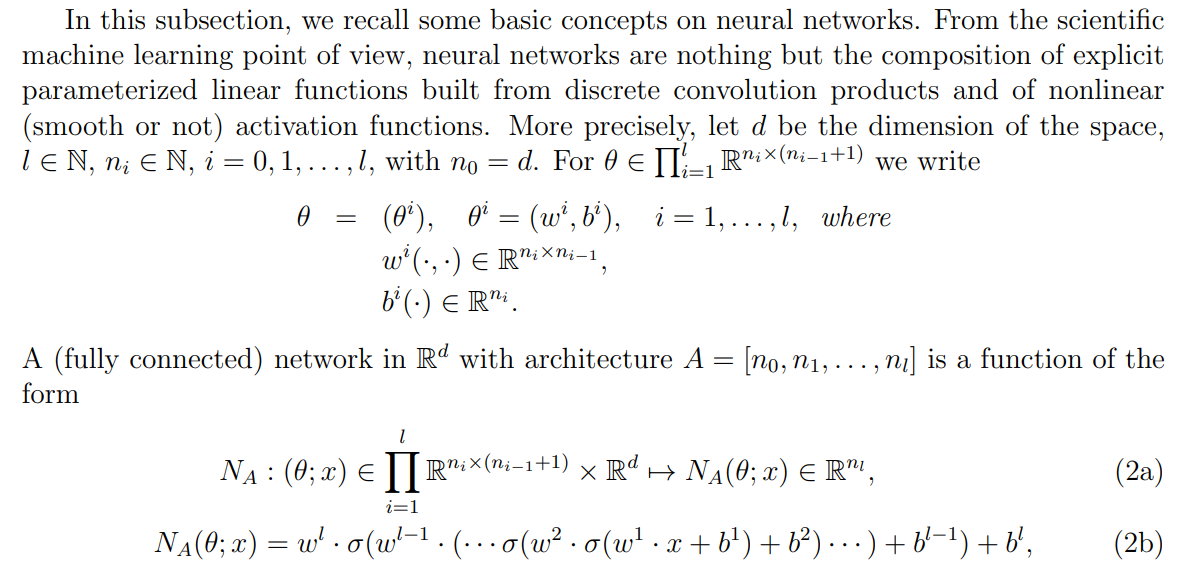
\ where σ : R 7→ R is a given function, called activation function, which acts on any vector or matrix component-wise. It is clear from this exposition that the network NA is defined uniquely by the architecture A. In all the networks we will consider the architecture A is given/fixed, and we will omit the letter A from NA.

\ These network functions, which will be used to approximate solutions to HCLs, benefit from automatic differentiation with respect to x and θ (parameters). This feature allows an evaluation of (1) without error. Naturally, the computed solutions are restricted to the function space spanned by the neural networks.

\
1.3. About the entropy of direct PINN methods

We finish this introduction by a short discussion on the entropy of PINN solvers for HCLs. As direct PINN solvers can not directly capture shock waves (discontinuous weak solution), artificial diffusion is usually added to HCLs, uε is searched as the solution to

\ \
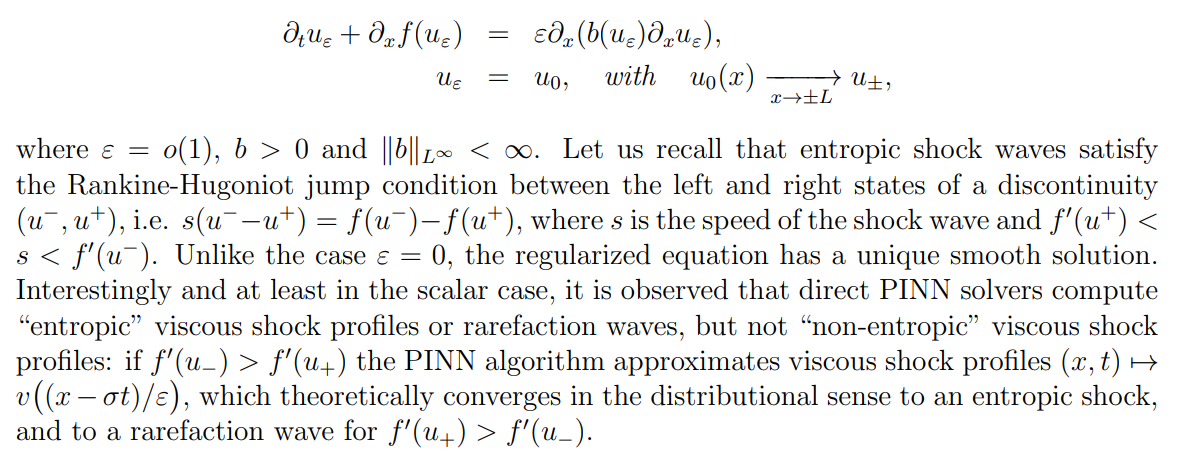
\ \ While we propose in Experiment 6 an illustration of this property of the PINN method, in this paper, we propose a totally different strategy which does not require the addition of any artificial viscosity, and computes entropic shock wave without diffusion.

1.4. Organization of the paper

This paper is organized as follows. Section 2 is devoted to the derivation of the basics of the non-diffusive neural network (NDNN) method. Different situations are analyzed including multiple shock waves, shock wave interaction, shock wave generation, and the extension to systems. In Section 3, we discuss the efficient implementation of the derived algorithm.

\ In Section 4, several numerical experiments are proposed to illustrate the convergence and the accuracy of the proposed algorithms. We conclude in Section 5.

\

:::info Authors:

(1) Emmanuel LORIN, School of Mathematics and Statistics, Carleton University, Ottawa, Canada, K1S 5B6 and Centre de Recherches Mathematiques, Universit´e de Montr´eal, Montreal, Canada, H3T 1J4 (elorin@math.carleton.ca);

(2) Arian NOVRUZI, a Corresponding Author from Department of Mathematics and Statistics, University of Ottawa, Ottawa, ON K1N 6N5, Canada (novruzi@uottawa.ca).

:::


:::info This paper is available on arxiv under CC by 4.0 Deed (Attribution 4.0 International) license.

:::

\

Market Opportunity
Waves Logo
Waves Price(WAVES)
$0.6611
$0.6611$0.6611
-1.26%
USD
Waves (WAVES) Live Price Chart
Disclaimer: The articles reposted on this site are sourced from public platforms and are provided for informational purposes only. They do not necessarily reflect the views of MEXC. All rights remain with the original authors. If you believe any content infringes on third-party rights, please contact service@support.mexc.com for removal. MEXC makes no guarantees regarding the accuracy, completeness, or timeliness of the content and is not responsible for any actions taken based on the information provided. The content does not constitute financial, legal, or other professional advice, nor should it be considered a recommendation or endorsement by MEXC.

You May Also Like

Microsoft Corp. $MSFT blue box area offers a buying opportunity

Microsoft Corp. $MSFT blue box area offers a buying opportunity

The post Microsoft Corp. $MSFT blue box area offers a buying opportunity appeared on BitcoinEthereumNews.com. In today’s article, we’ll examine the recent performance of Microsoft Corp. ($MSFT) through the lens of Elliott Wave Theory. We’ll review how the rally from the April 07, 2025 low unfolded as a 5-wave impulse followed by a 3-swing correction (ABC) and discuss our forecast for the next move. Let’s dive into the structure and expectations for this stock. Five wave impulse structure + ABC + WXY correction $MSFT 8H Elliott Wave chart 9.04.2025 In the 8-hour Elliott Wave count from Sep 04, 2025, we saw that $MSFT completed a 5-wave impulsive cycle at red III. As expected, this initial wave prompted a pullback. We anticipated this pullback to unfold in 3 swings and find buyers in the equal legs area between $497.02 and $471.06 This setup aligns with a typical Elliott Wave correction pattern (ABC), in which the market pauses briefly before resuming its primary trend. $MSFT 8H Elliott Wave chart 7.14.2025 The update, 10 days later, shows the stock finding support from the equal legs area as predicted allowing traders to get risk free. The stock is expected to bounce towards 525 – 532 before deciding if the bounce is a connector or the next leg higher. A break into new ATHs will confirm the latter and can see it trade higher towards 570 – 593 area. Until then, traders should get risk free and protect their capital in case of a WXY double correction. Conclusion In conclusion, our Elliott Wave analysis of Microsoft Corp. ($MSFT) suggested that it remains supported against April 07, 2025 lows and bounce from the blue box area. In the meantime, keep an eye out for any corrective pullbacks that may offer entry opportunities. By applying Elliott Wave Theory, traders can better anticipate the structure of upcoming moves and enhance risk management in volatile markets. Source: https://www.fxstreet.com/news/microsoft-corp-msft-blue-box-area-offers-a-buying-opportunity-202509171323
Share
BitcoinEthereumNews2025/09/18 03:50
WTI drifts higher above $59.50 on Kazakh supply disruptions

WTI drifts higher above $59.50 on Kazakh supply disruptions

The post WTI drifts higher above $59.50 on Kazakh supply disruptions appeared on BitcoinEthereumNews.com. West Texas Intermediate (WTI), the US crude oil benchmark
Share
BitcoinEthereumNews2026/01/21 11:24
MYX Finance price surges again as funding rate points to a crash

MYX Finance price surges again as funding rate points to a crash

MYX Finance price went parabolic again as the recent short-squeeze resumed. However, the formation of a double-top pattern and the funding rate point to an eventual crash in the coming days. MYX Finance (MYX) came in the spotlight earlier this…
Share
Crypto.news2025/09/18 02:57