Stablecoin intermediaries in Australia have been allowed to distribute licensed stablecoins without having to hold a separate financial services license as per a “first-of-its-kind” special exemption granted by the Australian Securities and Investments Commission (ASIC). According to ASIC, the exemption…Stablecoin intermediaries in Australia have been allowed to distribute licensed stablecoins without having to hold a separate financial services license as per a “first-of-its-kind” special exemption granted by the Australian Securities and Investments Commission (ASIC). According to ASIC, the exemption…

Australia’s ASIC cuts compliance burden for stablecoin intermediaries

Stablecoin intermediaries in Australia have been allowed to distribute licensed stablecoins without having to hold a separate financial services license as per a “first-of-its-kind” special exemption granted by the Australian Securities and Investments Commission (ASIC).

Summary
  • ASIC has granted a first-of-its-kind exemption allowing Stablecoin intermediaries to distribute licensed stablecoins without separate licenses.
  • Catena Digital’s AUDM is the first stablecoin to qualify under the exemption.
  • The relief comes in response to a December 2024 consultation paper issued by ASIC.

According to ASIC, the exemption is an “important step in facilitating growth and innovation in the digital assets and payments sectors,” and only applies to stablecoins issued by firms that have acquired the Australian financial services license.

How does ASIC’s exemption impact stablecoin intermediaries?

The exemption means crypto exchanges and other intermediaries can save on compliance costs and offer access to select regulated stablecoins without the burden of extra licensing.

“ASIC is committed to supporting responsible innovation in the rapidly evolving digital assets space, while ensuring important consumer protections are in place by having eligible stablecoins issued under an AFS licence,” the regulator said.

So far, only Catena Digital, an Australian stablecoin issuer, has been granted an AFS license, and therefore, its Australian dollar-denominated stablecoin, AUDM, is the first to qualify under the new exemption.

However, intermediaries that offer AUDM will be required to provide its product disclosure statement to clients, to ensure transparency and allow locals to make informed decisions.

ASIC also plans to extend this relief to additional stablecoin issuers as they become licensed.

As of now, the relief will take effect once it is registered on the Federal Register of Legislation, which is the official step required for it to become legally binding.

ASIC set to formalize crypto rules

The exemption is a direct response to concerns raised during ASIC’s consultation on crypto regulation, which was outlined in Consultation Paper 381, which the regulator published late last year.

“Many digital assets and related products are financial products under the current law. Stakeholders have been calling for greater clarity, and in response, we are releasing our draft updated guidance,” ASIC commissioner Alan Kirkland said at the time.

In that paper, ASIC proposed several updates to its digital assets guidance, INFO 225, to better accommodate digital assets, and included practical examples of how existing financial product definitions could apply to stablecoins, wrapped tokens, exchange-native tokens, and even meme coins.

ASIC is currently finalizing the updates and said it would publish the revised INFO 225, along with key themes and public submissions from the consultation, in the coming weeks.

Simultaneously, the regulator said it was “working closely” with the country’s Treasury department to develop a stablecoin framework.

Disclaimer: The articles reposted on this site are sourced from public platforms and are provided for informational purposes only. They do not necessarily reflect the views of MEXC. All rights remain with the original authors. If you believe any content infringes on third-party rights, please contact service@support.mexc.com for removal. MEXC makes no guarantees regarding the accuracy, completeness, or timeliness of the content and is not responsible for any actions taken based on the information provided. The content does not constitute financial, legal, or other professional advice, nor should it be considered a recommendation or endorsement by MEXC.

You May Also Like

The Channel Factories We’ve Been Waiting For

The Channel Factories We’ve Been Waiting For

The post The Channel Factories We’ve Been Waiting For appeared on BitcoinEthereumNews.com. Visions of future technology are often prescient about the broad strokes while flubbing the details. The tablets in “2001: A Space Odyssey” do indeed look like iPads, but you never see the astronauts paying for subscriptions or wasting hours on Candy Crush.  Channel factories are one vision that arose early in the history of the Lightning Network to address some challenges that Lightning has faced from the beginning. Despite having grown to become Bitcoin’s most successful layer-2 scaling solution, with instant and low-fee payments, Lightning’s scale is limited by its reliance on payment channels. Although Lightning shifts most transactions off-chain, each payment channel still requires an on-chain transaction to open and (usually) another to close. As adoption grows, pressure on the blockchain grows with it. The need for a more scalable approach to managing channels is clear. Channel factories were supposed to meet this need, but where are they? In 2025, subnetworks are emerging that revive the impetus of channel factories with some new details that vastly increase their potential. They are natively interoperable with Lightning and achieve greater scale by allowing a group of participants to open a shared multisig UTXO and create multiple bilateral channels, which reduces the number of on-chain transactions and improves capital efficiency. Achieving greater scale by reducing complexity, Ark and Spark perform the same function as traditional channel factories with new designs and additional capabilities based on shared UTXOs.  Channel Factories 101 Channel factories have been around since the inception of Lightning. A factory is a multiparty contract where multiple users (not just two, as in a Dryja-Poon channel) cooperatively lock funds in a single multisig UTXO. They can open, close and update channels off-chain without updating the blockchain for each operation. Only when participants leave or the factory dissolves is an on-chain transaction…
Share
BitcoinEthereumNews2025/09/18 00:09
Franklin Templeton CEO Dismisses 50bps Rate Cut Ahead FOMC
Franklin Templeton CEO Dismisses 50bps Rate Cut Ahead FOMC

The post Franklin Templeton CEO Dismisses 50bps Rate Cut Ahead FOMC appeared on BitcoinEthereumNews.com. Franklin Templeton CEO Jenny Johnson has weighed in on whether the Federal Reserve should make a 25 basis points (bps) Fed rate cut or 50 bps cut. This comes ahead of the Fed decision today at today’s FOMC meeting, with the market pricing in a 25 bps cut. Bitcoin and the broader crypto market are currently trading flat ahead of the rate cut decision. Franklin Templeton CEO Weighs In On Potential FOMC Decision In a CNBC interview, Jenny Johnson said that she expects the Fed to make a 25 bps cut today instead of a 50 bps cut. She acknowledged the jobs data, which suggested that the labor market is weakening. However, she noted that this data is backward-looking, indicating that it doesn’t show the current state of the economy. She alluded to the wage growth, which she remarked is an indication of a robust labor market. She added that retail sales are up and that consumers are still spending, despite inflation being sticky at 3%, which makes a case for why the FOMC should opt against a 50-basis-point Fed rate cut. In line with this, the Franklin Templeton CEO said that she would go with a 25 bps rate cut if she were Jerome Powell. She remarked that the Fed still has the October and December FOMC meetings to make further cuts if the incoming data warrants it. Johnson also asserted that the data show a robust economy. However, she noted that there can’t be an argument for no Fed rate cut since Powell already signaled at Jackson Hole that they were likely to lower interest rates at this meeting due to concerns over a weakening labor market. Notably, her comment comes as experts argue for both sides on why the Fed should make a 25 bps cut or…
Share
BitcoinEthereumNews2025/09/18 00:36
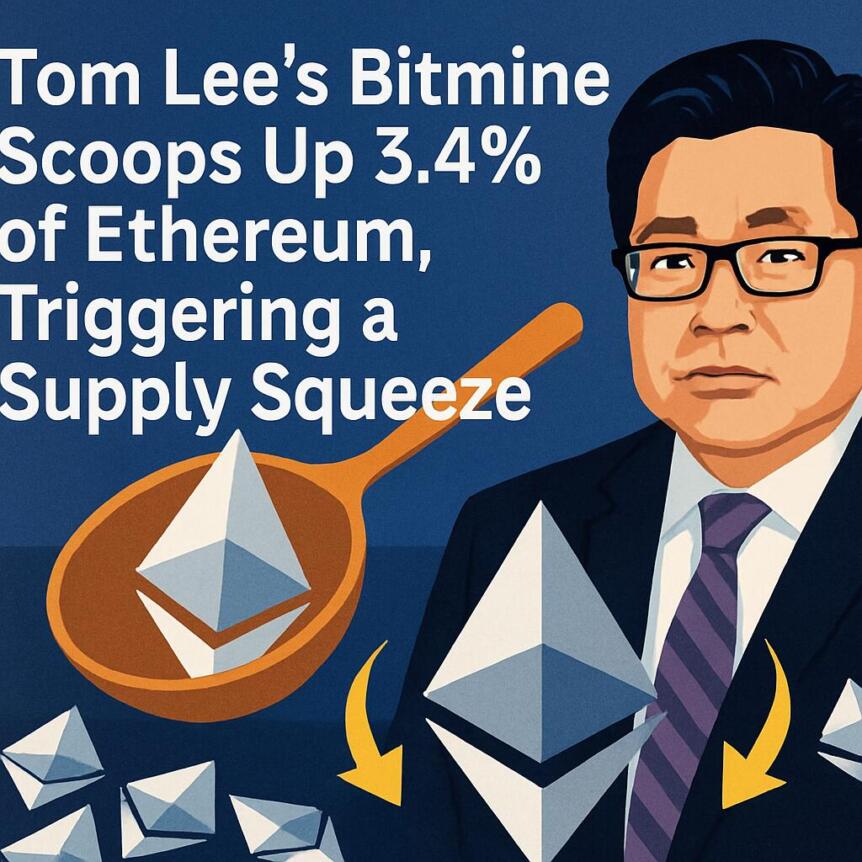
Tom Lee’s Bitmine Scoops Up 3.4% of Ethereum, Triggering a Supply Squeeze

Tom Lee’s Bitmine Scoops Up 3.4% of Ethereum, Triggering a Supply Squeeze

Bitmine Immersion now controls 3.4% of Ethereum amid shrinking exchange supply and rising institutional accumulation.
Share
Crypto Breaking News2026/01/20 16:27