XRP is under intense selling pressure as the broader crypto market enters a decisive stage marked by fear, uncertainty, and a rapid shift in investor sentiment. With Bitcoin struggling to recover and altcoins posting steep losses, many analysts are warning that XRP could face a continued decline in the coming days. Investors are bracing for more volatility as liquidity thins and market confidence weakens. Related Reading: Major Bitcoin LTH Sell-Off Signals Cycle Exhaustion as Supply Drops to 13.6M BTC Yet, despite the bearish narrative, the XRP ecosystem has shown unusual levels of activity—particularly on the institutional front. The arrival of the first US spot XRP ETFs has reshaped its market profile. Canary Capital was the first to launch on November 13, soon followed by Franklin Templeton, Bitwise, and Grayscale. In a matter of days, XRP transitioned from a conventional crypto asset to one accessible through regulated institutional vehicles, potentially shifting its long-term demand dynamics. This new backdrop makes one ongoing trend on Binance even more striking. Since October, XRP reserves on the exchange have been falling sharply. Current data shows reserves have dropped to roughly 2.7 billion XRP, one of the lowest levels ever recorded on the platform. Such consistent outflows signal rising demand for self-custody—an important metric as XRP navigates this critical market phase. XRP Exchange Outflows Signal Strengthening Long-Term Demand According to a new CryptoQuant report by analyst Darkfost, XRP is experiencing one of its most notable exchange outflow trends in years. Since October 6, roughly 300 million XRP have left Binance alone—a figure far too large and too consistent to dismiss as simple internal reshuffling. While a small portion of these transfers may be operational movements by the exchange, the broader pattern is unmistakable: investors are steadily withdrawing XRP from trading platforms. This behavior is typically interpreted as a bullish long-term signal. Day after day, the decline in exchange reserves continues, suggesting that buyers are choosing to move their XRP into private wallets rather than leaving them on exchanges for trading or short-term speculation. Historically, large-scale withdrawals reflect strong conviction, as holders position themselves for longer-term appreciation rather than immediate selling. The supply dynamics created by this trend are significant. With fewer tokens available on exchanges, liquidity tightens. When combined with the rising institutional interest brought by newly launched U.S. spot ETFs, this creates the potential foundation for a powerful shift in momentum. If exchange reserves continue dropping at the current pace, XRP could enter a more structured phase of accumulation—one driven not by hype, but by growing confidence from both retail and institutional participants. Related Reading: Ethereum ICO Whale Sells 20,000 ETH ($58M), Raising Questions Over Market Timing XRP Attempts to Stabilize but Remains Under Strong Selling Pressure XRP’s recent price action on the 3D chart shows an asset trying to stabilize, yet still struggling against a clearly bearish backdrop. After weeks of decline, XRP found temporary support near the $2 psychological zone, where buyers briefly stepped in to prevent a deeper breakdown. This area aligns closely with the 200-day moving average (red line), which has acted as a final line of defense during multiple market cycles. Despite the small rebound, XRP continues to trade well below the 50-day and 100-day moving averages, both of which are now sloping downward and reinforcing the broader bearish trend. The inability to reclaim the $2.40–$2.50 zone — an important previous support turned resistance — suggests that sellers still dominate the market structure. Volume also remains muted compared to earlier phases of the cycle, indicating that strong conviction buying has not yet returned. Related Reading: Bitcoin Short Squeeze Flushes Out Late Longers as Funding Turns Negative: Classic Capitulation Signal The wick-down capitulation move seen earlier in the month reflects aggressive liquidation, followed by a rapid recovery. While this type of price action can sometimes precede short-term relief rallies, the overall pattern still leans bearish unless XRP can break above key moving averages. Featured image from ChatGPT, chart from TradingView.comXRP is under intense selling pressure as the broader crypto market enters a decisive stage marked by fear, uncertainty, and a rapid shift in investor sentiment. With Bitcoin struggling to recover and altcoins posting steep losses, many analysts are warning that XRP could face a continued decline in the coming days. Investors are bracing for more volatility as liquidity thins and market confidence weakens. Related Reading: Major Bitcoin LTH Sell-Off Signals Cycle Exhaustion as Supply Drops to 13.6M BTC Yet, despite the bearish narrative, the XRP ecosystem has shown unusual levels of activity—particularly on the institutional front. The arrival of the first US spot XRP ETFs has reshaped its market profile. Canary Capital was the first to launch on November 13, soon followed by Franklin Templeton, Bitwise, and Grayscale. In a matter of days, XRP transitioned from a conventional crypto asset to one accessible through regulated institutional vehicles, potentially shifting its long-term demand dynamics. This new backdrop makes one ongoing trend on Binance even more striking. Since October, XRP reserves on the exchange have been falling sharply. Current data shows reserves have dropped to roughly 2.7 billion XRP, one of the lowest levels ever recorded on the platform. Such consistent outflows signal rising demand for self-custody—an important metric as XRP navigates this critical market phase. XRP Exchange Outflows Signal Strengthening Long-Term Demand According to a new CryptoQuant report by analyst Darkfost, XRP is experiencing one of its most notable exchange outflow trends in years. Since October 6, roughly 300 million XRP have left Binance alone—a figure far too large and too consistent to dismiss as simple internal reshuffling. While a small portion of these transfers may be operational movements by the exchange, the broader pattern is unmistakable: investors are steadily withdrawing XRP from trading platforms. This behavior is typically interpreted as a bullish long-term signal. Day after day, the decline in exchange reserves continues, suggesting that buyers are choosing to move their XRP into private wallets rather than leaving them on exchanges for trading or short-term speculation. Historically, large-scale withdrawals reflect strong conviction, as holders position themselves for longer-term appreciation rather than immediate selling. The supply dynamics created by this trend are significant. With fewer tokens available on exchanges, liquidity tightens. When combined with the rising institutional interest brought by newly launched U.S. spot ETFs, this creates the potential foundation for a powerful shift in momentum. If exchange reserves continue dropping at the current pace, XRP could enter a more structured phase of accumulation—one driven not by hype, but by growing confidence from both retail and institutional participants. Related Reading: Ethereum ICO Whale Sells 20,000 ETH ($58M), Raising Questions Over Market Timing XRP Attempts to Stabilize but Remains Under Strong Selling Pressure XRP’s recent price action on the 3D chart shows an asset trying to stabilize, yet still struggling against a clearly bearish backdrop. After weeks of decline, XRP found temporary support near the $2 psychological zone, where buyers briefly stepped in to prevent a deeper breakdown. This area aligns closely with the 200-day moving average (red line), which has acted as a final line of defense during multiple market cycles. Despite the small rebound, XRP continues to trade well below the 50-day and 100-day moving averages, both of which are now sloping downward and reinforcing the broader bearish trend. The inability to reclaim the $2.40–$2.50 zone — an important previous support turned resistance — suggests that sellers still dominate the market structure. Volume also remains muted compared to earlier phases of the cycle, indicating that strong conviction buying has not yet returned. Related Reading: Bitcoin Short Squeeze Flushes Out Late Longers as Funding Turns Negative: Classic Capitulation Signal The wick-down capitulation move seen earlier in the month reflects aggressive liquidation, followed by a rapid recovery. While this type of price action can sometimes precede short-term relief rallies, the overall pattern still leans bearish unless XRP can break above key moving averages. Featured image from ChatGPT, chart from TradingView.com

XRP Reserves On Binance Collapse To Record Lows: Investors Move Toward Long-Term Holding

2025/11/28 06:00
4 min. læsning
For feedback eller bekymringer vedrørende dette indhold, kontakt os venligst på crypto.news@mexc.com

XRP is under intense selling pressure as the broader crypto market enters a decisive stage marked by fear, uncertainty, and a rapid shift in investor sentiment. With Bitcoin struggling to recover and altcoins posting steep losses, many analysts are warning that XRP could face a continued decline in the coming days. Investors are bracing for more volatility as liquidity thins and market confidence weakens.

Yet, despite the bearish narrative, the XRP ecosystem has shown unusual levels of activity—particularly on the institutional front. The arrival of the first US spot XRP ETFs has reshaped its market profile. Canary Capital was the first to launch on November 13, soon followed by Franklin Templeton, Bitwise, and Grayscale. In a matter of days, XRP transitioned from a conventional crypto asset to one accessible through regulated institutional vehicles, potentially shifting its long-term demand dynamics.

This new backdrop makes one ongoing trend on Binance even more striking. Since October, XRP reserves on the exchange have been falling sharply. Current data shows reserves have dropped to roughly 2.7 billion XRP, one of the lowest levels ever recorded on the platform. Such consistent outflows signal rising demand for self-custody—an important metric as XRP navigates this critical market phase.

XRP Exchange Outflows Signal Strengthening Long-Term Demand

According to a new CryptoQuant report by analyst Darkfost, XRP is experiencing one of its most notable exchange outflow trends in years. Since October 6, roughly 300 million XRP have left Binance alone—a figure far too large and too consistent to dismiss as simple internal reshuffling. While a small portion of these transfers may be operational movements by the exchange, the broader pattern is unmistakable: investors are steadily withdrawing XRP from trading platforms.

XRP Ledger Exchange Reserve on Binance | Source: CryptoQuant

This behavior is typically interpreted as a bullish long-term signal. Day after day, the decline in exchange reserves continues, suggesting that buyers are choosing to move their XRP into private wallets rather than leaving them on exchanges for trading or short-term speculation. Historically, large-scale withdrawals reflect strong conviction, as holders position themselves for longer-term appreciation rather than immediate selling.

The supply dynamics created by this trend are significant. With fewer tokens available on exchanges, liquidity tightens. When combined with the rising institutional interest brought by newly launched U.S. spot ETFs, this creates the potential foundation for a powerful shift in momentum.

If exchange reserves continue dropping at the current pace, XRP could enter a more structured phase of accumulation—one driven not by hype, but by growing confidence from both retail and institutional participants.

XRP Attempts to Stabilize but Remains Under Strong Selling Pressure

XRP’s recent price action on the 3D chart shows an asset trying to stabilize, yet still struggling against a clearly bearish backdrop. After weeks of decline, XRP found temporary support near the $2 psychological zone, where buyers briefly stepped in to prevent a deeper breakdown. This area aligns closely with the 200-day moving average (red line), which has acted as a final line of defense during multiple market cycles.
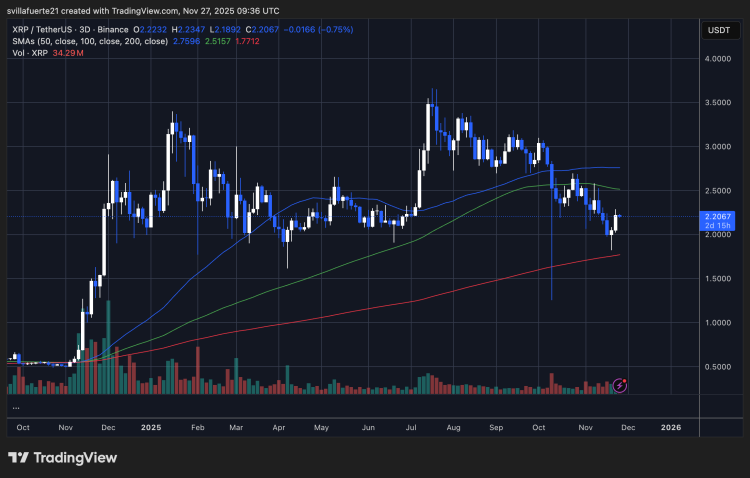
XRP testing key resistance | Source: XRPUSDT chart on TradingView

Despite the small rebound, XRP continues to trade well below the 50-day and 100-day moving averages, both of which are now sloping downward and reinforcing the broader bearish trend. The inability to reclaim the $2.40–$2.50 zone — an important previous support turned resistance — suggests that sellers still dominate the market structure. Volume also remains muted compared to earlier phases of the cycle, indicating that strong conviction buying has not yet returned.

The wick-down capitulation move seen earlier in the month reflects aggressive liquidation, followed by a rapid recovery. While this type of price action can sometimes precede short-term relief rallies, the overall pattern still leans bearish unless XRP can break above key moving averages.

Featured image from ChatGPT, chart from TradingView.com

Markedsmulighed
XRP Logo
XRP-kurs(XRP)
$1,4433
$1,4433$1,4433
+0,81%
USD
XRP (XRP) Live prisdiagram
Ansvarsfraskrivelse: Artiklerne på dette websted er hentet fra offentlige platforme og er kun til orientering. De afspejler ikke nødvendigvis MEXCs synspunkter. Alle rettigheder forbliver hos de oprindelige forfattere. Hvis du mener, at noget indhold krænker tredjeparts rettigheder, bedes du kontakte crypto.news@mexc.com for at få det fjernet. MEXC giver ingen garantier for indholdets nøjagtighed, fuldstændighed eller aktualitet og er ikke ansvarlig for handlinger foretaget på baggrund af de angivne oplysninger. Indholdet udgør ikke finansiel, juridisk eller anden professionel rådgivning og skal heller ikke opfattes som en anbefaling eller godkendelse fra MEXC.

Du kan måske også lide

American Bitcoin’s $5B Nasdaq Debut Puts Trump-Backed Miner in Crypto Spotlight

American Bitcoin’s $5B Nasdaq Debut Puts Trump-Backed Miner in Crypto Spotlight

The post American Bitcoin’s $5B Nasdaq Debut Puts Trump-Backed Miner in Crypto Spotlight appeared on BitcoinEthereumNews.com. Key Takeaways: American Bitcoin (ABTC) surged nearly 85% on its Nasdaq debut, briefly reaching a $5B valuation. The Trump family, alongside Hut 8 Mining, controls 98% of the newly merged crypto-mining entity. Eric Trump called Bitcoin “modern-day gold,” predicting it could reach $1 million per coin. American Bitcoin, a fast-rising crypto mining firm with strong political and institutional backing, has officially entered Wall Street. After merging with Gryphon Digital Mining, the company made its Nasdaq debut under the ticker ABTC, instantly drawing global attention to both its stock performance and its bold vision for Bitcoin’s future. Read More: Trump-Backed Crypto Firm Eyes Asia for Bold Bitcoin Expansion Nasdaq Debut: An Explosive First Day ABTC’s first day of trading proved as dramatic as expected. Shares surged almost 85% at the open, touching a peak of $14 before settling at lower levels by the close. That initial spike valued the company around $5 billion, positioning it as one of 2025’s most-watched listings. At the last session, ABTC has been trading at $7.28 per share, which is a small positive 2.97% per day. Although the price has decelerated since opening highs, analysts note that the company has been off to a strong start and early investor activity is a hard-to-find feat in a newly-launched crypto mining business. According to market watchers, the listing comes at a time of new momentum in the digital asset markets. With Bitcoin trading above $110,000 this quarter, American Bitcoin’s entry comes at a time when both institutional investors and retail traders are showing heightened interest in exposure to Bitcoin-linked equities. Ownership Structure: Trump Family and Hut 8 at the Helm Its management and ownership set up has increased the visibility of the company. The Trump family and the Canadian mining giant Hut 8 Mining jointly own 98 percent…
Dele
BitcoinEthereumNews2025/09/18 01:33
XRP Ledger Stablecoin Supply Jumps 100% Since December

XRP Ledger Stablecoin Supply Jumps 100% Since December

TLDR Stablecoin supply on the XRP Ledger reached $568 million after rising more than 100% since December 2025. The number of wallets holding less than 100 XRP climbed
Dele
Coincentral2026/03/24 00:43
Why The Green Bay Packers Must Take The Cleveland Browns Seriously — As Hard As That Might Be

Why The Green Bay Packers Must Take The Cleveland Browns Seriously — As Hard As That Might Be

The post Why The Green Bay Packers Must Take The Cleveland Browns Seriously — As Hard As That Might Be appeared on BitcoinEthereumNews.com. Jordan Love and the Green Bay Packers are off to a 2-0 start. Getty Images The Green Bay Packers are, once again, one of the NFL’s better teams. The Cleveland Browns are, once again, one of the league’s doormats. It’s why unbeaten Green Bay (2-0) is a 8-point favorite at winless Cleveland (0-2) Sunday according to betmgm.com. The money line is also Green Bay -500. Most expect this to be a Packers’ rout, and it very well could be. But Green Bay knows taking anyone in this league for granted can prove costly. “I think if you look at their roster, the paper, who they have on that team, what they can do, they got a lot of talent and things can turn around quickly for them,” Packers safety Xavier McKinney said. “We just got to kind of keep that in mind and know we not just walking into something and they just going to lay down. That’s not what they going to do.” The Browns certainly haven’t laid down on defense. Far from. Cleveland is allowing an NFL-best 191.5 yards per game. The Browns gave up 141 yards to Cincinnati in Week 1, including just seven in the second half, but still lost, 17-16. Cleveland has given up an NFL-best 45.5 rushing yards per game and just 2.1 rushing yards per attempt. “The biggest thing is our defensive line is much, much improved over last year and I think we’ve got back to our personality,” defensive coordinator Jim Schwartz said recently. “When we play our best, our D-line leads us there as our engine.” The Browns rank third in the league in passing defense, allowing just 146.0 yards per game. Cleveland has also gone 30 straight games without allowing a 300-yard passer, the longest active streak in the NFL.…
Dele
BitcoinEthereumNews2025/09/18 00:41
