Dirty Pirate Metrics helps tech founders measure true success beyond simple vanity metrics, but to track growth, retention, and sustainability for dev tools.Dirty Pirate Metrics helps tech founders measure true success beyond simple vanity metrics, but to track growth, retention, and sustainability for dev tools.

Dirty Pirate Metrics: How to Measure the Success of Your Open-Source Dev Tool

Tech founders who are venture-backed always have a dashboard with numbers they show to investors: sign-ups, MRR projections, growth charts that slope neatly upwards. These are useful, but deep down, they know those dashboards don’t actually tell them whether the tool and the company are headed in the right direction.

\ The truth is, most founders don’t know how to measure the real success of their product. That’s where Pirate Metrics, and more importantly, Dirty Pirate Metrics, come in.

Pirate Metrics: The Starting Point

The Pirate Metrics framework (AARRR: Acquisition, Activation, Retention, Revenue, Referral) was created by Dave McClure to help SaaS startups stop obsessing over vanity metrics (like impressions and likes) and focus on what actually drives growth.

\ It worked because it gave early-stage companies a new way to measure progress when the traditional marketing funnel didn’t fit. But if you’re building a developer tool that depends on GitHub stars, you’ll quickly see AARRR doesn’t go deep enough.

Enter Dirty Pirate Metrics

My former mentor, Stefan Verkerk (WeTransfer founding shareholder, angel investor), extended Pirate Metrics into something that founders can actually run their companies on. He broke down the funnel further so you could measure not just “users coming in and paying,” but also the stages where your product, your community, and your team determine whether you live or die.

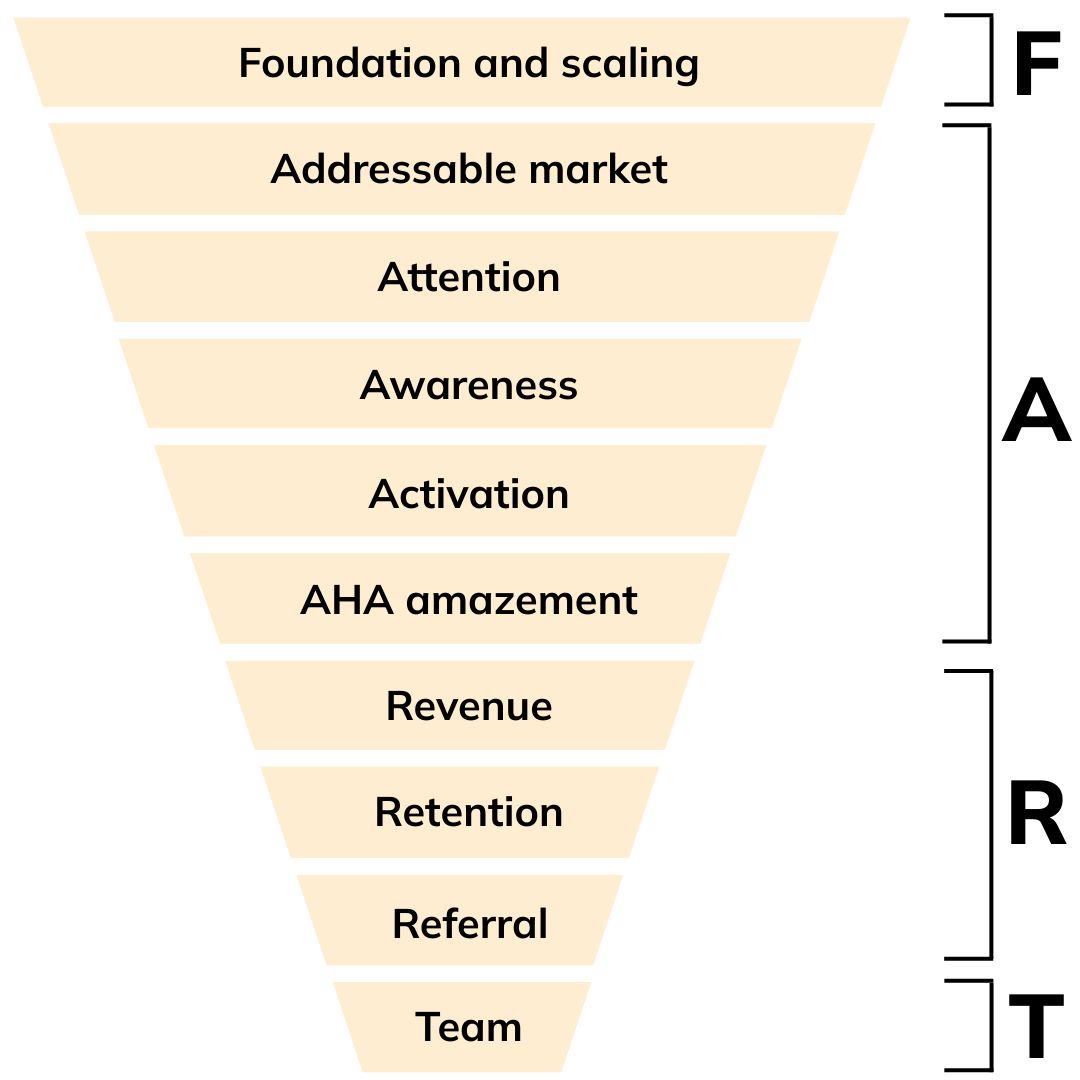
\ That framework is called Dirty Pirate Metrics (because the acronym is FAAAAARRRT).

\ The steps are:

  • Foundation & Scaling

  • Addressable Market

  • Attention

  • Awareness

  • Activation

  • AHA Amazement

  • Revenue

  • Retention

  • Referral

  • Team

\ It looks like a lot, but in reality, it gives you a much clearer picture of whether your product is actually healthy, or whether you’re just dressing up your numbers for pitch decks.

Why This Matters for Founders

Let’s be honest: investors love growth curves, but users don’t care about your MRR chart. Developers care about whether your tool works, solves their problem, and fits into their workflow. If you can’t measure those things, you’re essentially flying blind.

\

  • Foundation & Scaling forces you to ask: What are the limitations of my tool, how fast and how far it scales for users?
  • Addressable Market: Am I building in a space that’s actually worth it?
  • Attention & Awareness: Do devs even know I exist, and do they understand what I do?
  • Activation & AHA: Are they trying it, and do they actually love it?
  • Retention: Do they keep coming back, or do I churn users after one test run?
  • Revenue: What’s my actual sustainability path: sponsorships, enterprise licenses, grants?
  • Referral: Are my users doing my marketing for me?
  • Team: Do people want to build with me, or am I alone?

The Reality Check

If your current “metrics deck” is mostly GitHub stars, Discord sign-ups, and a hockey stick drawn in Excel, you’re not measuring success; you’re performing for investors.

\ Dirty Pirate Metrics forces you to get honest:

  • Where exactly are devs falling off?
  • Which part of the funnel is healthy, and which one is broken?
  • Is your company built on substance, or just good optics?

Where to Start?

Don’t overcomplicate it. Focus on what matters for your stage:

  • 0-1,000 users: Attention & Activation, getting devs to try your tool.
  • 1,000-10,000 users: Retention, making sure they stick around.
  • 10,000+ users: Revenue & Team, building sustainability and scaling your company.

\ The bottom line: Dirty Pirate Metrics gives you a way to measure the true health of your tool and your company. Investors might still get their pretty charts, but you’ll finally know whether what you’re building is real or just theater.

Market Opportunity
OpenLedger Logo
OpenLedger Price(OPEN)
$0.15826
$0.15826$0.15826
-11.41%
USD
OpenLedger (OPEN) Live Price Chart
Disclaimer: The articles reposted on this site are sourced from public platforms and are provided for informational purposes only. They do not necessarily reflect the views of MEXC. All rights remain with the original authors. If you believe any content infringes on third-party rights, please contact service@support.mexc.com for removal. MEXC makes no guarantees regarding the accuracy, completeness, or timeliness of the content and is not responsible for any actions taken based on the information provided. The content does not constitute financial, legal, or other professional advice, nor should it be considered a recommendation or endorsement by MEXC.

You May Also Like

The Stark Reality Of Post-Airdrop Market Dynamics

The Stark Reality Of Post-Airdrop Market Dynamics

The post The Stark Reality Of Post-Airdrop Market Dynamics appeared on BitcoinEthereumNews.com. Lighter Trading Volume Plummets: The Stark Reality Of Post-Airdrop
Share
BitcoinEthereumNews2026/01/19 13:16
Headwind Helps Best Wallet Token

Headwind Helps Best Wallet Token

The post Headwind Helps Best Wallet Token appeared on BitcoinEthereumNews.com. Google has announced the launch of a new open-source protocol called Agent Payments Protocol (AP2) in partnership with Coinbase, the Ethereum Foundation, and 60 other organizations. This allows AI agents to make payments on behalf of users using various methods such as real-time bank transfers, credit and debit cards, and, most importantly, stablecoins. Let’s explore in detail what this could mean for the broader cryptocurrency markets, and also highlight a presale crypto (Best Wallet Token) that could explode as a result of this development. Google’s Push for Stablecoins Agent Payments Protocol (AP2) uses digital contracts known as ‘Intent Mandates’ and ‘Verifiable Credentials’ to ensure that AI agents undertake only those payments authorized by the user. Mandates, by the way, are cryptographically signed, tamper-proof digital contracts that act as verifiable proof of a user’s instruction. For example, let’s say you instruct an AI agent to never spend more than $200 in a single transaction. This instruction is written into an Intent Mandate, which serves as a digital contract. Now, whenever the AI agent tries to make a payment, it must present this mandate as proof of authorization, which will then be verified via the AP2 protocol. Alongside this, Google has also launched the A2A x402 extension to accelerate support for the Web3 ecosystem. This production-ready solution enables agent-based crypto payments and will help reshape the growth of cryptocurrency integration within the AP2 protocol. Google’s inclusion of stablecoins in AP2 is a massive vote of confidence in dollar-pegged cryptocurrencies and a huge step toward making them a mainstream payment option. This widens stablecoin usage beyond trading and speculation, positioning them at the center of the consumption economy. The recent enactment of the GENIUS Act in the U.S. gives stablecoins more structure and legal support. Imagine paying for things like data crawls, per-task…
Share
BitcoinEthereumNews2025/09/18 01:27
Nasdaq Company Adds 7,500 BTC in Bold Treasury Move

Nasdaq Company Adds 7,500 BTC in Bold Treasury Move

The live-streaming and e-commerce company has struck a deal to acquire 7,500 BTC, instantly becoming one of the largest public […] The post Nasdaq Company Adds 7,500 BTC in Bold Treasury Move appeared first on Coindoo.
Share
Coindoo2025/09/18 02:15