In the meme market, where trading volatility requirements are extremely high and price sensitivity is extremely low, positioning yourself as a passive LP is an excellent strategy to maximize returns.In the meme market, where trading volatility requirements are extremely high and price sensitivity is extremely low, positioning yourself as a passive LP is an excellent strategy to maximize returns.

Another profit strategy in the Meme market is to increase returns by being a passive LP

2024/11/18 19:23
4 min read

Author: @jackmelnick_ , Head of DeFi at Berachain

Compiled by: Felix, PANews

I wrote a post about LP costs 8 months ago, which didn’t attract much attention at the time, but the number of views on the post tripled yesterday, so this article re-validates this method with the latest examples.

Prerequisite: In order for this method to work better, you need to deploy memecoin as early as possible, recognize that a certain memecoin has certain advantages in the medium and long term, and the trading volume must be large. The example in this article uses the BUCK token.

As mentioned in the previous post , you need to set a v3 range with the lower end of the range slightly lower than the current price of the token (usually about 25% lower) and the upper end of the range relatively high (about 100 BUCK/SOL or about $2.5/BUCK is chosen in this example). This setting minimizes the amount of SOL you have to deposit with LP, and as the price rises, DCA (Constant Amount Contribution) will gradually allow you to transfer from memecoin to SOL.

Let's talk about impermanent loss (IL): Here is @AbishekFi's statement:

IL is a tool, not a loss Measuring LP returns is a hot topic, but it really depends on your preference as an LP . Do you want asset A or asset B ? Or would you rather your position be worth more?

The only way this could happen is if one / both assets in your token pair appreciate in value, resulting in impermanent loss. However, if you LP on two assets you don’t mind holding , then you’ve just created an on-chain DCA that also generates fees .

As @shawmakesmagic mentioned, this could be a very valuable tool for token developers, especially for AI agents with ongoing costs. Providing v3 scoped liquidity for a token pair allows developers to use fees to profit/pay fees while participating in token appreciation. It will directly adjust value in the long term (depending on how the scope is set).

To prove that this approach is effective, let’s look at a simple BUCK example, which the author divides into initial reserves, ongoing impermanent loss, incurred expenses, and return on investment.

A BUCK/SOL LP was created yesterday, offering 17 SOL and 892,000 BUCK. The reason for this is that the Gamestop campaign has broad appeal, fast token rotation, and extremely high volatility and trading volume.

The range is set from an upper limit of 100 BUCK/SOL (about $2.5) to a lower limit of 8,500 BUCK/SOL (about $0.029), which is about 20% lower than the market price of about 6,900 BUCK/SOL, ensuring that the token pair will not fall out of the range if BUCK falls in the short term.

This represents a total value of approximately $4,000 in SOL and $30,000 in BUCK (relevant for calculating impermanent loss later).

After 10 hours the LP was extracted, which yielded:

  • 29.3 SOL and 156,000 BUCK (fees)
  • 25.1 SOL and 841,456 BUCK (LP)

$12,500 in fees in 10 hours on a $34,000 deposit is roughly 88% of the daily fees. This is an absolutely incredible number, even without compounding, the APY is 32,120%.

The impermanent loss in this case is a loss of about 50,000 BUCK tokens, which are replaced by an additional 8 SOL, which is negligible from the perspective of impermanent loss.

To make it clearer:

  • Deposit (Total) = 17 SOL and 892,000 BUCK
  • Withdrawal (Total) = 54.4 SOL and 997,000 BUCK
  • Total profit of LP = 37.4 SOL and 105,000 BUCK

It is clear that the impermanent loss generated by the pool is more than offset by the fees generated by the trading volume. This is optimized in token pairs that keep prices roughly consistent with extremely high trading volumes.
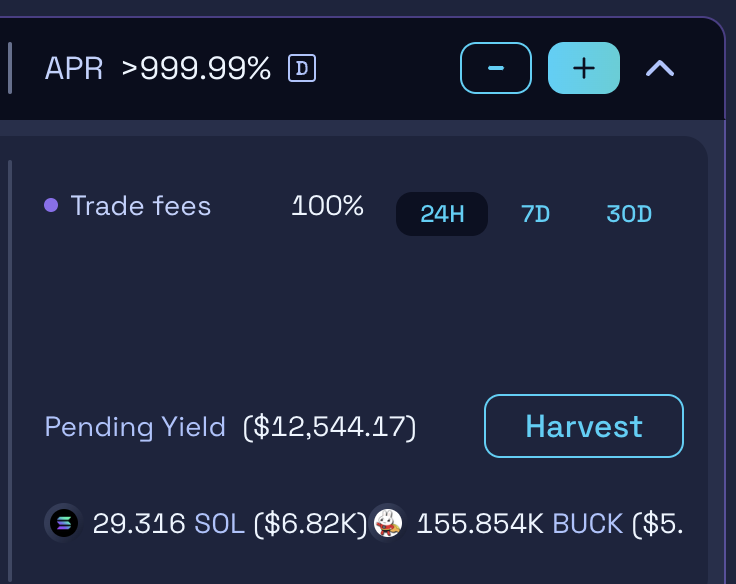
Another profit strategy in the Meme market is to increase returns by being a passive LP

Even crazier, this can be optimized further:

  • Adjusted LP fee tier from 1% to 2% due to deeper liquidity and higher trading volume
  • Tighten the upper limit of the initial range to further concentrate liquidity, and rebalance the range over time if prices rise
  • If you want to avoid a fall after the token has risen (no round trip trading), you can pull your LP and rebalance the lower limit of the range to 20% of the current floor price again, thereby pocketing your DCAed SOL.

In the meme market, where trading volatility is extremely high and price sensitivity is extremely low, positioning yourself as a passive LP is an excellent strategy to maximize returns, especially for token pairs with longer holding periods and larger trading volumes, and taking into account users who are not sure whether to hold SOL or meme.

Related reading: In-depth discussion of two DEX mechanisms: How to solve LP’s profit risk?

Market Opportunity
Memecoin Logo
Memecoin Price(MEME)
$0.0006156
$0.0006156$0.0006156
0.00%
USD
Memecoin (MEME) Live Price Chart
Disclaimer: The articles reposted on this site are sourced from public platforms and are provided for informational purposes only. They do not necessarily reflect the views of MEXC. All rights remain with the original authors. If you believe any content infringes on third-party rights, please contact crypto.news@mexc.com for removal. MEXC makes no guarantees regarding the accuracy, completeness, or timeliness of the content and is not responsible for any actions taken based on the information provided. The content does not constitute financial, legal, or other professional advice, nor should it be considered a recommendation or endorsement by MEXC.

You May Also Like

South Korea NTS Seed Phrase Leak: 4.8M$ PRTG Stolen

South Korea NTS Seed Phrase Leak: 4.8M$ PRTG Stolen

The post South Korea NTS Seed Phrase Leak: 4.8M$ PRTG Stolen appeared on BitcoinEthereumNews.com. South Korea NTS’s Crypto Wallet Security Blunder South Korea’s
Share
BitcoinEthereumNews2026/02/27 22:53
Why Is Crypto Crashing in 2026? Bitcoin ETFs Flip to Net Sellers While Smart Money Quietly Loads Pepeto at Six Zeros

Why Is Crypto Crashing in 2026? Bitcoin ETFs Flip to Net Sellers While Smart Money Quietly Loads Pepeto at Six Zeros

The answer to why crypto is crashing is hiding in plain sight. On the surface, Bitcoin ETFs just recorded two consecutive weeks of outflows totaling $1.7 billion
Share
Captainaltcoin2026/02/27 23:45
Whales Dump 200 Million XRP in Just 2 Weeks – Is XRP’s Price on the Verge of Collapse?

Whales Dump 200 Million XRP in Just 2 Weeks – Is XRP’s Price on the Verge of Collapse?

Whales offload 200 million XRP leaving market uncertainty behind. XRP faces potential collapse as whales drive major price shifts. Is XRP’s future in danger after massive sell-off by whales? XRP’s price has been under intense pressure recently as whales reportedly offloaded a staggering 200 million XRP over the past two weeks. This massive sell-off has raised alarms across the cryptocurrency community, as many wonder if the market is on the brink of collapse or just undergoing a temporary correction. According to crypto analyst Ali (@ali_charts), this surge in whale activity correlates directly with the price fluctuations seen in the past few weeks. XRP experienced a sharp spike in late July and early August, but the price quickly reversed as whales began to sell their holdings in large quantities. The increased volume during this period highlights the intensity of the sell-off, leaving many traders to question the future of XRP’s value. Whales have offloaded around 200 million $XRP in the last two weeks! pic.twitter.com/MiSQPpDwZM — Ali (@ali_charts) September 17, 2025 Also Read: Shiba Inu’s Price Is at a Tipping Point: Will It Break or Crash Soon? Can XRP Recover or Is a Bigger Decline Ahead? As the market absorbs the effects of the whale offload, technical indicators suggest that XRP may be facing a period of consolidation. The Relative Strength Index (RSI), currently sitting at 53.05, signals a neutral market stance, indicating that XRP could move in either direction. This leaves traders uncertain whether the XRP will break above its current resistance levels or continue to fall as more whales sell off their holdings. Source: Tradingview Additionally, the Bollinger Bands, suggest that XRP is nearing the upper limits of its range. This often points to a potential slowdown or pullback in price, further raising concerns about the future direction of the XRP. With the price currently around $3.02, many are questioning whether XRP can regain its footing or if it will continue to decline. The Aftermath of Whale Activity: Is XRP’s Future in Danger? Despite the large sell-off, XRP is not yet showing signs of total collapse. However, the market remains fragile, and the price is likely to remain volatile in the coming days. With whales continuing to influence price movements, many investors are watching closely to see if this trend will reverse or intensify. The coming weeks will be critical for determining whether XRP can stabilize or face further declines. The combination of whale offloading and technical indicators suggest that XRP’s price is at a crossroads. Traders and investors alike are waiting for clear signals to determine if the XRP will bounce back or continue its downward trajectory. Also Read: Metaplanet’s Bold Move: $15M U.S. Subsidiary to Supercharge Bitcoin Strategy The post Whales Dump 200 Million XRP in Just 2 Weeks – Is XRP’s Price on the Verge of Collapse? appeared first on 36Crypto.
Share
Coinstats2025/09/17 23:42