The crypto market fell sharply on February 28. After reports of rising tensions between the US-Israel and Iran. Market data shows the total crypto market value The crypto market fell sharply on February 28. After reports of rising tensions between the US-Israel and Iran. Market data shows the total crypto market value

Crypto Market Drops as US-Israel Iran Strike Reports Emerge

2026/02/28 15:41
3 min read

The crypto market fell sharply on February 28. After reports of rising tensions between the US-Israel and Iran. Market data shows the total crypto market value dropped. From 2.63% to $2.17 trillion within one hour. The sudden move erased recent gains. It pushed traders into risk off mode. Bitcoin slipped to around $65,683. While Ethereum fell harder to near $1,926. The sell-off came as investors reacted quickly to headlines. That suggests possible military escalation in the Middle East.

Geopolitical Tensions Spark Market Sell-Off

Market pressure increased after reports circulated about a joint US-Israel operation in Tehran. Israeli Channel 12 cited targeted strikes. It alleged assassination attempts on senior Iranian leadership. Reports say Iran Supreme Leader Ayatollah Ali Khamenei was moved to a secure location. There were also claims about activity near Iran’s presidential complex.

But many details remain unconfirmed and continue to evolve. But markets reacted fast. Crypto traders often treat geopolitical shocks as risk events. So capital quickly rotated out of volatile assets. Similar patterns appeared in early 2022. When the Russia and Ukraine conflict triggered double-digit crypto corrections.

Sharp Decline Hits Bitcoin and Ethereum

The market drop showed up clearly across major assets. Bitcoin fell about 3.17% during the move. While Ethereum dropped roughly 5.88%. Total crypto trading volume surged to around $175 billion as volatility spiked.
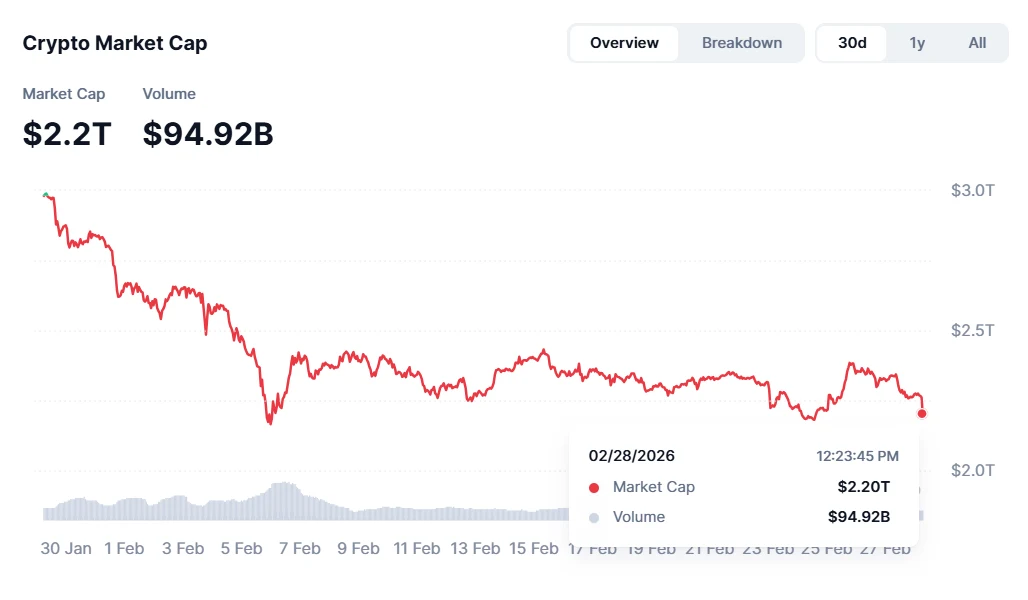
Crypto Market Cap on coinmarketcap on February 28, 2026

Chart: Crypto Market Cap on coinmarketcap on February 28, 2026
Meanwhile, derivatives data showed more than $80 million in long liquidations during the slide. That suggests many leveraged traders were caught off guard. Some traders even opened fresh BTC short positions. Immediately after headlines mentioning potential US strikes on Iran. At the same time, traditional safe haven assets strengthened. Gold ticked higher and the US dollar firmed. This shift reinforced the classic risk-off pattern seen during geopolitical stress.

Extreme Fear Returns to Crypto Market

Investor mood also worsened quickly. The Crypto Fear and Greed Index fell to 14. Which signals “Extreme Fear.” The index uses a 0-100 scale to measure market emotion. Lower readings often reflect panic selling and heavy uncertainty. On February 5, the index fell to its annual low of 5. Which earlier peaked in May 2025 at 76.

The wide swing shows how sensitive crypto sentiment remains to external shocks. Traders debated the next course of action on social media. Some speculated that if tensions rise, Bitcoin would retest the $45K–$50K level. Others argued that if the situation calms down, the dip can turn into a temporary overreaction.

Uncertainty Remains Despite Past Recoveries

Looking ahead the key driver will be US-Israel geopolitical clarity. Crypto markets historically react fast to global conflict headlines. But often stabilize once uncertainty fades. Still, the current environment remains fragile. Some analysts warned of a “perfect storm” if Middle East tensions rise. Alongside macro pressure and options expiry flows.

Prediction markets also showed rising odds tied to potential military escalation. Even so crypto has repeatedly recovered from shock events in the past. Much will depend on whether the situation de-escalates or worsens. Right now traders appear cautious. While volatility will likely stay elevated in the near term.

The post Crypto Market Drops as US-Israel Iran Strike Reports Emerge appeared first on Coinfomania.

Market Opportunity
StrikeBit AI Logo
StrikeBit AI Price(STRIKE)
$0.006258
$0.006258$0.006258
-0.12%
USD
StrikeBit AI (STRIKE) Live Price Chart
Disclaimer: The articles reposted on this site are sourced from public platforms and are provided for informational purposes only. They do not necessarily reflect the views of MEXC. All rights remain with the original authors. If you believe any content infringes on third-party rights, please contact crypto.news@mexc.com for removal. MEXC makes no guarantees regarding the accuracy, completeness, or timeliness of the content and is not responsible for any actions taken based on the information provided. The content does not constitute financial, legal, or other professional advice, nor should it be considered a recommendation or endorsement by MEXC.

You May Also Like

The Channel Factories We’ve Been Waiting For
The Channel Factories We’ve Been Waiting For

The post The Channel Factories We’ve Been Waiting For appeared on BitcoinEthereumNews.com. Visions of future technology are often prescient about the broad strokes while flubbing the details. The tablets in “2001: A Space Odyssey” do indeed look like iPads, but you never see the astronauts paying for subscriptions or wasting hours on Candy Crush.  Channel factories are one vision that arose early in the history of the Lightning Network to address some challenges that Lightning has faced from the beginning. Despite having grown to become Bitcoin’s most successful layer-2 scaling solution, with instant and low-fee payments, Lightning’s scale is limited by its reliance on payment channels. Although Lightning shifts most transactions off-chain, each payment channel still requires an on-chain transaction to open and (usually) another to close. As adoption grows, pressure on the blockchain grows with it. The need for a more scalable approach to managing channels is clear. Channel factories were supposed to meet this need, but where are they? In 2025, subnetworks are emerging that revive the impetus of channel factories with some new details that vastly increase their potential. They are natively interoperable with Lightning and achieve greater scale by allowing a group of participants to open a shared multisig UTXO and create multiple bilateral channels, which reduces the number of on-chain transactions and improves capital efficiency. Achieving greater scale by reducing complexity, Ark and Spark perform the same function as traditional channel factories with new designs and additional capabilities based on shared UTXOs.  Channel Factories 101 Channel factories have been around since the inception of Lightning. A factory is a multiparty contract where multiple users (not just two, as in a Dryja-Poon channel) cooperatively lock funds in a single multisig UTXO. They can open, close and update channels off-chain without updating the blockchain for each operation. Only when participants leave or the factory dissolves is an on-chain transaction…
Share
BitcoinEthereumNews2025/09/18 00:09
Top 5 Cryptocurrencies for Long-Term Investment in 2026: Expert Analysis

Top 5 Cryptocurrencies for Long-Term Investment in 2026: Expert Analysis

Discover the top 5 cryptocurrencies for long-term investment in 2026. Bitcoin, Ethereum, Solana, Chainlink, and Avalanche lead with institutional backing. The post
Share
Blockonomi2026/03/01 19:48
Tindig Pilipinas backs clergy’s complaint to fast-track Sara Duterte impeachment

Tindig Pilipinas backs clergy’s complaint to fast-track Sara Duterte impeachment

'Consolidating our support behind the third complaint will strengthen our position and help move the case forward to the Senate impeachment court,' Tindig Pilipinas
Share
Rappler2026/03/01 19:47