Interactive Brokers Statistics 2026: Record Growth
Interactive Brokers remains one of the rapidly expanding online brokerages in the financial industry as of today. The firm’s robust growth trajectory reflects surging client adoption, expanding global market access, and strong trading activity. In real-world finance, this impacts both individual day traders seeking low costs and institutions requiring deep liquidity. Hedge funds and registered advisors increasingly depend on IBKR’s execution tools for multi-asset strategies. Below, explore key statistics shaping Interactive Brokers’ performance profile.
Editor’s Choice
- 4.539 million client accounts as of February 1, 2026, up approximately 32% year over year.
- 4,411,000 daily average revenue trades (DARTs) reported in early 2026.
- Added over 1 million net new accounts in 2025, a record annual increase.
- Operates in 170 market centers globally.
- Offers trading in 29 currencies across markets.
Recent Developments
- On January 2, IBKR reported monthly metrics for late 2025.
- Clients averaged 19.2% return in 2025 vs S&P 17.9%.
- Monthly releases continue transparently through 2026.
- January DARTs hit 4.411 million, up 27% YoY.
- Client equity reached $814.3 billion, up 38% YoY.
- Accounts grew to 4.539 million, up 32% YoY.
- Margin loans at $91.2 billion, up 41% YoY.
- Reg-NMS average trade $21,785, 211 DARTs per account.
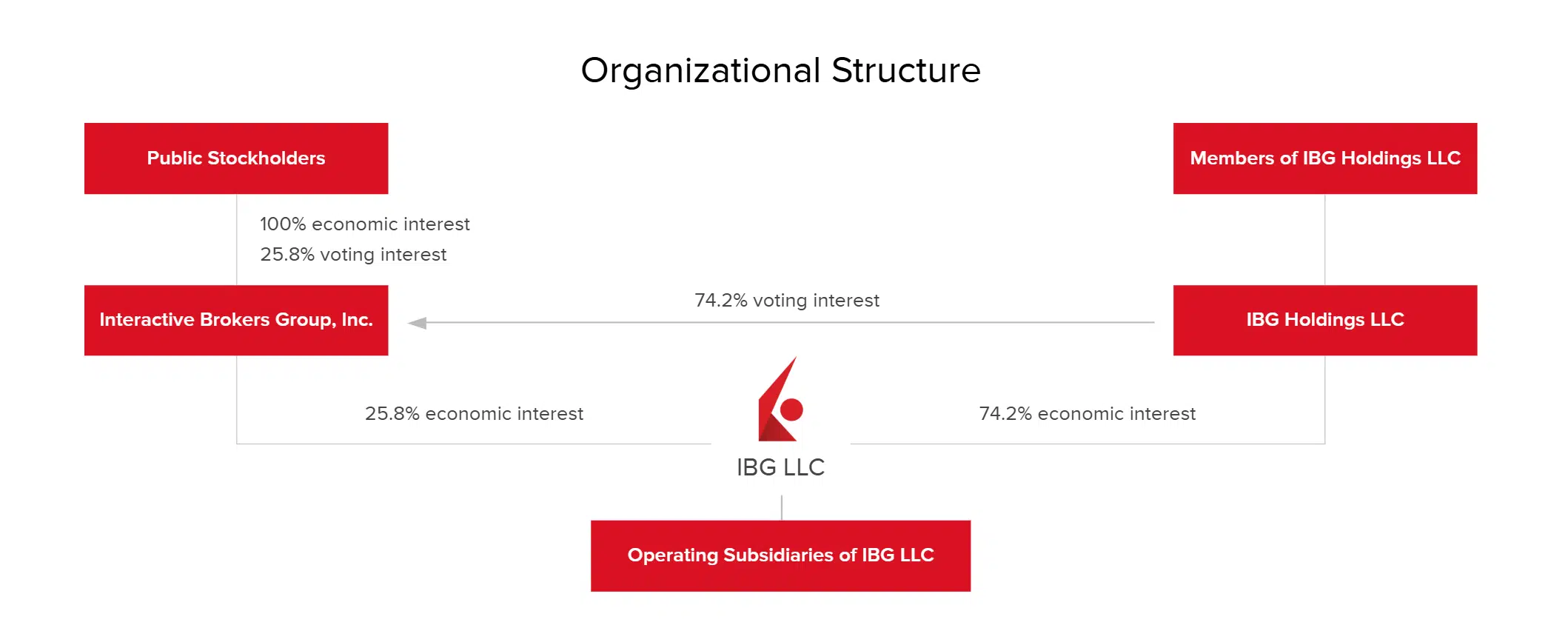
Interactive Brokers Organizational Structure
- Public stockholders own 100% economic interest in Interactive Brokers Group, Inc.
- Public stockholders hold only 25.8% voting power, meaning they have limited control over decisions
- IBG Holdings LLC controls the company with 74.2% voting interest in Interactive Brokers Group, Inc.
- Interactive Brokers Group, Inc. owns 25.8% economic interest in IBG LLC
- IBG Holdings LLC owns the remaining 74.2% economic interest in IBG LLC
- Both entities share ownership of IBG LLC, but IBG Holdings LLC holds the larger stake
- IBG LLC serves as the main operating entity of the business
- Operating subsidiaries run under IBG LLC, which manages day-to-day operations
- Members of IBG Holdings LLC ultimately maintain control of the overall corporate structure
 (Reference: Investing in the Web)
Overview of Interactive Brokers
- Founded in 1978, IBKR is an American multinational brokerage firm headquartered in Greenwich, Connecticut.
- It offers direct market access to stocks, options, futures, forex, bonds, and funds.
- The platform serves clients in over 170 global market centers.
- Clients can trade in 29 different currencies.
- Monthly brokerage metrics reporting reflects ongoing transparency.
- IBKR has operations in 40+ countries with extensive global market coverage.
- The firm had excess regulatory capital of $13.3 billion, supporting stability.
Client Equity and Assets Under Management
- Client equity reached $814.3 billion in January, up 38% YoY.
- Client equity rose 4% from December’s $779.9 billion.
- Client credit balances hit $162.6 billion, up 35% YoY.
- Insured bank sweeps totaled $6.2 billion in January.
- Client accounts grew to 4.539 million, up 32% YoY.
- Added over 1 million net new accounts in 2025.
- Client equity surged 37% to $780 billion by the end of 2025.
- AUM reported as $628.2 billion as of May 2025.
- Excess SIPC coverage up to $150 million per client.
- 18% of client money is in protected custody accounts.
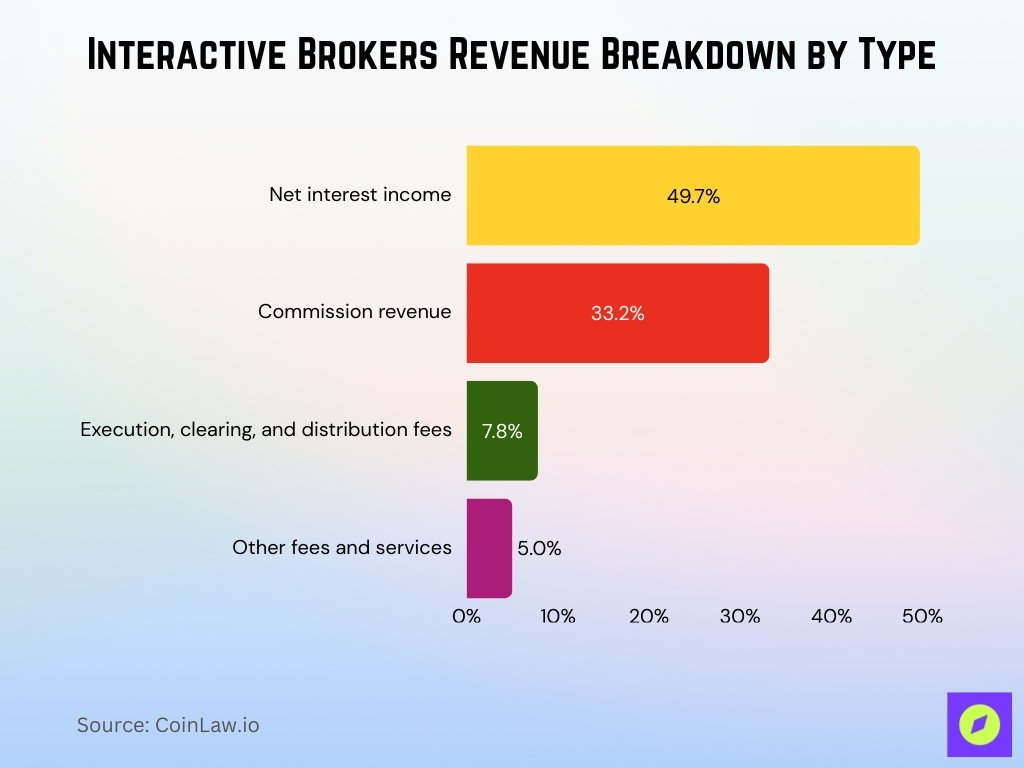
Interactive Brokers Revenue Breakdown by Type
- Net interest income generates the largest share at 49.7% of total revenue
- Commission revenue contributes a significant 33.2% to overall earnings
- Execution, clearing, and distribution fees account for 7.8% of revenue
- Other fees and services make up 5.0% of total income
- Interest-related income and commissions together produce over 80% of the company’s revenue
- Fee-based and miscellaneous sources contribute less than 20% combined
- The revenue mix shows strong reliance on interest income and trading activity
 (Reference: Investing in the Web)
Trading Volume by Asset Class
- 4.411 million DARTs in January, up 27% YoY and 30% MoM.
- Stocks: 899 shares average per cleared order.
- Equity options: 6.7 contracts average per cleared order.
- Futures: 2.9 contracts average per cleared order.
- 211 annualized DARTs per client account.
- Stocks trading volume is up 65% in the recent cycle.
- Options trading up 32% YoY.
- Q4 2025 commissions $582 million, up 22%.
- Average commission per order is $2.62.
Commission Revenue and Fee Income
- FY 2025 total net revenues $6.205 billion, up 20% YoY.
- FY 2025 commission revenue $2.1 billion, up 27% YoY.
- Q4 2025 commission revenue $582 million, up 22% YoY.
- Q4 net interest income $966 million, up 20% YoY.
- FY net interest income $3.6 billion, record high.
- The average commission per order was $2.85 in 2025.
- Options commissions 60% of total commission revenue.
- Stocks 28%, futures 12% of commission revenue.
- Other fees exceeded $500 million in 2025.
Geographic Distribution of Clients
- 70% accounts are from North America, and the U.S. is dominant.
- Europe 20% of client accounts, UK/EU growth.
- Asia-Pacific 10% accounts, and Hong Kong/Singapore are rising.
- Clients in 200+ countries and territories.
- Regulated subsidiaries in 9 countries worldwide.
- International new accounts outpaced U.S. growth in 2025.
- 170+ global exchanges accessible cross-border.
- Multilingual support spans major world markets.
Net Interest Income and Margin Loans
- FY 2025 net interest income $3.563 billion, up 13% YoY.
- Q4 2025 net interest income $966 million, up 20% YoY.
- Customer margin loans $90.2 billion end-Q4, up 40% YoY.
- Average customer margin loans $55 billion by late 2025.
- Customer credit balances were $162.6 billion in January.
- Customer margin loans yield 4.39% Q4 2025.
- Net interest margin 2.02% Q4 2025.
- USD cash up to 4.83% APY in the early year.
- Net interest 60% of total net revenue in 2025.
Profit Margins and Financial Ratios
- FY 2025 net income is $3.373 billion for IBG LLC.
- FY 2025 net income available to common $984 million.
- Q4 pretax profit margin 79% reported and adjusted.
- FY diluted EPS $2.26 available to common.
- Q4 diluted EPS $0.63 reported, $0.65 adjusted.
- Total equity capital is $20.5 billion at year-end.
- Excess regulatory capital buffer over $13 billion.
- ROE approximately 20% in 2025.
- Quarterly dividends totaled $1.00 per share in 2025.
Platform Usage and Trading Activity
- Options 60% of total commission revenue.
- Equity trades 28% of commissionable volume.
- Mobile/tablet 65% retail login sessions.
- 4.411 million DARTs in the early year, up 27% YoY.
- Client accounts were 4.539 million in February.
- Client equity exceeded $814 billion as of January end.
- GlobalTrader app covers 90+ markets.
- Margin balances averaged $55 billion in 2025.
- Crypto volumes up modestly with expanded offerings.
Average Account Size and Client Profile
- 4.539 million client accounts as of February 1.
- Client equity of $814.3 billion yields an average of $179,500 per account.
- 211 annualized DARTs per client account.
- Average account size ~$183,400 as of September 2025.
- International accounts over 30% of the total.
- Mobile trading adoption exceeded 65% active retail.
- RIAs custody billions via Advisor platform.
- Hedge funds contribute disproportionately to volume.
- Over 200 introducing broker relationships globally.
Execution Quality and Order Routing Metrics
- Publishes monthly Rule 605 execution reports covering 26.10 million orders and $568,594 billion traded value.
- Average trade size $21,785 with net expense 0.019% of trade value.
- Servers process orders in about 5–6 milliseconds plus roughly 30 ms transatlantic latency.
- Independent tests show most trades are filled in under 40 ms.
- U.S. equity orders see price improvement over $30 per 1,000 shares on average.
- Over 90% of U.S. equity market orders receive price improvement or execute at NBBO.
- SmartRouting scans 170+ market destinations to optimize execution.
- Payment for order flow is limited versus retail peers, focusing on price over rebates.
Client Performance vs Market Benchmarks
- IBKR serves over 4 million clients with $750+ billion assets.
- Clients can earn up to 3.14% on uninvested cash balances.
- Margin rates as low as 4.14%, up to 55% below the industry average.
- Over 50% of client assets are in international securities, enhancing diversification.
Risk Management and Capital Metrics
- Equity capital $20.5 billion with excess regulatory capital $13.3 billion.
- Excess regulatory capital reached $13.7 billion across subsidiaries in Q3 2025.
- 99.2% of total assets are classified as liquid on the balance sheet.
- Market capitalization was about $25.7 billion in September 2025.
- SIPC covers $500,000 per client, including $250,000 cash.
- Excess SIPC adds $30 million per account up to $150 million aggregate.
- Client equity $814.3 billion held in segregated accounts.
- Regulated under the SEC, FINRA, FCA, MAS, and others.
- Long-term debt is minimal relative to the $20.5 billion equity base.
Industry Rankings and Market Share
- IBKR added 1.06 million net new accounts in 2025, up 32% YoY.
- Client equity rose 37% to $779.9 billion, signaling share gains.
- Q4 2025 processed 4.04 million daily transactions, up 30% YoY.
- Operating margins near 70%, among industry leaders.
- Ranked #1 “Best Online Broker” for active traders by BrokerChooser.
- Serves clients in 200+ countries via a global platform.
Frequently Asked Questions (FAQs)
The brokerage recorded 4.411 million DARTs in January 2026.
Client equity reached approximately $814.3 billion, up 38% year-over-year.
Client margin loan balances increased roughly 41% year-over-year to about $91.2 billion.
Interactive Brokers provides access to 170 market centers and supports trading in 29 currencies.
Conclusion
Interactive Brokers continues to strengthen its position as a global electronic trading leader today. Account growth, rising client equity, and elevated trading volumes signal sustained demand across retail and institutional segments. Moreover, strong net interest income and industry-leading margins reinforce financial resilience.
For U.S. investors, hedge funds, and registered advisors alike, the data points to a brokerage platform built on efficiency, technology, and global access. As market volatility persists and cross-border investing expands, Interactive Brokers’ statistical profile suggests it will remain a dominant force in active trading markets.
The post Interactive Brokers Statistics 2026: Record Growth appeared first on CoinLaw.
You May Also Like

The Manchester City Donnarumma Doubters Have Missed Something Huge