Embedded Insurance Industry Statistics 2026: Hidden Opportunities
Imagine a world where your car, smartphone, or even a fitness app could offer you tailored insurance coverage the moment you need it. Embedded insurance is transforming this vision into reality. By seamlessly integrating insurance options within products and services, this industry is rewriting the rules on how consumers buy, use, and benefit from insurance.
Today, embedded insurance isn’t just a trend; it’s a booming market with remarkable growth potential. This article explores the embedded insurance industry’s pivotal statistics and trends, shedding light on why it’s becoming a central element in today’s digital-first economy.
Editor’s Choice
- Embedded insurance premiums could exceed $70 billion globally by 2030, driven by growth in e-commerce, digital banking, and on-demand services.
- Embedded insurance could represent up to 15% of all insurance distribution this year, particularly as digital platforms scale globally.
- About 70% of consumers prefer embedded insurance when integrated into digital platforms.
- Over 74% of embedded premiums now flow through online API channels.
- Around 60% of insurers plan to invest in embedded solutions this year.
- InsurTech investments are expected to exceed $1 billion over the next 12 months.
Recent Developments
- Policy-as-a-Service (PaaS) platforms are expanding rapidly with a projected 11% annual growth as insurers increasingly embed customizable policy modules.
- Digital claims processing automation has cut claims settlement time by around 50%, leading the way in customer experience improvements.
- Dynamic pricing models based on user behavior, especially via telematics, have led to premium reductions of up to 25% in auto and health embedded insurance.
- Partnerships with e-commerce platforms deliver 72% market share in distribution, notably boosting device and returns coverage.
- Micro-insurance designed for short-term needs has grown by 7.4%, especially in travel and gadget sectors.
- Regulatory frameworks in key regions have become more robust, with updated guidelines boosting transparency and data protection in embedded insurance.
Embedded Insurance Market Growth Forecast
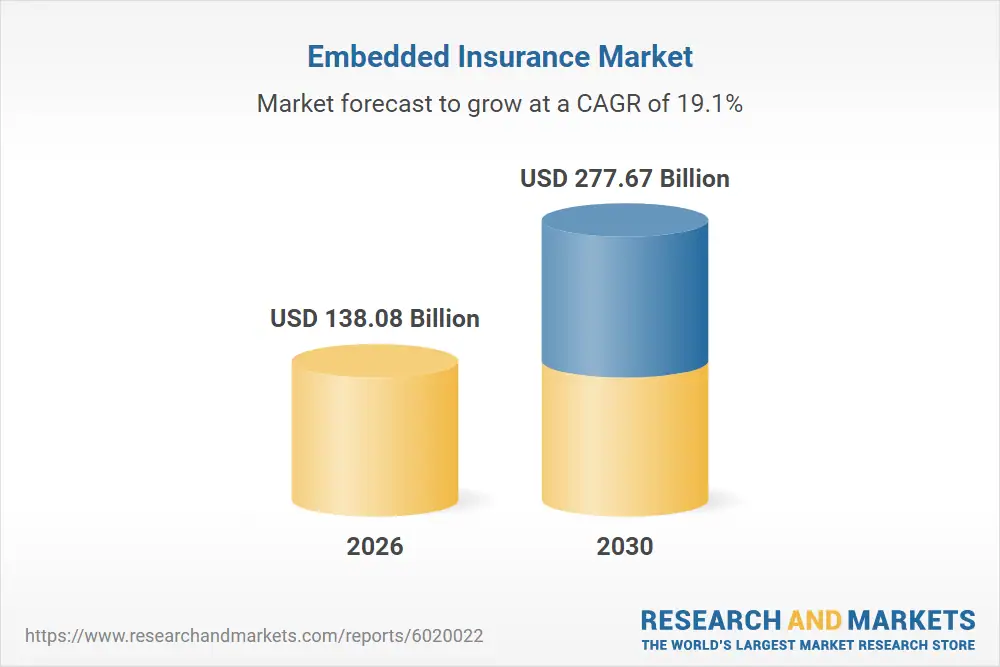
- The embedded insurance market will grow at a strong 19.1% CAGR over the forecast period.
- The market size will reach about $138.08 billion in 2026.
- It is expected to almost double to $277.67 billion by 2030.
- This sharp rise shows strong demand for insurance built into digital products and services.
- Businesses are rapidly adding insurance options at the point of sale to boost revenue.
- Consumers prefer fast, simple coverage without separate applications.
- The growth trend signals a major shift toward seamless, on-demand insurance.
 (Reference: Research and Markets)
Embedded Insurance Industry Segmentation
- The automotive sector represents around 30% of the market this year, with strong growth in embedded auto policies.
- Healthcare holds approximately 15%, driven by digital health and wearable integration.
- Retail and e-commerce are leading sectors for embedded insurance, contributing over 52% of distribution in some markets, though the exact global share may vary by methodology.
- Travel and tourism embedded insurance makes up around 11% of the market and continues to grow rapidly.
- Banking and fintech contribute roughly 8% as digital banks expand their insurance offerings.
- Real estate and home services represent around 5%, with growing adoption via property platforms.
- Technology and devices lead with 43% of embedded insurance revenues, fueled by demand for electronics protection.
Why Consumers Choose Embedded Insurance
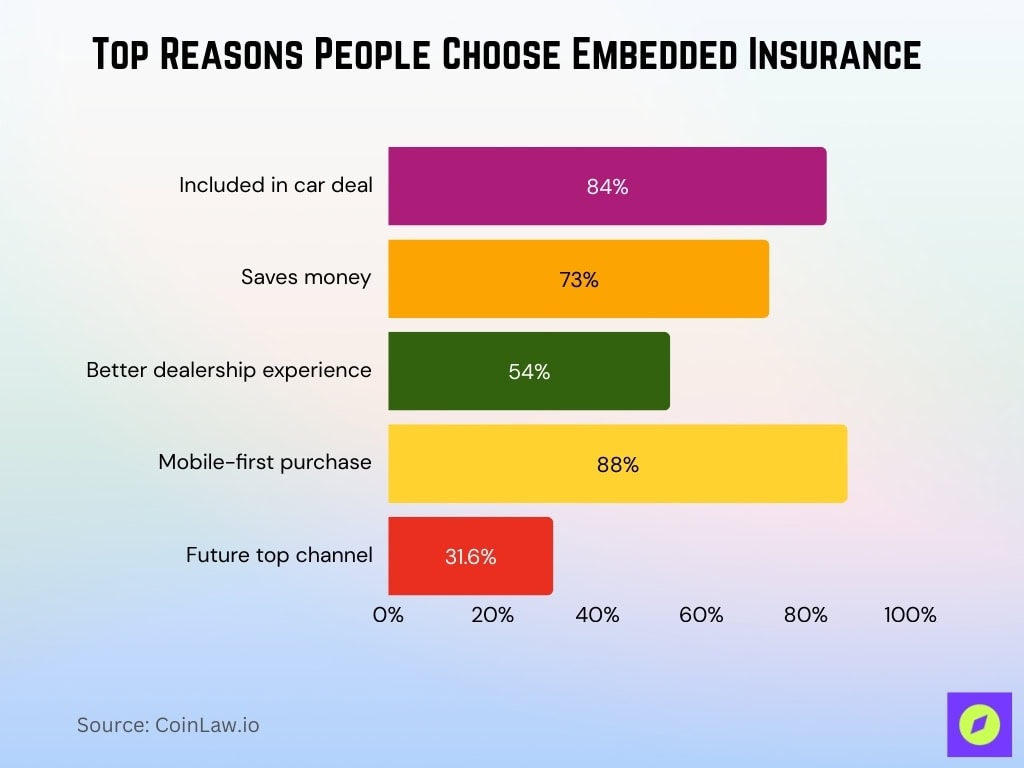
- 88% of Millennials and Gen Z prefer to compare and buy insurance on their phones, showing strong demand for mobile-first options.
- 84% of young buyers want insurance included in the car deal, making it a key part of the purchase process.
- 73% of buyers will add extra protection if it saves money on insurance costs.
- 54% of consumers say they have a better experience when insurance is offered at the dealership.
- 31.6% of insurance professionals believe embedded insurance will become the top future sales channel for personal policies.
 (Reference: Polly, Insurance Business)
Technological Advancements and InsurTech Integration
- Over 75% of embedded insurance providers now use AI to improve underwriting and personalized policy recommendations.
- Adoption of IoT-powered embedded insurance is growing rapidly, with use cases in health and auto segments contributing to growth rates nearing 35% year-over-year.
- Approximately 88% of embedded insurance products now run on API integrations for real-time offers.
- Approximately 22% of insurers are experimenting with blockchain to enhance transparency and automation in claims processing, particularly within embedded insurance frameworks.
- Predictive analytics and machine learning are credited with reducing fraud by up to 20% in pilot programs, particularly in auto and health embedded insurance.
- Over 78% of insurers use cloud platforms to scale embedded products, improving speed, flexibility, and security.
Leading Players in the Embedded Insurance Market
- Cover Genius holds around 16% of the embedded insurance market share.
- Penn Io accounts for approximately 15%, closely following Cover Genius.
- Fletch captures an estimated 14% market share.
- Lemonade represents about 11% of the total market.
- FetchaQuote holds a smaller slice at 10%.
Geographical Insights and Regional Analysis
- North America holds approximately 36% of the market this year and remains the leading contributor.
- Europe accounts for around 26% of global embedded insurance revenues, supported by regulatory adoption.
- Asia-Pacific is the fastest-growing region, driven by digital expansion in countries like China and India.
- Latin America holds about 8% of the market, with strong growth in Brazil and Mexico due to rising digital inclusion.
- Middle East and Africa show accelerating adoption with projected growth above 22% CAGR through 2027.
- Australia and New Zealand contribute a small but growing share, especially in travel and health insurance.
Embedded Insurance by Policy Type (Share Breakdown)
- Motor insurance leads with the largest share at 29%, making it the top category in embedded policies.
- Life insurance follows at 23%, showing strong demand for digitally integrated life cover.
- Both Health and Household insurance represent 15% each of the embedded market.
- Travel insurance accounts for 12%, reflecting growth in online booking integrations.
- Pet insurance makes up 5%, indicating a niche but growing segment.
Customer Acquisition and Engagement Trends
- Approximately 74% of consumers are more likely to buy insurance if it’s embedded into their main purchase journey.
- AI-powered personalization tools can improve customer engagement by up to 42%, according to user experience studies in digital insurance ecosystems.
- Subscription-based embedded insurance models represent a growing portion of digital insurance, especially in health tech and device protection, with some sources estimating up to 27% adoption in key verticals.
- Simplified, one-click claims systems deliver a 22% boost in customer satisfaction, with 47% of embedded policies using digital-first claims.
- Over 62% of embedded insurance purchases are completed on mobile devices, underscoring the need for mobile-first experiences.
Frequently Asked Questions (FAQs)
Embedded property and casualty insurance could generate up to $722 billion in gross written premiums by 2030.
Overall, embedded insurance gross written premiums are projected to exceed $70 billion by 2030.
Embedded insurance is forecast to reach between $277.67 billion and $2.07 trillion by 2030–2035, depending on methodology and scope.
Conclusion
Embedded insurance has evolved from a niche concept to a dynamic industry reshaping the insurance landscape. By making coverage accessible at the point of purchase, this model addresses consumer demands for convenience, personalization, and seamless experiences. The market is set to grow exponentially, driven by technological advancements, strategic partnerships, and expanding global reach.
As embedded insurance continues to flourish, it offers a promising pathway for businesses across sectors to enhance customer value, improve engagement, and innovate the traditional insurance model. The future of embedded insurance looks bright, with more industries and consumers set to benefit from its transformative potential.
The post Embedded Insurance Industry Statistics 2026: Hidden Opportunities appeared first on CoinLaw.
You May Also Like

The Manchester City Donnarumma Doubters Have Missed Something Huge