

Google Executive Positions Company's Blockchain Against Stripe, Circle Rivals

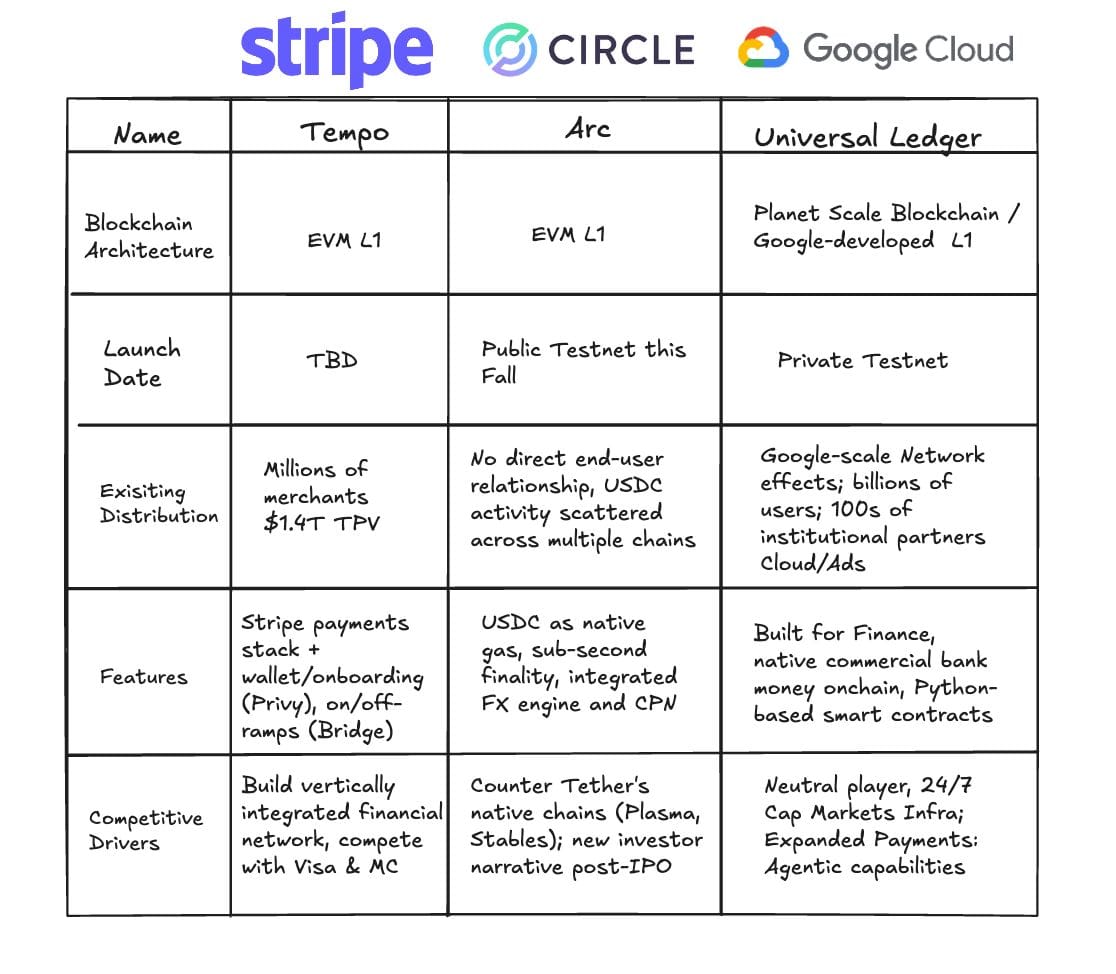
A Google exec has disclosed new details about its proprietary blockchain platform designed for financial institutions, positioning the Google Cloud Universal Ledger (GCUL) as a neutral alternative to competing corporate blockchains from Stripe and Circle.
Rich Widmann, Google's head of strategy for Web3, said Monday in a LinkedIn post that GCUL incorporates years of company research and development to provide financial institutions with a "performant, credibly neutral" Layer 1 blockchain featuring Python-based smart contracts.
 Rich Widmann (LinkedIn)
The platform currently operates on a private testnet and has been piloted with CME Group, one of the world's largest derivatives exchanges, for tokenization and payments applications. Google and CME completed initial integration testing in March, with plans to begin direct testing with market participants later this year and launch services in 2026.
Widmann emphasized GCUL's positioning as neutral infrastructure that any financial institution can utilize, contrasting it with blockchain platforms developed by payment companies that may face adoption barriers from competitors. He noted that "Tether won't use Circle's blockchain - and Adyen probably won't use Stripe's blockchain. But any financial institution can build with GCUL."
The blockchain is designed to simplify account and asset management while facilitating transfers on a private, permissioned network. Widmann characterized GCUL as built specifically for finance with "native commercial bank money on-chain" capabilities and 24/7 capital markets infrastructure.
Technical architecture details remain limited, though he described GCUL as a "planet scale" blockchain leveraging the company's global infrastructure. The platform's Python-based smart contract capability differentiates it from most blockchain networks that primarily use Solidity or other specialized programming languages.
Google plans to leverage its existing distribution network of billions of users and hundreds of institutional partners to scale GCUL adoption. Widmann indicated that Google will release additional technical specifications in coming months as development progresses.


You May Also Like
PBOC Sets USD/CNY Reference Rate at 6.8487, Slightly Lower Than Previous Fixing

Crypto Fraud Shockwave: Authorities Freeze Tens Of Millions In Assets




