Gold pushing above $5,600 per ounce feels dramatic, especially with social media packed with crash narratives. But the chart shared by analyst Reflection tells Gold pushing above $5,600 per ounce feels dramatic, especially with social media packed with crash narratives. But the chart shared by analyst Reflection tells

Gold at $5,600 Doesn’t Mean a Crash Is Coming—History Says the Opposite

3 min read

Gold pushing above $5,600 per ounce feels dramatic, especially with social media packed with crash narratives. But the chart shared by analyst Reflection tells a much less emotional story, and a far more consistent one.

The key point in Reflection’s analysis is timing. Gold does not lead market crashes. It follows them.

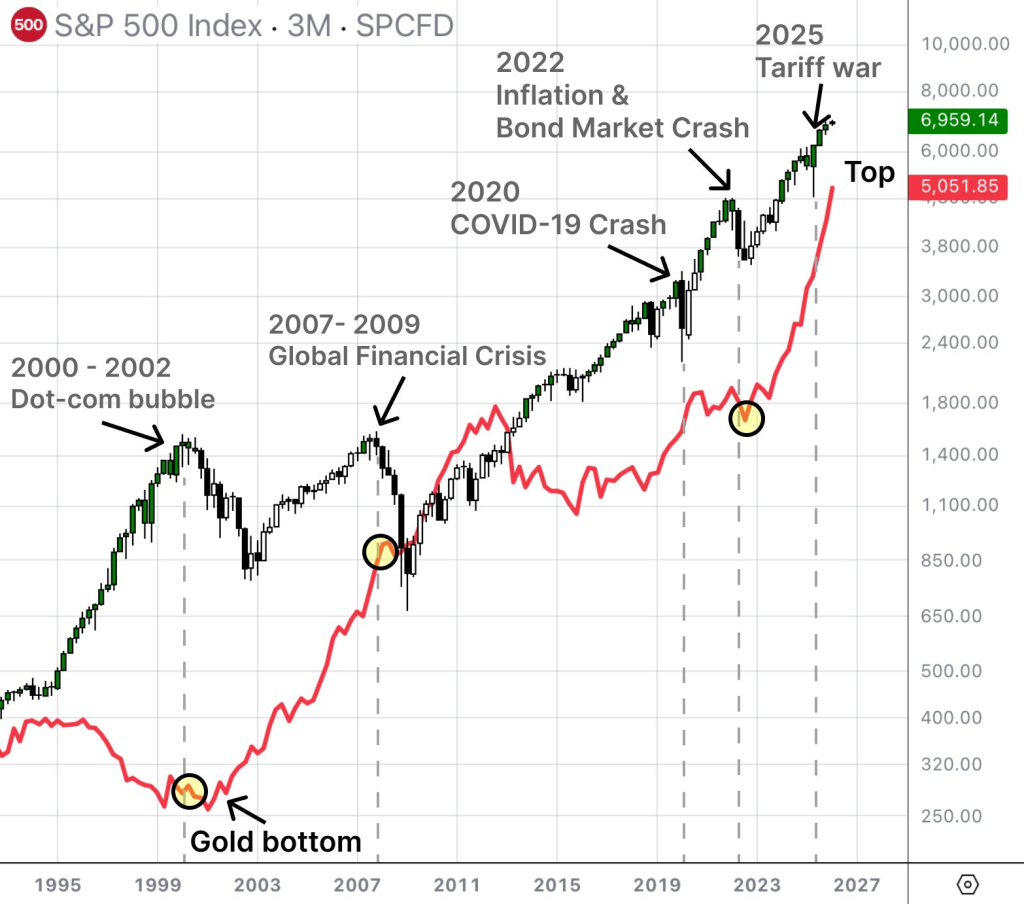
Looking at the S&P 500 plotted against gold across multiple cycles, the same structure repeats.

During the dot-com bubble (2000–2002), equities peaked first. The S&P 500 lost roughly 50%, while gold barely moved at the start. Only after stocks had already collapsed did gold begin its multi-year advance. The gold rally was a reaction to damage already done, not a warning signal.

The same pattern appears in the 2007–2009 Global Financial Crisis. Equities rolled over, credit broke, and fear entered the system. Gold rose during the crisis, but the larger move came after the bottom, once investors were traumatized and avoided risk. That post-crisis gold trade turned into a trap: from 2009 to 2019, gold went sideways while equities compounded aggressively.
Source: X/@0xReflection

Reflection highlights this clearly on the chart. The red gold line keeps rising long after the crash marker, while equities quietly rebuild and then outperform.

The COVID-19 crash follows the same logic. Gold dipped slightly during the initial liquidation. The real move higher came only after markets had already collapsed and panic had set in. Again, gold responded to fear—it didn’t predict it.

Why Today Looks Similar to Post-2009, Not Pre-Crash

Right now, gold is moving while equities are still holding up. That matters.

The chart labels this phase clearly: after crises, not before them, capital rotates into gold as a psychological hedge. Investors remember pain and choose safety—even when risk assets are already recovering.

That’s exactly what Reflection is warning about.

The current environment is saturated with fear narratives:
U.S. debt headlines, deficit panic, AI bubble talk, tariff wars, geopolitical noise. Gold benefits from that mood. But historically, this mood tends to appear after crashes, not right before them.

On the chart, every time gold became a consensus safety trade without an actual equity collapse, it underperformed for years afterward.

Read also: Robert Kiyosaki Admits Regret Over Bitcoin and Gold as Silver Becomes His Safety Net

The Core Risk Reflection Is Pointing Out

The danger isn’t owning gold. The danger is crowding.

When gold becomes the default response to headlines instead of actual market damage, capital gets parked in an asset that can range for a decade. That happened after 2011. It took almost ten years for gold buyers to see real gains again, while stocks and risk assets compounded relentlessly.

Reflection’s chart doesn’t argue that gold must crash from $5,600. It argues something more uncomfortable:
gold rising does not automatically mean a broader market collapse is coming.

In fact, history suggests the opposite.

Subscribe to our YouTube channel for daily crypto updates, market insights, and expert analysis.

The post Gold at $5,600 Doesn’t Mean a Crash Is Coming—History Says the Opposite appeared first on CaptainAltcoin.


Disclaimer: The articles reposted on this site are sourced from public platforms and are provided for informational purposes only. They do not necessarily reflect the views of MEXC. All rights remain with the original authors. If you believe any content infringes on third-party rights, please contact service@support.mexc.com for removal. MEXC makes no guarantees regarding the accuracy, completeness, or timeliness of the content and is not responsible for any actions taken based on the information provided. The content does not constitute financial, legal, or other professional advice, nor should it be considered a recommendation or endorsement by MEXC.

You May Also Like

Solana Hits $4B in Corporate Treasuries as Companies Boost Reserves

Solana Hits $4B in Corporate Treasuries as Companies Boost Reserves

TLDR Solana-based corporate treasuries have surpassed $4 billion in value. These reserves account for nearly 3% of Solana’s total circulating supply. Forward Industries is the largest holder with over 6.8 million SOL tokens. Helius Medical Technologies launched a $500 million Solana treasury reserve. Pantera Capital has a $1.1 billion position in Solana, emphasizing its potential. [...] The post Solana Hits $4B in Corporate Treasuries as Companies Boost Reserves appeared first on CoinCentral.
Share
Coincentral2025/09/18 04:08
SHIB Price Prediction: Mixed Signals Point to $0.0000085 Target by February End

SHIB Price Prediction: Mixed Signals Point to $0.0000085 Target by February End

Technical analysis reveals SHIB trading near oversold levels with RSI at 35.06. Despite bearish MACD momentum, support levels suggest potential recovery toward $
Share
BlockChain News2026/02/04 16:04
CEO Sandeep Nailwal Shared Highlights About RWA on Polygon

CEO Sandeep Nailwal Shared Highlights About RWA on Polygon

The post CEO Sandeep Nailwal Shared Highlights About RWA on Polygon appeared on BitcoinEthereumNews.com. Polygon CEO Sandeep Nailwal highlighted Polygon’s lead in global bonds, Spiko US T-Bill, and Spiko Euro T-Bill. Polygon published an X post to share that its roadmap to GigaGas was still scaling. Sentiments around POL price were last seen to be bearish. Polygon CEO Sandeep Nailwal shared key pointers from the Dune and RWA.xyz report. These pertain to highlights about RWA on Polygon. Simultaneously, Polygon underlined its roadmap towards GigaGas. Sentiments around POL price were last seen fumbling under bearish emotions. Polygon CEO Sandeep Nailwal on Polygon RWA CEO Sandeep Nailwal highlighted three key points from the Dune and RWA.xyz report. The Chief Executive of Polygon maintained that Polygon PoS was hosting RWA TVL worth $1.13 billion across 269 assets plus 2,900 holders. Nailwal confirmed from the report that RWA was happening on Polygon. The Dune and https://t.co/W6WSFlHoQF report on RWA is out and it shows that RWA is happening on Polygon. Here are a few highlights: – Leading in Global Bonds: Polygon holds 62% share of tokenized global bonds (driven by Spiko’s euro MMF and Cashlink euro issues) – Spiko U.S.… — Sandeep | CEO, Polygon Foundation (※,※) (@sandeepnailwal) September 17, 2025 The X post published by Polygon CEO Sandeep Nailwal underlined that the ecosystem was leading in global bonds by holding a 62% share of tokenized global bonds. He further highlighted that Polygon was leading with Spiko US T-Bill at approximately 29% share of TVL along with Ethereum, adding that the ecosystem had more than 50% share in the number of holders. Finally, Sandeep highlighted from the report that there was a strong adoption for Spiko Euro T-Bill with 38% share of TVL. He added that 68% of returns were on Polygon across all the chains. Polygon Roadmap to GigaGas In a different update from Polygon, the community…
Share
BitcoinEthereumNews2025/09/18 01:10