Italy’s Consob Fines Fabrizio Corona €200K Over Illegal $CORONA Memecoin Offer
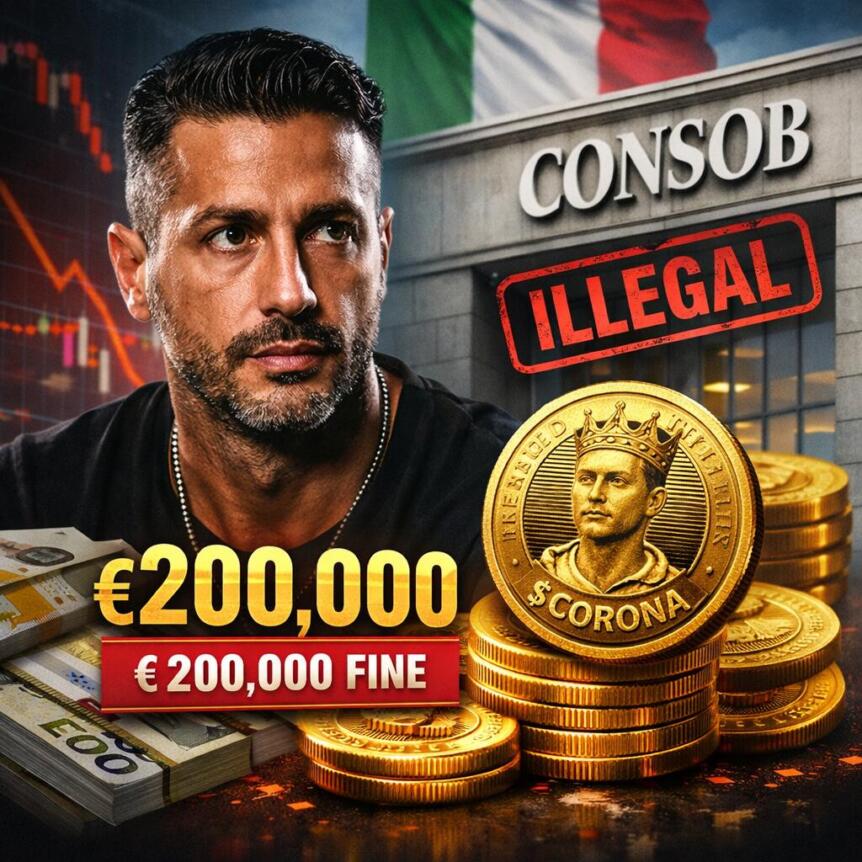
Italy’s securities regulator has imposed a €200,000 administrative fine on Fabrizio Corona for promoting and offering a memecoin known as $CORONA without meeting the requirements set by European crypto-asset rules. The sanction, made public on 26 January 2026, follows an earlier intervention in March 2025 that halted the initiative and blocked related online platforms. Regulators concluded that the offer lacked the mandatory disclosures and legal structure required under the Markets in Crypto-Assets Regulation, raising concerns about investor protection and transparency in the fast-moving memecoin market.
Key takeaways
- Italy’s Consob fined Fabrizio Corona €200,000 for an unauthorised public offer of the memecoin $CORONA.
- The offering was promoted via Telegram channels and a dedicated website without a compliant White Paper.
- Authorities determined the initiative violated the EU’s Markets in Crypto-Assets Regulation (MiCAR).
- The offer was active for at least nine days before being formally blocked on 4 March 2025.
- Consumer group Codacons flagged alleged suspicious trading patterns linked to the token’s launch.
Tickers mentioned: $CORONA
Sentiment: Neutral
Market context: The case reflects a broader regulatory push across Europe to enforce MiCAR rules as retail participation in high-risk crypto assets remains elevated.
Why it matters
The decision underscores how European regulators are applying MiCAR to curb unauthorised crypto promotions, particularly those targeting retail investors through social media. Memecoins often rely on viral marketing rather than fundamentals, making disclosure and accountability especially relevant.
For investors, the ruling highlights the risks of participating in token launches that lack formal documentation or regulatory oversight. For promoters and influencers, it signals that personal branding and online reach do not exempt crypto offerings from compliance obligations.
More broadly, the case illustrates how consumer complaints and watchdog scrutiny can accelerate enforcement actions in the crypto sector.
What to watch next
- Any follow-up investigations by Consob or other EU regulators into similar influencer-led token launches.
- Responses from platforms hosting crypto promotions regarding MiCAR compliance.
- Further actions stemming from Codacons’ additional complaints to Consob and the Bank of Italy.
Sources & verification
- Consob administrative sanction published via Borsa Italiana / Teleborsa
- Codacons official complaint and statement regarding the $CORONA memecoin
- Adnkronos report on Consob’s €200,000 fine and MiCAR violations
Consob enforcement and the $CORONA memecoin case
Italy’s securities watchdog concluded that the public promotion of the memecoin known as $CORONA (CRYPTO: CORONA) breached European crypto-asset rules by failing to meet basic legal and disclosure standards. According to the regulator, the initiative was promoted directly by Fabrizio Corona through online channels, including a Telegram group and a dedicated website, without being structured through a legal entity as required under MiCAR.
Central to the decision was the absence of a compliant White Paper. Under the EU framework, issuers of crypto-assets that are neither asset-referenced tokens nor e-money tokens must prepare and notify regulators of a detailed document outlining the project, associated risks, and investor rights. Consob stated that no such document was drafted or submitted in connection with the $CORONA memecoin.
The regulator also noted that the offer continued despite an initial warning. Online checks conducted from 24 February 2025 identified active promotion and token availability, with trading reportedly accessible on the decentralised exchange Raydium. On 4 March 2025, Consob exercised its powers under MiCAR to order the immediate termination of the offer and block access to the associated platforms.
In parallel with the $CORONA action, Consob reported blocking several other websites providing crypto-related services without authorisation, as well as financial brokerage sites deemed abusive. The authority framed these measures as part of a broader effort to safeguard retail investors from unregulated initiatives.
The enforcement process was also shaped by complaints from Codacons, an Italian consumer advocacy group. Codacons had submitted a formal report in early 2025 alleging irregularities tied to the “Progetto Corona” and the memecoin launch. According to the complaint, promotional messaging promised durability and potential returns, setting expectations that were not supported by transparent disclosures.
Codacons further alleged that trading activity surrounding the launch displayed hallmarks of market manipulation. In its submission, the group pointed to blockchain data suggesting that at least one wallet acquired tokens before the official contract address was made public. This, it argued, implied access to non-public information and raised the possibility of insider trading.
The consumer group also highlighted rapid sell-offs in the initial minutes after trading began, which coincided with a sharp drop in token value. Such dynamics, Codacons claimed, are characteristic of so-called pump-and-dump schemes, where early participants exit at the expense of later buyers.
Consob’s final decision referenced these concerns but focused its legal assessment on regulatory compliance rather than on-chain trading behaviour alone. The watchdog determined that the violation lasted at least nine days, from the initial online findings through the formal blocking order. In setting the €200,000 fine, Consob cited the seriousness of the breach and the scale of the potential audience reached through social media.
The regulator also noted a lack of cooperation during the proceedings. According to the decision, Corona did not engage constructively after receiving an initial warning and did not submit defensive arguments during the sanctioning process. Consob stated that no remedial measures were identified that would prevent similar conduct in the future.
Beyond the memecoin case, Codacons has since filed an additional complaint highlighting other initiatives allegedly promoted through social media accounts linked to Corona, including a service described as “Corona AI” that purportedly promised easy profits. The group has asked Consob and the Bank of Italy to assess whether those activities also fall within the scope of financial or crypto-asset regulations.
The case illustrates how MiCAR is being enforced in practice less than two years after its adoption, particularly in scenarios involving high-profile individuals and retail-focused marketing. While the regulation was designed to harmonise rules across the EU, national authorities retain significant discretion in monitoring online activity and responding to consumer complaints.
For market participants, the outcome serves as a reminder that crypto promotions aimed at European investors must adhere to formal requirements regardless of scale or branding. As regulators continue to monitor the sector, similar actions are likely where offerings bypass disclosure obligations or rely solely on social media reach to attract participants.
This article was originally published as Italy’s Consob Fines Fabrizio Corona €200K Over Illegal $CORONA Memecoin Offer on Crypto Breaking News – your trusted source for crypto news, Bitcoin news, and blockchain updates.


You May Also Like
US CPI Set to Show Fastest Inflation in Nearly Three Years as Rate-Cut Bets Fade

Q2 Market Insights: Bitcoin regains dominance in risk-averse environment, ETFs remain critical to market structure