US spot Bitcoin ETFs recorded $1.22B in net outflows over four days through January 22, marking the largest weekly outflow in two months. The post Bitcoin ETF US spot Bitcoin ETFs recorded $1.22B in net outflows over four days through January 22, marking the largest weekly outflow in two months. The post Bitcoin ETF

Bitcoin ETF Outflows Hit Two-Month Highs as BTC Faces Pressure

Over the past week, US Bitcoin ETFs recorded outflows of $1.22 billion, marking the largest weekly decline in the past two months since November 2025.

The data indicates waning institutional sentiment, as bullish investors have repeatedly failed to push Bitcoin BTC $88 781 24h volatility: 0.6% Market cap: $1.77 T Vol. 24h: $39.11 B above the $100,000 mark.

From a weekly high above $97,000, Bitcoin has dropped nearly 9% and is currently trading around $89,000.

Bitcoin ETF Outflows Show Lack of Institutional Interest

A net $1.22 billion flowed out of the market over the four days through January 22, including $479.7 million on January 20 and $708.7 million on January 21, according to data from Farside Investors.

The pace of outflows slowed significantly during yesterday’s trading session, with just $32 million withdrawn on January 22.

The outflows have largely offset the ETF inflows from the previous week. According to Bitcoin macro strategy platform Ecoinometrics, Bitcoin ETF flows have been in a prolonged drawdown for over 100 days.

This marks the longest period of weakness for BTC ETFs since their launch.

The research firm noted that renewed macro volatility this week disrupted a brief return of inflows from last week, highlighting the continued lack of sustained demand needed for a strong BTC price recovery.

Is BTC Price Forming a Local Bottom?

Heavy Bitcoin ETF outflows have often coincided with local price bottoms. In November, a four-day net withdrawal of $1.22 billion aligned with Bitcoin forming a low near $80,000, before rebounding above $90,000 in the following days.

A similar pattern occurred in March 2025, ahead of tariff-related market turbulence linked to President Donald Trump, when Bitcoin fell to around $76,000.

Glassnode data shows the average cost basis for ETF investors is currently $84,099, a level that has repeatedly acted as a key support zone.
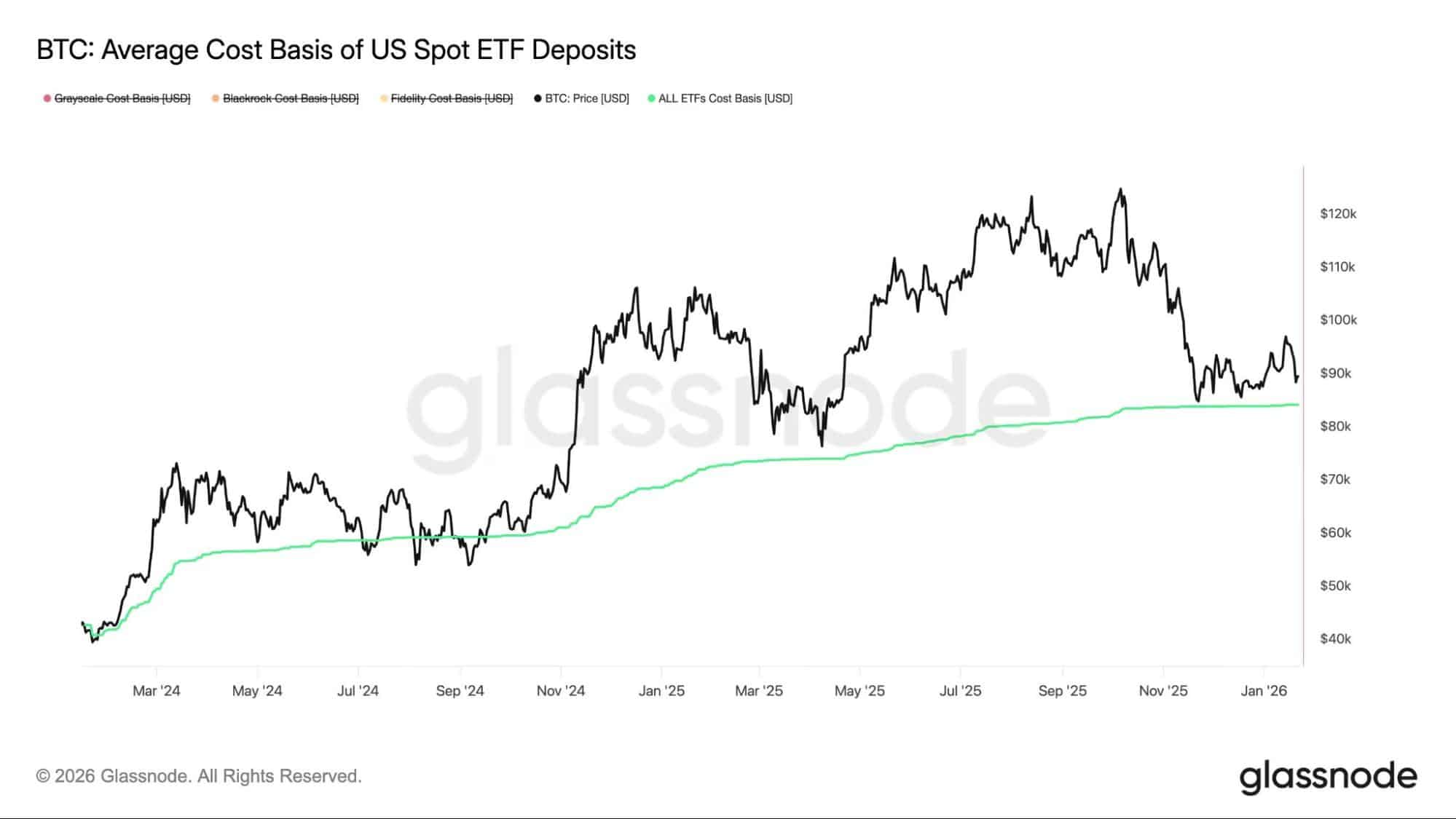
Average cost basis of Bitcoin ETF deposits. | Source: Glassnode

Average cost basis of Bitcoin ETF deposits. | Source: Glassnode

However, the pressure on BTC investors may continue in the near term.

Crypto trader Ted Pillows noted that Bitcoin has started losing momentum after a strong start to the year.

Pillows noted that Bitcoin outperformed equities last week but has since given back most of its 2026 gains.

He added that the pullback could continue toward the $87,000-$87,500 range, which he highlighted as an important support area before any potential upside move.

next

The post Bitcoin ETF Outflows Hit Two-Month Highs as BTC Faces Pressure appeared first on Coinspeaker.


Disclaimer: The articles reposted on this site are sourced from public platforms and are provided for informational purposes only. They do not necessarily reflect the views of MEXC. All rights remain with the original authors. If you believe any content infringes on third-party rights, please contact service@support.mexc.com for removal. MEXC makes no guarantees regarding the accuracy, completeness, or timeliness of the content and is not responsible for any actions taken based on the information provided. The content does not constitute financial, legal, or other professional advice, nor should it be considered a recommendation or endorsement by MEXC.

You May Also Like

This world-class blunder has even Trump's kingmaker anguished

This world-class blunder has even Trump's kingmaker anguished

Before he TACO’d at Davos, Donald Trump’s vow to take Greenland by hook or crook because he didn’t win the Nobel Peace Prize was next level insanity prancing on
Share
Rawstory2026/01/24 18:30
Gold continues to hit new highs. How to invest in gold in the crypto market?

Gold continues to hit new highs. How to invest in gold in the crypto market?

As Bitcoin encounters a "value winter", real-world gold is recasting the iron curtain of value on the blockchain.
Share
PANews2025/04/14 17:12
EUR/CHF slides as Euro struggles post-inflation data

EUR/CHF slides as Euro struggles post-inflation data

The post EUR/CHF slides as Euro struggles post-inflation data appeared on BitcoinEthereumNews.com. EUR/CHF weakens for a second straight session as the euro struggles to recover post-Eurozone inflation data. Eurozone core inflation steady at 2.3%, headline CPI eases to 2.0% in August. SNB maintains a flexible policy outlook ahead of its September 25 decision, with no immediate need for easing. The Euro (EUR) trades under pressure against the Swiss Franc (CHF) on Wednesday, with EUR/CHF extending losses for the second straight session as the common currency struggles to gain traction following Eurozone inflation data. At the time of writing, the cross is trading around 0.9320 during the American session. The latest inflation data from Eurostat showed that Eurozone price growth remained broadly stable in August, reinforcing the European Central Bank’s (ECB) cautious stance on monetary policy. The Core Harmonized Index of Consumer Prices (HICP), which excludes volatile items such as food and energy, rose 2.3% YoY, in line with both forecasts and the previous month’s reading. On a monthly basis, core inflation increased by 0.3%, unchanged from July, highlighting persistent underlying price pressures in the bloc. Meanwhile, headline inflation eased to 2.0% YoY in August, down from 2.1% in July and slightly below expectations. On a monthly basis, prices rose just 0.1%, missing forecasts for a 0.2% increase and decelerating from July’s 0.2% rise. The inflation release follows last week’s ECB policy decision, where the central bank kept all three key interest rates unchanged and signaled that policy is likely at its terminal level. While officials acknowledged progress in bringing inflation down, they reiterated a cautious, data-dependent approach going forward, emphasizing the need to maintain restrictive conditions for an extended period to ensure price stability. On the Swiss side, disinflation appears to be deepening. The Producer and Import Price Index dropped 0.6% in August, marking a sharp 1.8% annual decline. Broader inflation remains…
Share
BitcoinEthereumNews2025/09/18 03:08