

Ether Staking Heats Up As Entry Queue Hits 1.3 Million ETH
According to Beaconcha.in data and market reports, the Ethereum validator exit queue has shrunk to just 32 ETH, with a wait time of about one minute. That is a steep drop from its mid-September peak of 2.67 million ETH — a fall of almost a hundred percent. Markets often react when locked assets are freed up for sale. Right now, that specific source of immediate selling seems to have faded.
Validator Exit Queue Near Empty
The exit mechanism limits how fast validators can stop validating and pull out their full stake. With the queue near zero, there is no backlog waiting to cash out. That reduces one form of nervous selling.
Validators still earn rewards while queued and can face penalties if they act badly, but the bottleneck that once forced slow exits is gone. Reports show the withdrawal process for partial payouts remains separate, and those smaller payouts continue without affecting the full-exit flow.
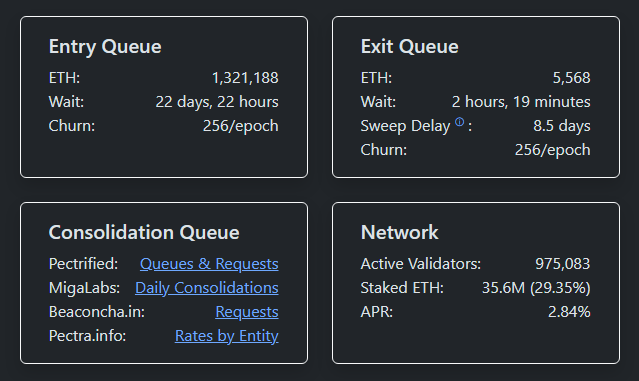
Entry Queue Hits Fresh Highs
Based on reports, the entry queue has climbed to about 1.3 million ETH, its largest level since mid-November. Large operators are sending chunks of ETH into staking. BitMine began staking on Dec. 26 and added 82,560 ETH to the queue on Jan. 3. The firm now lists 659,219 ETH staked, worth roughly $2.1 billion at current prices.
BitMine’s wider holdings stand at just over 4.1 million ETH, representing about 3.4% of the total supply and valued near $13 billion. Those moves add real, measurable demand for staked Ether and help explain why fewer validators appear eager to leave.
Exchange reserves for ETH sit at multi-year lows. That matters because when fewer coins are parked on trading platforms, automatic or panic selling becomes harder to pull off. Traders and analysts point to this as a reason selling pressure is easing.
Some industry figures have been quoted saying the exit queue is “basically empty,” and that selling pressure is drying up as staking outpaces withdrawals. Still, the market can move by other means — derivatives, lending desks, and off-exchange trades can shift exposure without touching the staking queues.
Market Cap Milestone And What It MeansMeanwhile, in another development, market watchers also noted that Ethereum has moved past Netflix to be the 36th-largest asset by market cap. That headline grabs attention. It says something about investor focus on blockchain assets right now.
But crossing a market-cap threshold is not the same as a direct reason to buy. Valuation rankings change often, and they can be driven by price moves that are themselves shaped by flows, news, or macro shifts rather than a change in the underlying business.
Featured image from Pexels, chart from TradingView
You May Also Like

‘Failed Experiment’: Are Bitcoin Treasury Companies Dumping BTC? Bitdeer Holdings Hit Zero

Fed Chair Powell says FOMC is divided on additional rate cuts in 2025
Powell said the Federal Open Market Committee is weighing interest rates on a meeting-by-meeting basis, with no long-term consensus. US Federal Reserve Chair Jerome Powell said the 19 members of the Federal Open Market Committee (FOMC) remain divided on additional interest rate cuts in 2025.At Wednesday’s press conference after the Fed’s 25-basis-point rate cut, Powell said the central bank is trying to balance its dual mandate of maximum employment and price stability in an unusual environment where the labor market is weakening even as inflation remains elevated. Powell said:Powell said that the “median” FOMC projection from the Federal Reserve’s Summary of Economic Projections (SEP), the Fed’s quarterly outlook for the US economy that informs interest rate decisions, projected interest rates at 3.6% at the end of 2025, 3.4% by the end of 2026, and 3.1% at the end of 2027.Read more
