SEC Commissioner Caroline Crenshaw to Depart Amid Shifting Regulatory Landscape Caroline Crenshaw, the only Democratic commissioner at the U.S. Securities and ExchangeSEC Commissioner Caroline Crenshaw to Depart Amid Shifting Regulatory Landscape Caroline Crenshaw, the only Democratic commissioner at the U.S. Securities and Exchange

SEC Commissioner Resigns, Leaving Only Republican Members Behind
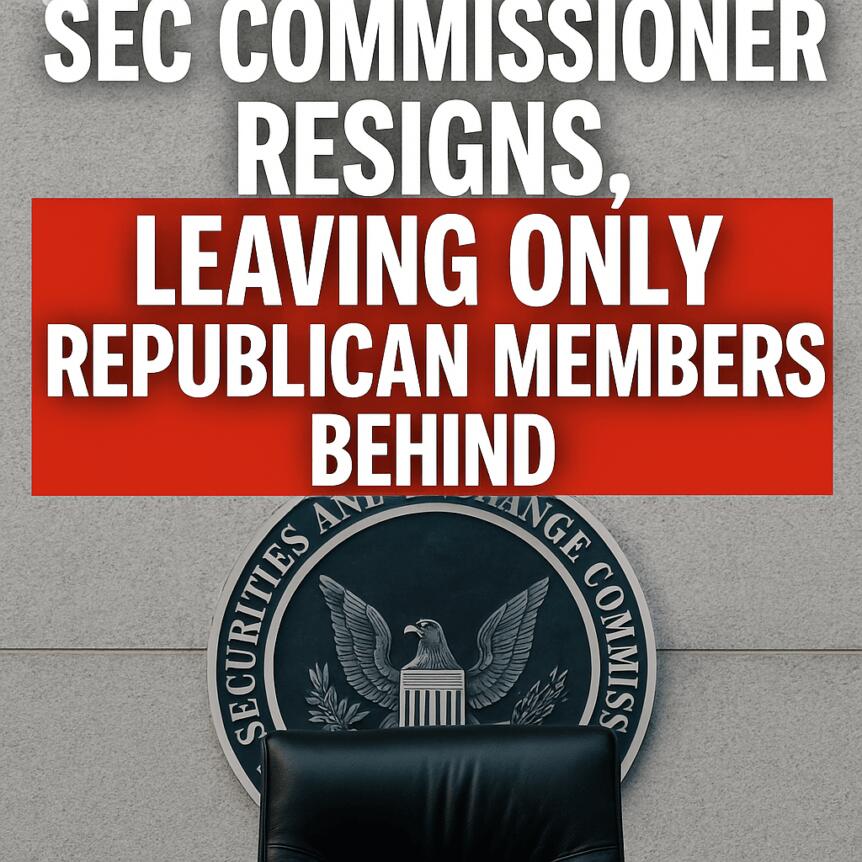
Sec Commissioner Resigns, Leaving Only Republican Members Behind

SEC Commissioner Caroline Crenshaw to Depart Amid Shifting Regulatory Landscape

Caroline Crenshaw, the only Democratic commissioner at the U.S. Securities and Exchange Commission (SEC), is set to leave the agency this week after more than five years of service. Her departure marks a significant shift within the regulatory body, which has been navigating the complex terrain of digital asset regulation for years.

Crenshaw, appointed in August 2020, has been a vocal critic of the SEC’s approach to cryptocurrencies and digital assets. She notably opposed the agency’s decision to settle its enforcement case against Ripple Labs and warned that lax regulation could trigger severe market contagion. Her outspoken stance on the need for clearer, more robust frameworks has distinguished her tenure and positioned her as a key advocate for investor protection in the evolving space.


Crenshaw’s departure will leave the SEC with three Republican commissioners, two of whom were nominated by former President Donald Trump. As of now, President Joe Biden has yet to announce plans to nominate a replacement to restore the commission’s bipartisan balance. The agency’s future stance on digital assets remains uncertain, especially as it faces increasing pressure from lawmakers and industry stakeholders seeking clearer guidance.

In a joint statement, Commissioners Hester Peirce, Mark Uyeda, and Chairman Paul Atkins praised Crenshaw as a “steadfast advocate for the agency’s mission,” acknowledging her contributions to the agency’s efforts in securities regulation and investor protection. Crenshaw has not publicly disclosed her plans post-SEC, but her influence on crypto policy is expected to be felt long after her departure.

Broader Regulatory Shifts and Congressional Oversight

The departure of Crenshaw coincides with broader shifts across US financial regulators. The Commodity Futures Trading Commission (CFTC), which also oversees digital assets, is similarly understaffed following the recent resignation of acting Chair Caroline Pham, who left for a role at crypto payments company MoonPay. Despite the confirmation of Michael Selig as the new chair, he remains the sole commissioner, with four seats vacant. This staffing shortage hampers the agencies’ ability to address rapid market developments effectively.

During President Biden’s tenure, regulatory agencies have taken a more engaged stance on digital assets, balancing enforcement with industry collaboration. However, critics like Representative Maxine Waters have called for congressional hearings to scrutinize the recent easing of enforcement actions and potential policy shifts that diminish regulatory oversight. As the Biden administration continues to navigate this complex landscape, stakeholder engagement and clear legislative frameworks remain key topics in the ongoing evolution of crypto regulation in the US.

This article was originally published as SEC Commissioner Resigns, Leaving Only Republican Members Behind on Crypto Breaking News – your trusted source for crypto news, Bitcoin news, and blockchain updates.


Market Opportunity
Union Logo
Union Price(U)
$0,003158
$0,003158$0,003158
+3,67%
USD
Union (U) Live Price Chart
Disclaimer: The articles reposted on this site are sourced from public platforms and are provided for informational purposes only. They do not necessarily reflect the views of MEXC. All rights remain with the original authors. If you believe any content infringes on third-party rights, please contact service@support.mexc.com for removal. MEXC makes no guarantees regarding the accuracy, completeness, or timeliness of the content and is not responsible for any actions taken based on the information provided. The content does not constitute financial, legal, or other professional advice, nor should it be considered a recommendation or endorsement by MEXC.

You May Also Like

The Channel Factories We’ve Been Waiting For

The Channel Factories We’ve Been Waiting For

The post The Channel Factories We’ve Been Waiting For appeared on BitcoinEthereumNews.com. Visions of future technology are often prescient about the broad strokes while flubbing the details. The tablets in “2001: A Space Odyssey” do indeed look like iPads, but you never see the astronauts paying for subscriptions or wasting hours on Candy Crush.  Channel factories are one vision that arose early in the history of the Lightning Network to address some challenges that Lightning has faced from the beginning. Despite having grown to become Bitcoin’s most successful layer-2 scaling solution, with instant and low-fee payments, Lightning’s scale is limited by its reliance on payment channels. Although Lightning shifts most transactions off-chain, each payment channel still requires an on-chain transaction to open and (usually) another to close. As adoption grows, pressure on the blockchain grows with it. The need for a more scalable approach to managing channels is clear. Channel factories were supposed to meet this need, but where are they? In 2025, subnetworks are emerging that revive the impetus of channel factories with some new details that vastly increase their potential. They are natively interoperable with Lightning and achieve greater scale by allowing a group of participants to open a shared multisig UTXO and create multiple bilateral channels, which reduces the number of on-chain transactions and improves capital efficiency. Achieving greater scale by reducing complexity, Ark and Spark perform the same function as traditional channel factories with new designs and additional capabilities based on shared UTXOs.  Channel Factories 101 Channel factories have been around since the inception of Lightning. A factory is a multiparty contract where multiple users (not just two, as in a Dryja-Poon channel) cooperatively lock funds in a single multisig UTXO. They can open, close and update channels off-chain without updating the blockchain for each operation. Only when participants leave or the factory dissolves is an on-chain transaction…
Share
BitcoinEthereumNews2025/09/18 00:09
PEPE leads memecoin gains amid post-holiday crypto market altcoin rally

PEPE leads memecoin gains amid post-holiday crypto market altcoin rally

Memecoins like FLOKI, Dogwifhat, and fartcoin are up double digits amid an early-year crypto market rally on Friday.
Share
Coinstats2026/01/03 03:19
Vitalik Buterin: Ethereum Progressed in 2025, Must Decentralize in 2026

Vitalik Buterin: Ethereum Progressed in 2025, Must Decentralize in 2026

Vitalik Buterin stressed that Ethereum’s next phase depends as much on decentralization as on technical upgrades.
Share
CryptoPotato2026/01/03 04:04