The latest progress in the strategic reserve of cryptocurrencies has boosted the market, but some industry insiders have questioned Trump's plan, pointing out that it is tilted towards a variety of assets. Is there any "interest transfer"? The implementation method remains to be clarified.The latest progress in the strategic reserve of cryptocurrencies has boosted the market, but some industry insiders have questioned Trump's plan, pointing out that it is tilted towards a variety of assets. Is there any "interest transfer"? The implementation method remains to be clarified.

Trump announces cryptocurrency reserve plan: 5 assets selected, but questioned for "ad space" and uncertain for implementation
2025/03/03 09:43

Trump announces cryptocurrency reserve plan: 5 assets selected, but questioned for "ad space" and uncertain for implementation

Author: Weilin, PANews

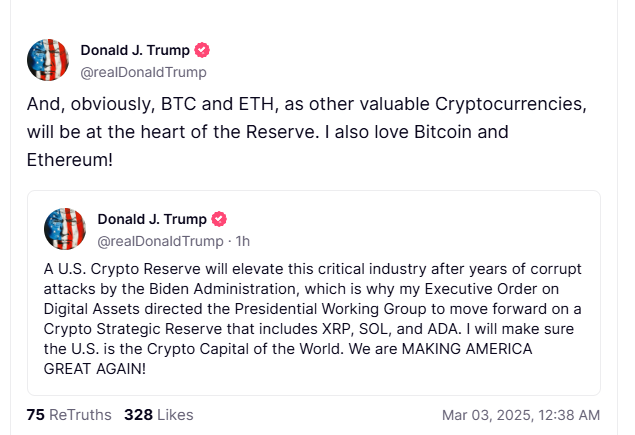
On the evening of March 2, US President Trump announced the asset categories of the strategic reserve of cryptocurrencies on Truth Social, including XRP, SOL, and ADA. He then added that Bitcoin BTC and Ethereum ETH, as other valuable cryptocurrencies, will also be the core of the reserve.

Once the news was released, the cryptocurrency market rebounded quickly, with the five major currencies generally rising. As of 8:00 on March 3, the price of Bitcoin exceeded $94,000, up 9.71% on the day.

Trump announces 5 types of crypto assets in reserve: BTC, ETH, XRP, SOL, ADA

On March 2, amid a general market downturn, Trump suddenly released a statement on cryptocurrency reserves: "The U.S. cryptocurrency reserve will boost this critical industry after years of corrupt attacks by the Biden administration. That's why my digital asset executive order directs the Presidential Task Force to advance a strategic crypto reserve containing XRP, SOL, and ADA. I will ensure that the United States becomes the crypto capital of the world. We are making America great again!"

Subsequently, the crypto market was significantly boosted. As of 8:00 on March 3, Bitcoin was quoted at $94,338, up 9.71%; Ethereum was quoted at $2,513, up 13.41%; Solana (SOL) rose to $178, up 24.35%; XRP rose to $2.91, up 33%; Cardano (ADA) rose sharply by 72.16%. In addition, Trump's meme coin TRUMP also rose by 25.36%.
Trump announces cryptocurrency reserve plan: 5 assets selected, but questioned for "ad space" and uncertain for implementation

Trump had pledged to establish a "Strategic National Reserve of Bitcoin" at a Bitcoin conference in Nashville in 2024. In his keynote speech, Trump told the audience: "If I am elected, it will be the policy of my administration to reserve 100% of all Bitcoin currently held or acquired in the future by the United States government."

On January 23 of this year, within the first week of Trump taking office, he signed a crypto executive order as president, instructing the Digital Asset Working Group to study the feasibility of establishing a national crypto reserve and explore a regulatory framework for stablecoins.

“President Trump announced the creation of a strategic crypto reserve comprised of Bitcoin and other top cryptocurrencies. This is consistent with his Executive Order 14178, which he issued in week one,” David Sacks, the White House’s director of artificial intelligence and cryptography, wrote on the X platform. He added: “More news will be released during the summit.”

It is reported that President Trump will attend and speak at the first White House Cryptocurrency Summit on March 7. Participants will include well-known founders, CEOs and investors in the cryptocurrency industry, as well as members of the President's Digital Asset Task Force. The summit will be hosted by David Sacks, the White House AI and cryptocurrency czar, and managed by Bo Hines, executive director of the task force.

Is there any "interest transfer" in the tilt towards multiple assets? The implementation method still needs to be clarified

Although the latest progress in the strategic reserve of cryptocurrencies has boosted the market, some industry insiders have questioned Trump's crypto reserve plan. In particular, the inclusion of ADA has caused some unexpected reactions. According to @CryptoDoggyCN, in early February, ADA founder Charles Hoskinson announced in a live broadcast that he would meet a big shot. On February 27, he posted that he could not go to ETHDenver and had to go to Florida, where Trump's home, Mar-a-Lago, is located. @CryptoDoggyCN believes that the inclusion of ADA may be influenced by a kind of lobbying.

Some influential figures in the technology and crypto industries have criticized Trump for including cryptocurrencies other than Bitcoin in the reserve. AngelList co-founder Naval Ravikant wrote: "American taxpayers should not be 'on the hook' for cryptocurrencies that are nominally decentralized." He added: "If it has lobbyists, it's not decentralized." Aave founder Stani Kulechov also wrote: "Good news: strategic crypto reserves are in preparation; bad news: lack of DeFi; ugly news: XRP, SOL and ADA."

Alex Xu, research partner at Mint Ventures, analyzed that SOL, XRP, and ADA have been frequenting Mar-a-Lago since Trump took office, and have also provided Trump with a lot of open sponsorship, such as donations to the inauguration fund, etc. There is a high probability that all kinds of roundabout benefits will be transferred privately. This time, Trump also returned the favor and gave an open feedback, arranging an "advertising space" within the presidential authority. However, in the long run, projects such as ada and xrp can be used as reserve assets to promote. This absurd practice will only weaken the seriousness of the BTC strategic reserve itself and further reduce the possibility of the BTC reserve bill being passed at the federal level. It is one thing to let the working group advance the work, and it is another to succeed at the legislative level. The Republican advantage in the House of Representatives is very weak, and it is impossible to pass legislation to pass sol, ada, and xrp into the national reserve. The only possibility is that Trump establishes a national sovereign fund directly under the Treasury Department through the executive branch, so that the above assets can be directly purchased without federal legislation. But how likely is this? How much benefit do SOL, XRP, and ADA need to deliver to the Trump family before the president explicitly orders to buy these things with taxpayers' money?

In addition, industry insiders pointed out that in the past few months, Trump has used the words "reserve" and "stockpile" interchangeably when referring to relevant policies, but there are some key differences between them. Rebecca Rettig, chief legal officer of Jito Labs, said: "As I understand it, the reserve means that the government will hold the cryptocurrencies they have accumulated through various cases, and the reserve is ultimately what the Treasury Department decides to buy and hold."

Analyst Jason Chen said on the X platform that there is a very uncertain factor in the package of cryptocurrency strategic reserve plans: how to complete the reserve? According to Trump's extremely selfish style as a businessman, he has always adhered to the principle of not spending money if he can get it for free. It is difficult to expect him to take out real money from his pocket to buy to complete the reserve and then "pull up the market". The US fiscal deficit has reached 1.83 trillion US dollars and the landlords have no surplus food. Therefore, Trump is likely to complete the reserve in a way that does not require spending money, such as requiring the government to stop selling the BTC it holds, allowing cryptocurrency-related companies to use BTC to pay taxes, and even actively handing it over through donations.

He said that in the future, APT, SUI, MOVE, etc. may be reserved. If the money is not taken out to complete the reserve, the nature of the benefit is essentially equivalent to locking the position, that is, the funds flowing into the strategic reserve will not be sold for a long time, for example, offsetting the negative impact of the US government's market crash that everyone was most worried about before, and it will not really be like BlackRock and MicroStrategy using money to pull up the market.

Nevertheless, on March 3, Zhao Changpeng, former CEO of Binance, expressed his observations on the current market in an article on the X platform. The current market is obviously dominated by "US crypto assets" (US Coins), which have promoted the development of encryption. It is good to see any progress in the adoption of cryptocurrencies. The industry as a whole benefits and keeps building.

Coinbase co-founder and CEO Brian Armstrong said on the X platform when talking about investment strategies: "I think investing only in Bitcoin may be the best option - the simplest, and the logic behind it as the successor to gold is also clear; if people want more diversified options, they can build a market capitalization-weighted crypto asset index to keep it unbiased. But maybe the first option is the simplest."

At present, the five major categories of crypto asset reserves announced by Trump have injected optimism into the market, but its implementation methods and specific results still need time to test. The future market will further verify them, and PANews will pay close attention to subsequent developments.


Market Opportunity
OFFICIAL TRUMP Logo
OFFICIAL TRUMP Price(TRUMP)
$4.948
$4.948$4.948
+0.22%
USD
OFFICIAL TRUMP (TRUMP) Live Price Chart
Disclaimer: The articles reposted on this site are sourced from public platforms and are provided for informational purposes only. They do not necessarily reflect the views of MEXC. All rights remain with the original authors. If you believe any content infringes on third-party rights, please contact service@support.mexc.com for removal. MEXC makes no guarantees regarding the accuracy, completeness, or timeliness of the content and is not responsible for any actions taken based on the information provided. The content does not constitute financial, legal, or other professional advice, nor should it be considered a recommendation or endorsement by MEXC.

You May Also Like

Crucial ETH Unstaking Period: Vitalik Buterin’s Unwavering Defense for Network Security

Crucial ETH Unstaking Period: Vitalik Buterin’s Unwavering Defense for Network Security

BitcoinWorld Crucial ETH Unstaking Period: Vitalik Buterin’s Unwavering Defense for Network Security Ever wondered why withdrawing your staked Ethereum (ETH) isn’t an instant process? It’s a question that often sparks debate within the crypto community. Ethereum founder Vitalik Buterin recently stepped forward to defend the network’s approximately 45-day ETH unstaking period, asserting its crucial role in safeguarding the network’s integrity. This lengthy waiting time, while sometimes seen as an inconvenience, is a deliberate design choice with profound implications for security. Why is the ETH Unstaking Period a Vital Security Measure? Vitalik Buterin’s defense comes amidst comparisons to other networks, like Solana, which boast significantly shorter unstaking times. He drew a compelling parallel to military operations, explaining that an army cannot function effectively if its soldiers can simply abandon their posts at a moment’s notice. Similarly, a blockchain network requires a stable and committed validator set to maintain its security. The current ETH unstaking period isn’t merely an arbitrary delay. It acts as a critical buffer, providing the network with sufficient time to detect and respond to potential malicious activities. If validators could instantly exit, it would open doors for sophisticated attacks, jeopardizing the entire system. Currently, Ethereum boasts over one million active validators, collectively staking approximately 35.6 million ETH, representing about 30% of the total supply. This massive commitment underpins the network’s robust security model, and the unstaking period helps preserve this stability. Network Security: Ethereum’s Paramount Concern A shorter ETH unstaking period might seem appealing for liquidity, but it introduces significant risks. Imagine a scenario where a large number of validators, potentially colluding, could quickly withdraw their stake after committing a malicious act. Without a substantial delay, the network would have limited time to penalize them or mitigate the damage. This “exit queue” mechanism is designed to prevent sudden validator exodus, which could lead to: Reduced decentralization: A rapid drop in active validators could concentrate power among fewer participants. Increased vulnerability to attacks: A smaller, less stable validator set is easier to compromise. Network instability: Frequent and unpredictable changes in validator numbers can lead to performance issues and consensus failures. Therefore, the extended period is not a bug; it’s a feature. It’s a calculated trade-off between immediate liquidity for stakers and the foundational security of the entire Ethereum ecosystem. Ethereum vs. Solana: Different Approaches to Unstaking When discussing the ETH unstaking period, many point to networks like Solana, which offers a much quicker two-day unstaking process. While this might seem like an advantage for stakers seeking rapid access to their funds, it reflects fundamental differences in network architecture and security philosophies. Solana’s design prioritizes speed and immediate liquidity, often relying on different consensus mechanisms and validator economics to manage security risks. Ethereum, on the other hand, with its proof-of-stake evolution from proof-of-work, has adopted a more cautious approach to ensure its transition and long-term stability are uncompromised. Each network makes design choices based on its unique goals and threat models. Ethereum’s substantial value and its role as a foundational layer for countless dApps necessitate an extremely robust security posture, making the current unstaking duration a deliberate and necessary component. What Does the ETH Unstaking Period Mean for Stakers? For individuals and institutions staking ETH, understanding the ETH unstaking period is crucial for managing expectations and investment strategies. It means that while staking offers attractive rewards, it also comes with a commitment to the network’s long-term health. Here are key considerations for stakers: Liquidity Planning: Stakers should view their staked ETH as a longer-term commitment, not immediately liquid capital. Risk Management: The delay inherently reduces the ability to react quickly to market volatility with staked assets. Network Contribution: By participating, stakers contribute directly to the security and decentralization of Ethereum, reinforcing its value proposition. While the current waiting period may not be “optimal” in every sense, as Buterin acknowledged, simply shortening it without addressing the underlying security implications would be a dangerous gamble for the network’s reliability. In conclusion, Vitalik Buterin’s defense of the lengthy ETH unstaking period underscores a fundamental principle: network security cannot be compromised for the sake of convenience. It is a vital mechanism that protects Ethereum’s integrity, ensuring its stability and trustworthiness as a leading blockchain platform. This deliberate design choice, while requiring patience from stakers, ultimately fortifies the entire ecosystem against potential threats, paving the way for a more secure and reliable decentralized future. Frequently Asked Questions (FAQs) Q1: What is the main reason for Ethereum’s long unstaking period? A1: The primary reason is network security. A lengthy ETH unstaking period prevents malicious actors from quickly withdrawing their stake after an attack, giving the network time to detect and penalize them, thus maintaining stability and integrity. Q2: How long is the current ETH unstaking period? A2: The current ETH unstaking period is approximately 45 days. This duration can fluctuate based on network conditions and the number of validators in the exit queue. Q3: How does Ethereum’s unstaking period compare to other blockchains? A3: Ethereum’s unstaking period is notably longer than some other networks, such as Solana, which has a two-day period. This difference reflects varying network architectures and security priorities. Q4: Does the unstaking period affect ETH stakers? A4: Yes, it means stakers need to plan their liquidity carefully, as their staked ETH is not immediately accessible. It encourages a longer-term commitment to the network, aligning staker interests with Ethereum’s stability. Q5: Could the ETH unstaking period be shortened in the future? A5: While Vitalik Buterin acknowledged the current period might not be “optimal,” any significant shortening would likely require extensive research and network upgrades to ensure security isn’t compromised. For now, the focus remains on maintaining robust network defenses. Found this article insightful? Share it with your friends and fellow crypto enthusiasts on social media to spread awareness about the critical role of the ETH unstaking period in Ethereum’s security! To learn more about the latest Ethereum trends, explore our article on key developments shaping Ethereum’s institutional adoption. This post Crucial ETH Unstaking Period: Vitalik Buterin’s Unwavering Defense for Network Security first appeared on BitcoinWorld.
Share
Coinstats2025/09/18 15:30
Shiba Inu Price Forecast: Why This New Trending Meme Coin Is Being Dubbed The New PEPE After Record Presale

Shiba Inu Price Forecast: Why This New Trending Meme Coin Is Being Dubbed The New PEPE After Record Presale

While Shiba Inu (SHIB) continues to build its ecosystem and PEPE holds onto its viral roots, a new contender, Layer […] The post Shiba Inu Price Forecast: Why This New Trending Meme Coin Is Being Dubbed The New PEPE After Record Presale appeared first on Coindoo.
Share
Coindoo2025/09/18 01:13
The U.S. Financial Accounting Standards Board plans to study in 2026 whether crypto assets such as stablecoins can be classified as cash equivalents.

The U.S. Financial Accounting Standards Board plans to study in 2026 whether crypto assets such as stablecoins can be classified as cash equivalents.

PANews reported on December 31 that the Financial Accounting Standards Board (FASB) plans to study in 2026 whether certain crypto assets can be classified as cash
Share
PANews2025/12/31 16:50