Fake CAPTCHAs are being used to trick users into installing malware or giving away private data. A fake CAPTCHA is crafted to look like a normal verification step, but behind the scenes, the attackers are executing a malicious plan. The Amadey Trojan, in particular, acts as a clipper: it detects crypto addresses already copied on the clipboard.Fake CAPTCHAs are being used to trick users into installing malware or giving away private data. A fake CAPTCHA is crafted to look like a normal verification step, but behind the scenes, the attackers are executing a malicious plan. The Amadey Trojan, in particular, acts as a clipper: it detects crypto addresses already copied on the clipboard.

Educational Byte: How Fake CAPTCHAs Can Steal Your Crypto

We all know CAPTCHAs: those “I’m not a robot” boxes or image grids you click when logging in or browsing. They’re meant to block bots and make websites safer. But cybercriminals have started using deceptive versions. They’re fake CAPTCHAs that trick users into installing malware or giving away private data.

What begins as a harmless-looking verification ends up being a gateway for crypto theft, credential harvesting, or system compromise. So, we’ll explore how those fake CAPTCHAs work, the risks they pose to your crypto, and most importantly, steps you can take to defend yourself.

How the Fake Captcha Scam Works

A fake CAPTCHA is crafted to look like a normal verification step, but behind the scenes, the attackers are executing a malicious plan. You click “I’m not a robot,” and the page quietly copies a command into your clipboard. Then it prompts you to paste it somewhere (often the Windows Run box) and press Enter. That simple command executes malware like Lumma Stealer or the Amadey Trojan, which harvest passwords, browser cookies, crypto wallet keys, and more. Not even a proper download is needed.

\ Example of a fake CAPTCHA with the Windows Run Box. Image by Reliaquest
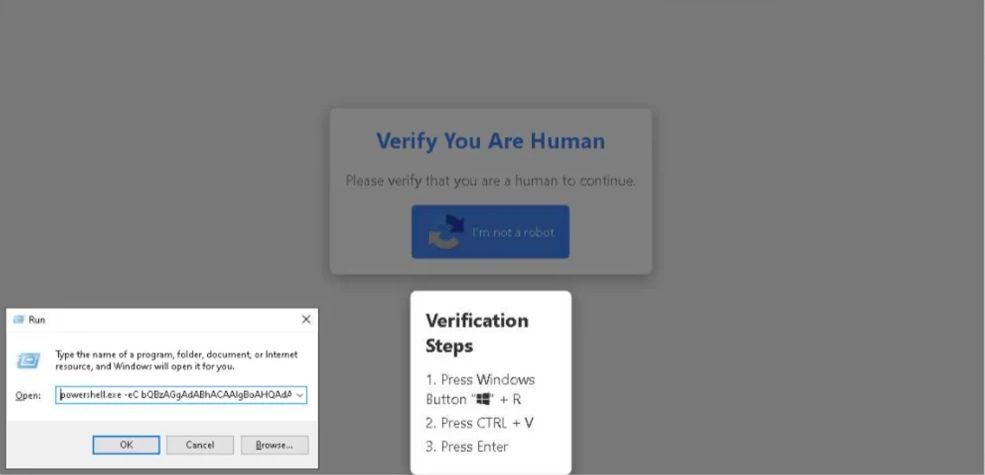
\ Researchers have observed this tactic being embedded into compromised websites across different industries, sometimes via ads or via third-party scripts on otherwise legitimate domains. The attack often uses fileless execution, which means the malware doesn’t leave a noticeable trace on disk, making detection trickier.

Once inside, the malware scans for browser-saved credentials, cookie data, two-factor tokens, and wallet files, and can quietly exfiltrate what it finds. The Amadey Trojan, in particular, also acts as a clipper: it detects crypto addresses already copied on the clipboard, and then replaces them with ones controlled by the hackers. This way, when you paste the address to send funds, it may not be your intended destination.

It might sound technical, but the key is that the CAPTCHA prompt acts as a lure: you believe you’re just verifying you’re human, and don’t see what’s really happening behind. Analysts saw that in some tests, 17% of users exposed to a fake CAPTCHA campaign ended up following the instructions that triggered malware. \n

Why the “I’m Not a Robot” Trick is So Effective

Fake CAPTCHAs work so well because they exploit a ritual we’ve all learned to trust. Clicking a box or selecting traffic lights feels routine, something safe and familiar. That habit makes users lower their guard. Attackers count on this automatic behavior. They mimic Google’s design style and use the same fonts and layouts.

In a way, fake CAPTCHAs are the perfect social engineering tool: they blend technical deception with psychological manipulation. People tend to associate CAPTCHAs with extra safety, just a filter that keeps bots out. That’s what makes them ideal for smuggling in the very threats they’re supposed to block. We could call this “trust hijacking”: turning a symbol of security into bait.

When the malware behind these scams targets crypto users, it’s not random. Criminals follow where the money flows, and crypto wallets are pure digital gold. Stealing one recovery phrase can be worth more than months of low-level phishing attempts. The trick’s elegance lies in its simplicity: a single click that feels harmless, leading straight into the attacker’s control.

\

How to Protect Yourself from Fake Captcha Attacks

We must be careful not to assume every CAPTCHA is safe. Here are strategies to reduce risk and keep your crypto secure:

\

  • Start by checking whether the website is known and trustworthy. If a CAPTCHA appears on an already suspicious site or seems oddly intrusive, exit immediately.

  • Always verify the URL. Misspellings, extra characters, or odd domains are warning signs.

  • Never paste commands into your system based on web prompts. No legitimate CAPTCHA ever asks you to run something manually.

  • To avoid incidents when pasting complex crypto addresses, you can use easier shortcodes, usernames, and textcoins in Obyte to send and receive funds.

  • You can also use textcoins in Obyte to keep most of your funds offline, safe from any kind of hacking attempt.

\

  • Use up-to-date antivirus or endpoint protection that can block or detect malicious scripts or PowerShell executions.
  • Consider browser extensions or tools that block scripts or clipboard manipulation on untrusted pages.
  • Enable strong security habits: keep your software patched, distribute your funds across different wallets, and avoid storing private keys in digital form.

Fake CAPTCHAs are a cunning twist in the ongoing battle between cybercriminals and everyday users. For those holding or handling crypto, the stakes are high. Stay alert, follow the protective steps above, and treat any CAPTCHA prompt outside normal activity with skepticism.


:::info Featured Vector Image by pikisuperstar / Freepik

:::

\n

\

Market Opportunity
LOOK Logo
LOOK Price(LOOK)
$0.02156
$0.02156$0.02156
+7.10%
USD
LOOK (LOOK) Live Price Chart
Disclaimer: The articles reposted on this site are sourced from public platforms and are provided for informational purposes only. They do not necessarily reflect the views of MEXC. All rights remain with the original authors. If you believe any content infringes on third-party rights, please contact service@support.mexc.com for removal. MEXC makes no guarantees regarding the accuracy, completeness, or timeliness of the content and is not responsible for any actions taken based on the information provided. The content does not constitute financial, legal, or other professional advice, nor should it be considered a recommendation or endorsement by MEXC.

You May Also Like

Astonishing Kevin Durant Bitcoin Fortune: A Decade-Long Hold Yields 195-Fold Return

Astonishing Kevin Durant Bitcoin Fortune: A Decade-Long Hold Yields 195-Fold Return

BitcoinWorld Astonishing Kevin Durant Bitcoin Fortune: A Decade-Long Hold Yields 195-Fold Return Imagine logging into an old account and discovering a fortune! That’s exactly what happened to NBA superstar Kevin Durant. His decade-old, forgotten Coinbase account, which held an early Kevin Durant Bitcoin investment, has now resurfaced, revealing an incredible 195-fold return. This remarkable story highlights the immense potential of long-term cryptocurrency holdings and serves as a fascinating example for anyone interested in digital assets. The Accidental ‘Hodl’: How Kevin Durant’s Bitcoin Investment Skyrocketed The journey of Kevin Durant’s Bitcoin investment began in 2016. He encountered Bitcoin, then priced at a modest $600, during a birthday celebration for venture capitalist Ben Horowitz. Intrigued, Durant decided to invest, setting up a Coinbase account. However, as many early adopters can attest, managing digital assets in the nascent crypto landscape wasn’t always straightforward. Durant subsequently misplaced his Coinbase login credentials, leading to an involuntary long-term hold – a phenomenon affectionately known as "HODL" (Hold On for Dear Life) in the crypto community. This accidental strategy proved to be a stroke of pure luck. After a decade, with assistance from Coinbase and a thorough identity verification process, Durant successfully recovered his account. While the exact amount of BTC remains undisclosed, the outcome is clear: a staggering 195-fold return on his initial investment. Initial Investment: Bitcoin at $600 in 2016. Accidental Strategy: Lost login details led to an unintentional "HODL." Recovery: Coinbase assisted with identity verification. Return: A remarkable 195-fold increase in value. Beyond Personal Gains: Kevin Durant’s Broader Crypto Engagement This isn’t Kevin Durant’s first foray into the world of digital assets, nor is it his only connection to the industry. Long before this incredible recovery, Durant had already demonstrated a positive and forward-thinking stance toward cryptocurrency. His engagement extends beyond just holding assets; he has actively participated in the crypto ecosystem. Durant previously partnered with Coinbase, one of the leading cryptocurrency exchanges, showcasing his belief in the platform and the broader potential of digital currencies. He has also ventured into the realm of Non-Fungible Tokens (NFTs), purchasing digital collectibles and exploring this evolving sector. These actions underscore his understanding and acceptance of crypto’s growing influence. His continued involvement helps bridge the gap between mainstream culture and the crypto world, bringing increased visibility and legitimacy to digital assets. The story of his Kevin Durant Bitcoin recovery only adds another layer to his impressive crypto narrative, inspiring many to consider the long-term prospects of digital investments. Valuable Lessons from Kevin Durant’s Bitcoin Journey Kevin Durant’s story offers compelling insights for both seasoned investors and newcomers to the crypto space. It powerfully illustrates the potential rewards of a patient, long-term investment approach, even if accidental. While not everyone will forget their login details for a decade, the principle of "HODLing" through market volatility can yield significant returns. However, it also subtly highlights the importance of proper security and record-keeping. Losing access to an account, even if eventually recovered, can be a stressful experience. Here are some actionable takeaways: Embrace Long-Term Vision: Bitcoin’s history shows substantial growth over extended periods. Patience often outperforms short-term trading. Secure Your Assets: Always keep your login details, seed phrases, and recovery information in multiple, secure locations. Consider hardware wallets for significant holdings. Understand the Volatility: Crypto markets are volatile. Investing only what you can afford to lose and being prepared for price swings is crucial. Stay Informed: While Durant’s hold was accidental, continuous learning about the crypto market can help make informed decisions. His experience reinforces the idea that strategic, even if involuntary, patience can be profoundly rewarding in the world of cryptocurrency. The Kevin Durant Bitcoin story is a testament to this. The tale of Kevin Durant’s forgotten Coinbase account and his astonishing 195-fold return on a decade-old Bitcoin investment is nothing short of extraordinary. It’s a vivid reminder of the transformative power of early adoption and the incredible growth potential within the cryptocurrency market. Beyond the personal windfall, Durant’s continued engagement with crypto, from partnerships to NFTs, reinforces his role as a prominent figure in the digital asset space. His accidental "HODL" has become a legendary example, inspiring many to look at long-term crypto investments with renewed optimism and a keen eye on future possibilities. Frequently Asked Questions About Kevin Durant’s Bitcoin Investment Here are some common questions regarding Kevin Durant’s recent crypto revelation: Q: How much did Kevin Durant initially invest in Bitcoin?A: The exact amount of Bitcoin Kevin Durant initially invested has not been disclosed. However, it was purchased around 2016 when Bitcoin was priced at approximately $600. Q: How did Kevin Durant recover his forgotten Coinbase account?A: Coinbase assisted Kevin Durant in recovering his account after he completed a thorough identity verification process, confirming his ownership of the decade-old account. Q: What does "195-fold return" mean?A: A "195-fold return" means that the value of his initial investment multiplied by 195 times. If he invested $1,000, it would now be worth $195,000. Q: Has Kevin Durant invested in other cryptocurrencies or NFTs?A: Yes, Kevin Durant has shown a friendly stance toward cryptocurrency beyond Bitcoin. He has partnered with Coinbase and has also purchased Non-Fungible Tokens (NFTs) in the past. Q: Is Kevin Durant’s story typical for Bitcoin investors?A: While the 195-fold return is exceptional, the principle of significant gains from long-term holding (HODLing) is a common theme in Bitcoin’s history. However, not all investments yield such high returns, and market volatility is always a factor. Did Kevin Durant’s incredible crypto journey inspire you? Share this astonishing story with your friends and followers on social media to spark conversations about the future of digital assets and the power of long-term investing! Your shares help us bring more fascinating crypto news to a wider audience. To learn more about the latest Bitcoin trends, explore our article on key developments shaping Bitcoin’s institutional adoption. This post Astonishing Kevin Durant Bitcoin Fortune: A Decade-Long Hold Yields 195-Fold Return first appeared on BitcoinWorld.
Share
Coinstats2025/09/19 18:45
Vitalik Buterin Supports Native Rollup Integration on Ethereum

Vitalik Buterin Supports Native Rollup Integration on Ethereum

The post Vitalik Buterin Supports Native Rollup Integration on Ethereum appeared on BitcoinEthereumNews.com. Key Points: Vitalik Buterin supports ZK Rollups for
Share
BitcoinEthereumNews2026/01/19 15:43
NEAR Price Prediction: Testing Critical $1.88 Resistance with $2.10-$2.35 Targets by February 2026

NEAR Price Prediction: Testing Critical $1.88 Resistance with $2.10-$2.35 Targets by February 2026

The post NEAR Price Prediction: Testing Critical $1.88 Resistance with $2.10-$2.35 Targets by February 2026 appeared on BitcoinEthereumNews.com. Rebeca Moen
Share
BitcoinEthereumNews2026/01/19 15:34