Crypto markets are confronting a fast-moving repricing of US monetary policy expectations, and macro trader Alex Krüger argues that even after last week’s sharp dovish turn, futures curves still fail to discount what a Trump-aligned Federal Reserve leadership could look like. Fed Cut Mispricing Sets Up Crypto Repricing Event In a post on X, Krüger shared a CME-derived table of implied policy rates for late-stage 2026 and framed it as the market’s baseline for the post-Powell transition. The table shows an expected fed funds rate of 3.47% for the April 29, 2026 FOMC meeting (347 bps), drifting to 3.29% for June 17, 2026 (329 bps), to 3.10% for September 16, 2026 (310 bps), and to 2.99% for December 9, 2026 (299 bps). In other words, the curve prices roughly 48 basis points of easing between late April and early December 2026 about two quarter-point cuts across that span—implying a relatively gradual descent toward just under 3%. Krüger’s core claim is that this path is inconsistent with the policy preferences he associates with the Trump camp, and therefore inconsistent with an “ultra dovish” chair appointment. He situates the April 2026 meeting as the last one under Jerome Powell’s chairmanship, whose four-year term ends in mid-May 2026, and then treats the June 2026 meeting as the first under a new chair. Related Reading: Crypto Crash Is A Forced Crypto Seller Unwind, Glassnode Co-Founders Claim Against that transition, Krüger points to Fed Governor Stephen Miran—whom he casts as a proxy for Trump-world monetary instincts—as advocating a much faster return to neutral. In Krüger’s telling, Miran has argued that the “appropriate fed funds rate” is “roughly 2% to 2.5%,” has linked this year’s tighter stance to a rise in the neutral rate, and has characterized his divergence from colleagues as centered on “speed of cuts,” not destination. Krüger also highlights Miran’s preference for “50 bps cuts” over 25-bp steps as the way to get policy back to neutral. On Krüger’s arithmetic, a futures curve that delivers only about 50 bps of easing from the first post-Powell meeting in June 2026 through December 2026 is not a curve that has truly priced a Trump-era chair willing to front-load larger moves. Related Reading: Crypto Funds Face Third Consecutive Weekly Losses, Totaling $3 Billion In Outflows Put simply, he sees the market as still anchored to a Powell-style glide path, even while political risk is skewing toward more abrupt easing. “The Trump camp wants faster and bigger cuts, many of them. The Fed only cutting 50bps between the new Fed Chair’s FOMC in June and December 2026 falls short. That’s why I sustain an ultra dovish Fed Chair appointed by Trump is not priced in,” Krüger concludes. December Rate Cut Seems Likely The timing of Krüger’s warning matters because the front end has already undergone a dramatic swing. Last week, traders sharply increased the probability of another cut at the Fed’s December meeting after New York Fed President John Williams said rates could fall “in the near term,” a remark that pushed implied odds of a quarter-point December move into the mid-70% range on CME FedWatch, up from roughly 40% the day before. In parallel, Goldman Sachs chief economist Jan Hatzius reiterated a baseline in which the Fed cuts in December, then again in March and June 2026, taking the policy band down to roughly 3.00%–3.25%.” We expect another Fed cut in December, followed by two more moves in March and June 2026 that take the funds rate to 3-3.25%,” said Hatzius. GOLDMAN SEES DOWNSIDE RISKS FOR ECONOMY NEXT YEAR Goldman Sachs economists expect the Fed to cut rates in December, followed by a few more cuts in 2025, bringing rates just above 3%. Chief economist Jan Hatzius warns the economy could slow more than expected, requiring… — *Walter Bloomberg (@DeItaone) November 24, 2025 His path is modestly more dovish than what the curve had discounted earlier in the month, but it still resembles the gradualism embedded in Krüger’s CME table: sequential 25-bp steps, aiming for an early-2026 rate around the low-3% area rather than a rapid drop toward the low-2s. For the crypto markets, the dispute is less about whether cuts are coming than about the speed and terminal rate. Crypto is structurally levered to shifts in dollar liquidity and real-rate expectations; what Krüger is flagging is a scenario where the curve’s “destination” and, especially, its pacing remain too conservative relative to a potential political reorientation of the Fed. If traders are right that the Williams-sparked repricing is the beginning of a slower, data-dependent easing cycle, then current crypto asset valuations already incorporate the relevant macro impulse. If Krüger is right, the curve is still missing a regime change in reaction function—one in which larger front-loaded cuts compress cash yields faster than expected, steepen risk-on positioning, and force another round of cross-asset duration and liquidity repricing. That gap between a Powell-era slope and a Trump-era shock path is what he means when he says an ultra-dovish chair “is not priced in” for crypto markets. At press time, the total crypto market cap was at $2.92 trillion. Featured image created with DALL.E, chart from TradingView.comCrypto markets are confronting a fast-moving repricing of US monetary policy expectations, and macro trader Alex Krüger argues that even after last week’s sharp dovish turn, futures curves still fail to discount what a Trump-aligned Federal Reserve leadership could look like. Fed Cut Mispricing Sets Up Crypto Repricing Event In a post on X, Krüger shared a CME-derived table of implied policy rates for late-stage 2026 and framed it as the market’s baseline for the post-Powell transition. The table shows an expected fed funds rate of 3.47% for the April 29, 2026 FOMC meeting (347 bps), drifting to 3.29% for June 17, 2026 (329 bps), to 3.10% for September 16, 2026 (310 bps), and to 2.99% for December 9, 2026 (299 bps). In other words, the curve prices roughly 48 basis points of easing between late April and early December 2026 about two quarter-point cuts across that span—implying a relatively gradual descent toward just under 3%. Krüger’s core claim is that this path is inconsistent with the policy preferences he associates with the Trump camp, and therefore inconsistent with an “ultra dovish” chair appointment. He situates the April 2026 meeting as the last one under Jerome Powell’s chairmanship, whose four-year term ends in mid-May 2026, and then treats the June 2026 meeting as the first under a new chair. Related Reading: Crypto Crash Is A Forced Crypto Seller Unwind, Glassnode Co-Founders Claim Against that transition, Krüger points to Fed Governor Stephen Miran—whom he casts as a proxy for Trump-world monetary instincts—as advocating a much faster return to neutral. In Krüger’s telling, Miran has argued that the “appropriate fed funds rate” is “roughly 2% to 2.5%,” has linked this year’s tighter stance to a rise in the neutral rate, and has characterized his divergence from colleagues as centered on “speed of cuts,” not destination. Krüger also highlights Miran’s preference for “50 bps cuts” over 25-bp steps as the way to get policy back to neutral. On Krüger’s arithmetic, a futures curve that delivers only about 50 bps of easing from the first post-Powell meeting in June 2026 through December 2026 is not a curve that has truly priced a Trump-era chair willing to front-load larger moves. Related Reading: Crypto Funds Face Third Consecutive Weekly Losses, Totaling $3 Billion In Outflows Put simply, he sees the market as still anchored to a Powell-style glide path, even while political risk is skewing toward more abrupt easing. “The Trump camp wants faster and bigger cuts, many of them. The Fed only cutting 50bps between the new Fed Chair’s FOMC in June and December 2026 falls short. That’s why I sustain an ultra dovish Fed Chair appointed by Trump is not priced in,” Krüger concludes. December Rate Cut Seems Likely The timing of Krüger’s warning matters because the front end has already undergone a dramatic swing. Last week, traders sharply increased the probability of another cut at the Fed’s December meeting after New York Fed President John Williams said rates could fall “in the near term,” a remark that pushed implied odds of a quarter-point December move into the mid-70% range on CME FedWatch, up from roughly 40% the day before. In parallel, Goldman Sachs chief economist Jan Hatzius reiterated a baseline in which the Fed cuts in December, then again in March and June 2026, taking the policy band down to roughly 3.00%–3.25%.” We expect another Fed cut in December, followed by two more moves in March and June 2026 that take the funds rate to 3-3.25%,” said Hatzius. GOLDMAN SEES DOWNSIDE RISKS FOR ECONOMY NEXT YEAR Goldman Sachs economists expect the Fed to cut rates in December, followed by a few more cuts in 2025, bringing rates just above 3%. Chief economist Jan Hatzius warns the economy could slow more than expected, requiring… — *Walter Bloomberg (@DeItaone) November 24, 2025 His path is modestly more dovish than what the curve had discounted earlier in the month, but it still resembles the gradualism embedded in Krüger’s CME table: sequential 25-bp steps, aiming for an early-2026 rate around the low-3% area rather than a rapid drop toward the low-2s. For the crypto markets, the dispute is less about whether cuts are coming than about the speed and terminal rate. Crypto is structurally levered to shifts in dollar liquidity and real-rate expectations; what Krüger is flagging is a scenario where the curve’s “destination” and, especially, its pacing remain too conservative relative to a potential political reorientation of the Fed. If traders are right that the Williams-sparked repricing is the beginning of a slower, data-dependent easing cycle, then current crypto asset valuations already incorporate the relevant macro impulse. If Krüger is right, the curve is still missing a regime change in reaction function—one in which larger front-loaded cuts compress cash yields faster than expected, steepen risk-on positioning, and force another round of cross-asset duration and liquidity repricing. That gap between a Powell-era slope and a Trump-era shock path is what he means when he says an ultra-dovish chair “is not priced in” for crypto markets. At press time, the total crypto market cap was at $2.92 trillion. Featured image created with DALL.E, chart from TradingView.com

Crypto Markets Underestimate A Trump-Style Flood Of Rate Cuts: Expert

2025/11/25 13:00

Crypto markets are confronting a fast-moving repricing of US monetary policy expectations, and macro trader Alex Krüger argues that even after last week’s sharp dovish turn, futures curves still fail to discount what a Trump-aligned Federal Reserve leadership could look like.

Fed Cut Mispricing Sets Up Crypto Repricing Event

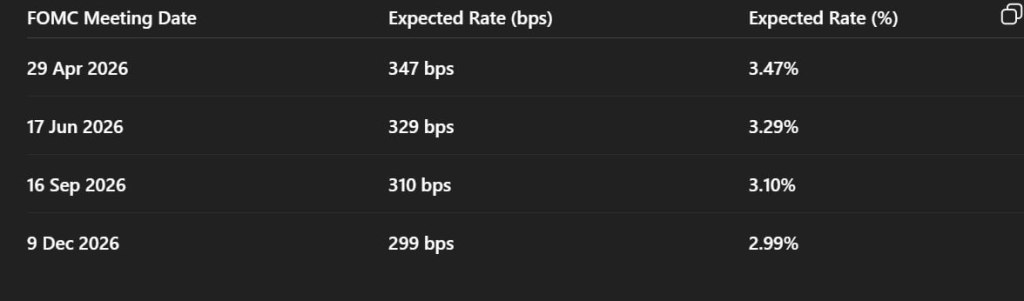
In a post on X, Krüger shared a CME-derived table of implied policy rates for late-stage 2026 and framed it as the market’s baseline for the post-Powell transition. The table shows an expected fed funds rate of 3.47% for the April 29, 2026 FOMC meeting (347 bps), drifting to 3.29% for June 17, 2026 (329 bps), to 3.10% for September 16, 2026 (310 bps), and to 2.99% for December 9, 2026 (299 bps).
Fed rate cut projections

In other words, the curve prices roughly 48 basis points of easing between late April and early December 2026 about two quarter-point cuts across that span—implying a relatively gradual descent toward just under 3%. Krüger’s core claim is that this path is inconsistent with the policy preferences he associates with the Trump camp, and therefore inconsistent with an “ultra dovish” chair appointment. He situates the April 2026 meeting as the last one under Jerome Powell’s chairmanship, whose four-year term ends in mid-May 2026, and then treats the June 2026 meeting as the first under a new chair.

Against that transition, Krüger points to Fed Governor Stephen Miran—whom he casts as a proxy for Trump-world monetary instincts—as advocating a much faster return to neutral. In Krüger’s telling, Miran has argued that the “appropriate fed funds rate” is “roughly 2% to 2.5%,” has linked this year’s tighter stance to a rise in the neutral rate, and has characterized his divergence from colleagues as centered on “speed of cuts,” not destination.

Krüger also highlights Miran’s preference for “50 bps cuts” over 25-bp steps as the way to get policy back to neutral. On Krüger’s arithmetic, a futures curve that delivers only about 50 bps of easing from the first post-Powell meeting in June 2026 through December 2026 is not a curve that has truly priced a Trump-era chair willing to front-load larger moves.

Put simply, he sees the market as still anchored to a Powell-style glide path, even while political risk is skewing toward more abrupt easing. “The Trump camp wants faster and bigger cuts, many of them. The Fed only cutting 50bps between the new Fed Chair’s FOMC in June and December 2026 falls short. That’s why I sustain an ultra dovish Fed Chair appointed by Trump is not priced in,” Krüger concludes.

December Rate Cut Seems Likely

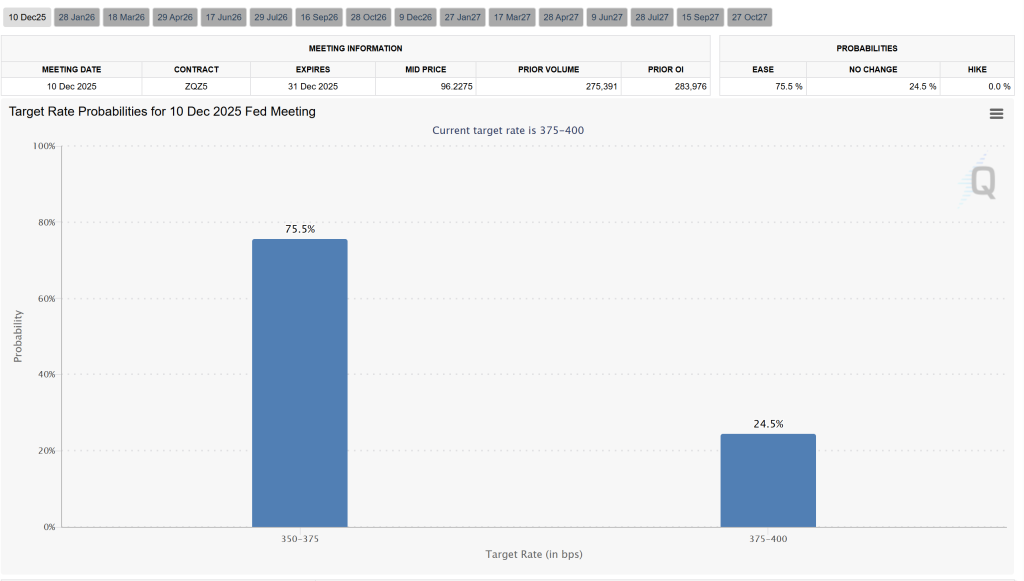
The timing of Krüger’s warning matters because the front end has already undergone a dramatic swing. Last week, traders sharply increased the probability of another cut at the Fed’s December meeting after New York Fed President John Williams said rates could fall “in the near term,” a remark that pushed implied odds of a quarter-point December move into the mid-70% range on CME FedWatch, up from roughly 40% the day before.
CME Fedwatch

In parallel, Goldman Sachs chief economist Jan Hatzius reiterated a baseline in which the Fed cuts in December, then again in March and June 2026, taking the policy band down to roughly 3.00%–3.25%.” We expect another Fed cut in December, followed by two more moves in March and June 2026 that take the funds rate to 3-3.25%,” said Hatzius.

His path is modestly more dovish than what the curve had discounted earlier in the month, but it still resembles the gradualism embedded in Krüger’s CME table: sequential 25-bp steps, aiming for an early-2026 rate around the low-3% area rather than a rapid drop toward the low-2s.

For the crypto markets, the dispute is less about whether cuts are coming than about the speed and terminal rate. Crypto is structurally levered to shifts in dollar liquidity and real-rate expectations; what Krüger is flagging is a scenario where the curve’s “destination” and, especially, its pacing remain too conservative relative to a potential political reorientation of the Fed.

If traders are right that the Williams-sparked repricing is the beginning of a slower, data-dependent easing cycle, then current crypto asset valuations already incorporate the relevant macro impulse.

If Krüger is right, the curve is still missing a regime change in reaction function—one in which larger front-loaded cuts compress cash yields faster than expected, steepen risk-on positioning, and force another round of cross-asset duration and liquidity repricing. That gap between a Powell-era slope and a Trump-era shock path is what he means when he says an ultra-dovish chair “is not priced in” for crypto markets.

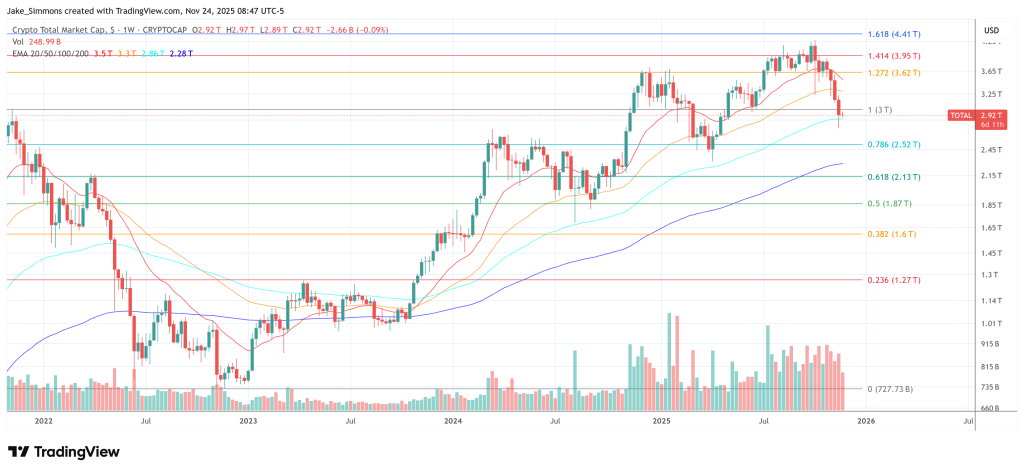
At press time, the total crypto market cap was at $2.92 trillion.
Total crypto market cap
Market Opportunity
OFFICIAL TRUMP Logo
OFFICIAL TRUMP Price(TRUMP)
$4.965
$4.965$4.965
-4.24%
USD
OFFICIAL TRUMP (TRUMP) Live Price Chart
Disclaimer: The articles reposted on this site are sourced from public platforms and are provided for informational purposes only. They do not necessarily reflect the views of MEXC. All rights remain with the original authors. If you believe any content infringes on third-party rights, please contact service@support.mexc.com for removal. MEXC makes no guarantees regarding the accuracy, completeness, or timeliness of the content and is not responsible for any actions taken based on the information provided. The content does not constitute financial, legal, or other professional advice, nor should it be considered a recommendation or endorsement by MEXC.

You May Also Like

SEI to Test Key Resistance at $0.128 Ahead of Potential Bullish Move

SEI to Test Key Resistance at $0.128 Ahead of Potential Bullish Move

SEI shows bullish reversal, targeting key resistance at $0.128 with potential for gains up to $0.136. Watch for price action. SEI has recently shown signs of a
Share
LiveBitcoinNews2026/01/19 12:15
RCBC Adds Motorcycle Loans and Biometric Security to Its Pulz App

RCBC Adds Motorcycle Loans and Biometric Security to Its Pulz App

Rizal Commercial Banking Corporation (RCBC) has announced a significant update to its digital banking platform, RCBC Pulz, scheduled for the first quarter of 2026
Share
Fintechnews2026/01/19 11:54
Hoskinson to Attend Senate Roundtable on Crypto Regulation

Hoskinson to Attend Senate Roundtable on Crypto Regulation

The post Hoskinson to Attend Senate Roundtable on Crypto Regulation appeared on BitcoinEthereumNews.com. Hoskinson confirmed for Senate roundtable on U.S. crypto regulation and market structure. Key topics include SEC vs CFTC oversight split, DeFi regulation, and securities rules. Critics call the roundtable slow, citing Trump’s 2025 executive order as faster. Cardano founder Charles Hoskinson has confirmed that he will attend the Senate Banking Committee roundtable on crypto market structure legislation.  Hoskinson left a hint about his attendance on X while highlighting Journalist Eleanor Terrett’s latest post about the event. Crypto insiders will meet with government officials Terrett shared information gathered from some invitees to the event, noting that a group of leaders from several major cryptocurrency establishments would attend the event. According to Terrett, the group will meet with the Senate Banking Committee leadership in a roundtable to continue talks on market structure regulation. Meanwhile, Terrett noted that the meeting will be held on Thursday, September 18, following an industry review of the committee’s latest approach to distinguishing securities from commodities, DeFi treatment, and other key issues, which has lasted over one week.  Related: Senate Draft Bill Gains Experts’ Praise for Strongest Developer Protections in Crypto Law Notably, the upcoming roundtable between US legislators and crypto industry leaders is a continuation of the process of regularising cryptocurrency regulation in the United States. It is part of the Donald Trump administration’s efforts to provide clarity in the US cryptocurrency ecosystem, which many crypto supporters consider a necessity for the digital asset industry. Despite the ongoing process, some crypto users are unsatisfied with how the US government is handling the issue, particularly the level of bureaucracy involved in creating a lasting cryptocurrency regulatory framework. One such user criticized the process, describing it as a “masterclass in bureaucratic foot-dragging.” According to the critic, America is losing ground to nations already leading in blockchain innovation. He cited…
Share
BitcoinEthereumNews2025/09/18 06:37
