Details the Q-Former architecture: a 12-layer BERT-based model using 32 learnable query embeddings. These queries use cross-attention to extract visual information for MLLM input.Details the Q-Former architecture: a 12-layer BERT-based model using 32 learnable query embeddings. These queries use cross-attention to extract visual information for MLLM input.

Visual Prompt Generation: Cross-Attention in Q-Former

Abstract and 1 Introduction

  1. Related Work

    2.1. Multimodal Learning

    2.2. Multiple Instance Learning

  2. Methodology

    3.1. Preliminaries and Notations

    3.2. Relations between Attention-based VPG and MIL

    3.3. MIVPG for Multiple Visual Inputs

    3.4. Unveiling Instance Correlation in MIVPG for Enhanced Multi-instance Scenarios

  3. Experiments and 4.1. General Setup

    4.2. Scenario 1: Samples with Single Image

    4.3. Scenario 2: Samples with Multiple Images, with Each Image as a General Embedding

    4.4. Scenario 3: Samples with Multiple Images, with Each Image Having Multiple Patches to be Considered and 4.5. Case Study

  4. Conclusion and References

\ Supplementary Material

A. Detailed Architecture of QFormer

B. Proof of Proposition

C. More Experiments

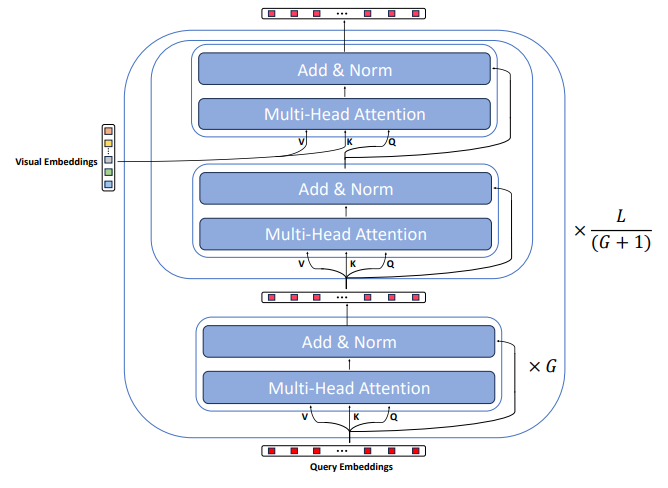
\ Figure 7. Overview of QFormer
A. Detailed Architecture of QFormer

The architecture overview is depicted in Figure 7. Specifically, QFormer is initialized as a BERT-based model[8] comprising a total of L = 12 layers. In contrast to typical BERT models that process textual inputs, QFormer takes R = 32 learnable query embeddings as inputs. These embeddings are utilized to extract visual information from the input visual data during Stage-1 pretraining in BLIP2[22]. Subsequently, they serve as visual prompt embeddings for the LLM inputs after projection.

\ Inside the QFormer, each layer includes a self-attention module composed of a Multi-Head Attention component and a Forward module (consisting of Linear, LayerNorm, and Residual Connection). The cross-attention module, initialized with random values, is inserted every G layers, where learnable query embeddings interact with visual embeddings. In the main paper, for the sake of conciseness, we condensed the representation of the multi-head attention and forward modules into self(cross) attention modules. Furthermore, we exclusively illustrated the modifications made to the cross-attention module in MIVPG, as the self-attention modules remain unchanged. The final QFormer output is represented by the last layer’s query embeddings.

\ For a more comprehensive understanding, readers are encouraged to refer to [22].

\

:::info Authors:

(1) Wenliang Zhong, The University of Texas at Arlington (wxz9204@mavs.uta.edu);

(2) Wenyi Wu, Amazon (wenyiwu@amazon.com);

(3) Qi Li, Amazon (qlimz@amazon.com);

(4) Rob Barton, Amazon (rab@amazon.com);

(5) Boxin Du, Amazon (boxin@amazon.com);

(6) Shioulin Sam, Amazon (shioulin@amazon.com);

(7) Karim Bouyarmane, Amazon (bouykari@amazon.com);

(8) Ismail Tutar, Amazon (ismailt@amazon.com);

(9) Junzhou Huang, The University of Texas at Arlington (jzhuang@uta.edu).

:::


:::info This paper is available on arxiv under CC by 4.0 Deed (Attribution 4.0 International) license.

:::

\

Market Opportunity
Prompt Logo
Prompt Price(PROMPT)
$0,05494
$0,05494$0,05494
-%3,01
USD
Prompt (PROMPT) Live Price Chart
Disclaimer: The articles reposted on this site are sourced from public platforms and are provided for informational purposes only. They do not necessarily reflect the views of MEXC. All rights remain with the original authors. If you believe any content infringes on third-party rights, please contact service@support.mexc.com for removal. MEXC makes no guarantees regarding the accuracy, completeness, or timeliness of the content and is not responsible for any actions taken based on the information provided. The content does not constitute financial, legal, or other professional advice, nor should it be considered a recommendation or endorsement by MEXC.

You May Also Like

The Channel Factories We’ve Been Waiting For

The Channel Factories We’ve Been Waiting For

The post The Channel Factories We’ve Been Waiting For appeared on BitcoinEthereumNews.com. Visions of future technology are often prescient about the broad strokes while flubbing the details. The tablets in “2001: A Space Odyssey” do indeed look like iPads, but you never see the astronauts paying for subscriptions or wasting hours on Candy Crush.  Channel factories are one vision that arose early in the history of the Lightning Network to address some challenges that Lightning has faced from the beginning. Despite having grown to become Bitcoin’s most successful layer-2 scaling solution, with instant and low-fee payments, Lightning’s scale is limited by its reliance on payment channels. Although Lightning shifts most transactions off-chain, each payment channel still requires an on-chain transaction to open and (usually) another to close. As adoption grows, pressure on the blockchain grows with it. The need for a more scalable approach to managing channels is clear. Channel factories were supposed to meet this need, but where are they? In 2025, subnetworks are emerging that revive the impetus of channel factories with some new details that vastly increase their potential. They are natively interoperable with Lightning and achieve greater scale by allowing a group of participants to open a shared multisig UTXO and create multiple bilateral channels, which reduces the number of on-chain transactions and improves capital efficiency. Achieving greater scale by reducing complexity, Ark and Spark perform the same function as traditional channel factories with new designs and additional capabilities based on shared UTXOs.  Channel Factories 101 Channel factories have been around since the inception of Lightning. A factory is a multiparty contract where multiple users (not just two, as in a Dryja-Poon channel) cooperatively lock funds in a single multisig UTXO. They can open, close and update channels off-chain without updating the blockchain for each operation. Only when participants leave or the factory dissolves is an on-chain transaction…
Share
BitcoinEthereumNews2025/09/18 00:09
Will XRP Price Increase In September 2025?

Will XRP Price Increase In September 2025?

Ripple XRP is a cryptocurrency that primarily focuses on building a decentralised payments network to facilitate low-cost and cross-border transactions. It’s a native digital currency of the Ripple network, which works as a blockchain called the XRP Ledger (XRPL). It utilised a shared, distributed ledger to track account balances and transactions. What Do XRP Charts Reveal? […]
Share
Tronweekly2025/09/18 00:00
China Blocks Nvidia’s RTX Pro 6000D as Local Chips Rise

China Blocks Nvidia’s RTX Pro 6000D as Local Chips Rise

The post China Blocks Nvidia’s RTX Pro 6000D as Local Chips Rise appeared on BitcoinEthereumNews.com. China Blocks Nvidia’s RTX Pro 6000D as Local Chips Rise China’s internet regulator has ordered the country’s biggest technology firms, including Alibaba and ByteDance, to stop purchasing Nvidia’s RTX Pro 6000D GPUs. According to the Financial Times, the move shuts down the last major channel for mass supplies of American chips to the Chinese market. Why Beijing Halted Nvidia Purchases Chinese companies had planned to buy tens of thousands of RTX Pro 6000D accelerators and had already begun testing them in servers. But regulators intervened, halting the purchases and signaling stricter controls than earlier measures placed on Nvidia’s H20 chip. Image: Nvidia An audit compared Huawei and Cambricon processors, along with chips developed by Alibaba and Baidu, against Nvidia’s export-approved products. Regulators concluded that Chinese chips had reached performance levels comparable to the restricted U.S. models. This assessment pushed authorities to advise firms to rely more heavily on domestic processors, further tightening Nvidia’s already limited position in China. China’s Drive Toward Tech Independence The decision highlights Beijing’s focus on import substitution — developing self-sufficient chip production to reduce reliance on U.S. supplies. “The signal is now clear: all attention is focused on building a domestic ecosystem,” said a representative of a leading Chinese tech company. Nvidia had unveiled the RTX Pro 6000D in July 2025 during CEO Jensen Huang’s visit to Beijing, in an attempt to keep a foothold in China after Washington restricted exports of its most advanced chips. But momentum is shifting. Industry sources told the Financial Times that Chinese manufacturers plan to triple AI chip production next year to meet growing demand. They believe “domestic supply will now be sufficient without Nvidia.” What It Means for the Future With Huawei, Cambricon, Alibaba, and Baidu stepping up, China is positioning itself for long-term technological independence. Nvidia, meanwhile, faces…
Share
BitcoinEthereumNews2025/09/18 01:37