Balaji Srinivasan has distilled 15 years of crypto experimentation down to a stark claim: after Bitcoin, only two core protocol breakthroughs truly matter—Ethereum for programmability and Zcash for privacy. In a wide-ranging appearance on Mert Mumtaz’s “Accelerate with Mert” podcast, Srinivasan argued that the industry has already completed the “programmability era” and is now entering […]Balaji Srinivasan has distilled 15 years of crypto experimentation down to a stark claim: after Bitcoin, only two core protocol breakthroughs truly matter—Ethereum for programmability and Zcash for privacy. In a wide-ranging appearance on Mert Mumtaz’s “Accelerate with Mert” podcast, Srinivasan argued that the industry has already completed the “programmability era” and is now entering […]

Ethereum and Zcash Are Crypto’s True Innovations Post Bitcoin, Says Balaji

Balaji Srinivasan has distilled 15 years of crypto experimentation down to a stark claim: after Bitcoin, only two core protocol breakthroughs truly matter—Ethereum for programmability and Zcash for privacy.

In a wide-ranging appearance on Mert Mumtaz’s “Accelerate with Mert” podcast, Srinivasan argued that the industry has already completed the “programmability era” and is now entering a decisive phase where privacy and zero-knowledge cryptography become central to crypto’s mission. “The two major innovations on Bitcoin were programmability in the form of Ethereum and privacy in the form of Zcash,” he said.

From Bitcoin To Programmability To Zcash

Srinivasan breaks crypto’s history into three arcs. First, Bitcoin simply had to prove that non-sovereign, cryptographic money could work at all. Then, Ethereum generalized that into a programmable platform with smart contracts, stablecoins, NFTs, DEXs and on-chain capital markets.

By now, he argued, that second phase is effectively validated. “We now have scalable on-chain smart contracts that can support [a] large number of users, large numbers of transactions with finality. There’s multiple good chains. It works. It runs 24/7,” he said, noting that crypto is already functioning in developing markets: “In Bolivia, they quote prices in Tether. In Nigeria, they save in Bitcoin. This stuff is no longer theory. It’s actually there.”

The next phase, he says, is privacy by design. “Now the next eight years… privacy,” Srinivasan said. “Taking everything we just did and encrypting it using ZK.” That includes ZK-based KYC (“ZKYC”), privacy-preserving DEXs, and smart contracts that reveal only the minimum necessary information. He pointed to industry work showing how traditional KYC could be replicated with zero-knowledge proofs: “If you nail ZK then you can replace the entire [compliance] system.”

This is where Zcash matters: not as a marketing brand, but as the first mainstream proof that advanced zero-knowledge privacy can be embedded at the protocol level. Ethereum represents programmability; Zcash represents privacy. In Srinivasan’s framing, the future is about merging those ideas—Ethereum-style expressivity with Zcash-style cryptographic concealment—across L1s, rollups and application-specific systems.

Srinivasan pushed back hard on the idea that crypto is now primarily a speculative or commercial arena. “Crypto isn’t just about the commercial part,” he said. “It’s about the ideological part. It’s about the fact that the banks have failed. It’s about the fact the political system has failed. It’s about the fact that we need an exit. It’s about the fact that we need self-sovereignty. And the missing part of that is privacy.”

He compared this to the way Christmas is often defended by religious believers as more than shopping and Santa. “Remember the reason for the season” becomes, in his telling, a reminder that crypto’s “season” is about exit and self-sovereignty, not just yield, DeFi and token prices. Privacy, he argued, is what reconnects modern “commercial crypto” to those original cypherpunk and anti-censorship roots.

Notably, Srinivasan is a long-time advocate for ZK based technologies. In November 2024, he wrote via X: “Yes, Zcash is great and it’s already fit for purpose. One can continue using it for private transactions. But ZK is to encryption what the transformer is to AI. It generalizes many special case hacks into a new compute paradigm. We will get a ZK economy. So we do want a chain with ZK primitives in addition to a simple Zcash-like chain.”

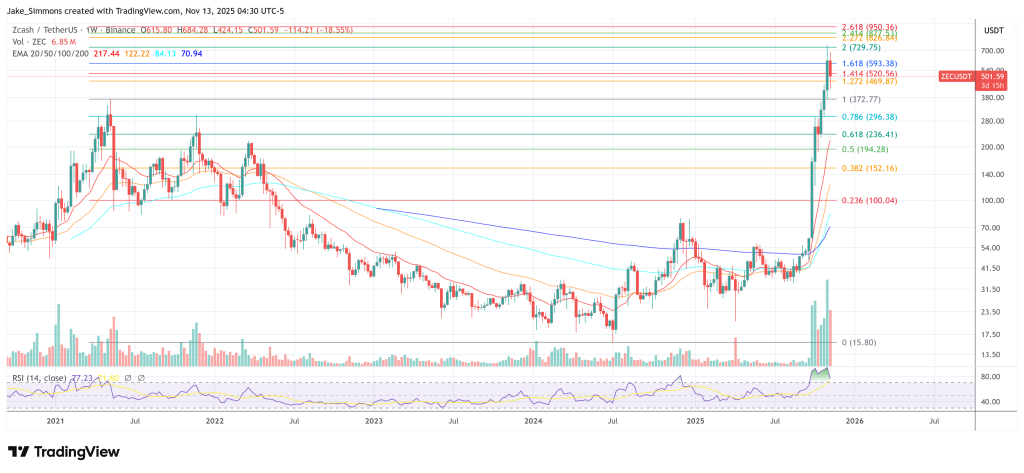
At press time, ZCash traded at $501.59.
Zcash price
Market Opportunity
Core DAO Logo
Core DAO Price(CORE)
$0.1156
$0.1156$0.1156
+0.69%
USD
Core DAO (CORE) Live Price Chart
Disclaimer: The articles reposted on this site are sourced from public platforms and are provided for informational purposes only. They do not necessarily reflect the views of MEXC. All rights remain with the original authors. If you believe any content infringes on third-party rights, please contact service@support.mexc.com for removal. MEXC makes no guarantees regarding the accuracy, completeness, or timeliness of the content and is not responsible for any actions taken based on the information provided. The content does not constitute financial, legal, or other professional advice, nor should it be considered a recommendation or endorsement by MEXC.

You May Also Like

Momentum Check: Can XDC Network Charge Back to Its Recent Highs, or Is a Pullback in Play?

Momentum Check: Can XDC Network Charge Back to Its Recent Highs, or Is a Pullback in Play?

The crypto market’s prolonged bearish fear is gaining more traction day by day, which has pulled down the total market cap toward $2.95 trillion. Meanwhile, most
Share
Thenewscrypto2025/12/27 15:21
Ondo Plans Tokenized U.S. Stocks and ETFs on Solana in 2026 After Low-Slippage Tests
Ondo Plans Tokenized U.S. Stocks and ETFs on Solana in 2026 After Low-Slippage Tests

The post Ondo Plans Tokenized U.S. Stocks and ETFs on Solana in 2026 After Low-Slippage Tests appeared on BitcoinEthereumNews.com. Ondo Finance plans to launch
Share
BitcoinEthereumNews2025/12/27 19:39
Vitalik Buterin Reveals Ethereum’s Bold Plan to Stay Quantum-Secure and Simple!

Vitalik Buterin Reveals Ethereum’s Bold Plan to Stay Quantum-Secure and Simple!

Buterin unveils Ethereum’s strategy to tackle quantum security challenges ahead. Ethereum focuses on simplifying architecture while boosting security for users. Ethereum’s market stability grows as Buterin’s roadmap gains investor confidence. Ethereum founder Vitalik Buterin has unveiled his long-term vision for the blockchain, focusing on making Ethereum quantum-secure while maintaining its simplicity for users. Buterin presented his roadmap at the Japanese Developer Conference, and splits the future of Ethereum into three phases: short-term, mid-term, and long-term. Buterin’s most ambitious goal for Ethereum is to safeguard the blockchain against the threats posed by quantum computing.  The danger of such future developments is that the future may call into question the cryptographic security of most blockchain systems, and Ethereum will be able to remain ahead thanks to more sophisticated mathematical techniques to ensure the safety and integrity of its protocols. Buterin is committed to ensuring that Ethereum evolves in a way that not only meets today’s security challenges but also prepares for the unknowns of tomorrow. Also Read: Ethereum Giant The Ether Machine Takes Major Step Toward Going Public! However, in spite of such high ambitions, Buterin insisted that Ethereum also needed to simplify its architecture. An important aspect of this vision is to remove unnecessary complexity and make Ethereum more accessible and maintainable without losing its strong security capabilities. Security and simplicity form the core of Buterin’s strategy, as they guarantee that the users of Ethereum experience both security and smooth processes. Focus on Speed and Efficiency in the Short-Term In the short term, Buterin aims to enhance Ethereum’s transaction efficiency, a crucial step toward improving scalability and reducing transaction costs. These advantages are attributed to the fact that, within the mid-term, Ethereum is planning to enhance the speed of transactions in layer-2 networks. According to Butterin, this is part of Ethereum’s expansion, particularly because there is still more need to use blockchain technology to date. The other important aspect of Ethereum’s development is the layer-2 solutions. Buterin supports an approach in which the layer-2 networks are dependent on layer-1 to perform some essential tasks like data security, proof, and censorship resistance. This will enable the layer-2 systems of Ethereum to be concerned with verifying and sequencing transactions, which will improve the overall speed and efficiency of the network. Ethereum’s Market Stability Reflects Confidence in Long-Term Strategy Ethereum’s market performance has remained solid, with the cryptocurrency holding steady above $4,000. Currently priced at $4,492.15, Ethereum has experienced a slight 0.93% increase over the last 24 hours, while its trading volume surged by 8.72%, reaching $34.14 billion. These figures point to growing investor confidence in Ethereum’s long-term vision. The crypto community remains optimistic about Ethereum’s future, with many predicting the price could rise to $5,500 by mid-October. Buterin’s clear, forward-thinking strategy continues to build trust in Ethereum as one of the most secure and scalable blockchain platforms in the market. Also Read: Whales Dump 200 Million XRP in Just 2 Weeks – Is XRP’s Price on the Verge of Collapse? The post Vitalik Buterin Reveals Ethereum’s Bold Plan to Stay Quantum-Secure and Simple! appeared first on 36Crypto.
Share
Coinstats2025/09/18 01:22