The post Wall Street Eyes the Fastest Network in Crypto appeared on BitcoinEthereumNews.com. Altcoins In the race to merge traditional finance with blockchain technology, Solana is starting to emerge as the name institutional investors whisper when they talk about speed, scale, and stability. The once retail-focused network, built for lightning-fast transactions, is now being positioned as a possible backbone for Wall Street’s next generation of digital assets. A Quiet Shift in Institutional Attention Matt Hougan, Chief Investment Officer at Bitwise Asset Management, recently pointed out that Solana’s evolution has reached a point where traditional finance can no longer ignore it. Speaking alongside Solana Labs’ Akshay Rajan, Hougan noted that the network’s ability to process transactions in microseconds has placed it squarely on the radar of asset managers and settlement firms looking for real-time systems. Solana’s engineers have reduced finality times from roughly 400 to 150 microseconds – a tiny slice of time that could make a big difference when trillions of dollars move across digital rails. For institutions used to waiting days for settlement, those numbers look like a revolution waiting to happen. Catching Up to Ethereum’s Empire Even with these advances, Solana is still the challenger, not the champion. Ethereum’s ecosystem continues to tower over the rest of the field, commanding nearly $173 billion in stablecoins – more than half the global total when layer-2 networks like Arbitrum, Base, and Polygon are included. Solana, by contrast, hosts just under $14 billion, or about 4.5% of the market. Yet numbers alone don’t tell the full story. Ethereum’s dominance rests on maturity and network effects, while Solana’s appeal lies in performance and cost efficiency. In an industry that prizes innovation over legacy, the underdog narrative might be exactly what gives Solana its momentum. Skeptics Hold Their Ground Not everyone is convinced that faster equals better. AJ Warner of Offchain Labs argues that institutional-grade stability… The post Wall Street Eyes the Fastest Network in Crypto appeared on BitcoinEthereumNews.com. Altcoins In the race to merge traditional finance with blockchain technology, Solana is starting to emerge as the name institutional investors whisper when they talk about speed, scale, and stability. The once retail-focused network, built for lightning-fast transactions, is now being positioned as a possible backbone for Wall Street’s next generation of digital assets. A Quiet Shift in Institutional Attention Matt Hougan, Chief Investment Officer at Bitwise Asset Management, recently pointed out that Solana’s evolution has reached a point where traditional finance can no longer ignore it. Speaking alongside Solana Labs’ Akshay Rajan, Hougan noted that the network’s ability to process transactions in microseconds has placed it squarely on the radar of asset managers and settlement firms looking for real-time systems. Solana’s engineers have reduced finality times from roughly 400 to 150 microseconds – a tiny slice of time that could make a big difference when trillions of dollars move across digital rails. For institutions used to waiting days for settlement, those numbers look like a revolution waiting to happen. Catching Up to Ethereum’s Empire Even with these advances, Solana is still the challenger, not the champion. Ethereum’s ecosystem continues to tower over the rest of the field, commanding nearly $173 billion in stablecoins – more than half the global total when layer-2 networks like Arbitrum, Base, and Polygon are included. Solana, by contrast, hosts just under $14 billion, or about 4.5% of the market. Yet numbers alone don’t tell the full story. Ethereum’s dominance rests on maturity and network effects, while Solana’s appeal lies in performance and cost efficiency. In an industry that prizes innovation over legacy, the underdog narrative might be exactly what gives Solana its momentum. Skeptics Hold Their Ground Not everyone is convinced that faster equals better. AJ Warner of Offchain Labs argues that institutional-grade stability…

Wall Street Eyes the Fastest Network in Crypto

For feedback or concerns regarding this content, please contact us at crypto.news@mexc.com
Altcoins

In the race to merge traditional finance with blockchain technology, Solana is starting to emerge as the name institutional investors whisper when they talk about speed, scale, and stability.

The once retail-focused network, built for lightning-fast transactions, is now being positioned as a possible backbone for Wall Street’s next generation of digital assets.

A Quiet Shift in Institutional Attention

Matt Hougan, Chief Investment Officer at Bitwise Asset Management, recently pointed out that Solana’s evolution has reached a point where traditional finance can no longer ignore it. Speaking alongside Solana Labs’ Akshay Rajan, Hougan noted that the network’s ability to process transactions in microseconds has placed it squarely on the radar of asset managers and settlement firms looking for real-time systems.

Solana’s engineers have reduced finality times from roughly 400 to 150 microseconds – a tiny slice of time that could make a big difference when trillions of dollars move across digital rails. For institutions used to waiting days for settlement, those numbers look like a revolution waiting to happen.

Catching Up to Ethereum’s Empire

Even with these advances, Solana is still the challenger, not the champion. Ethereum’s ecosystem continues to tower over the rest of the field, commanding nearly $173 billion in stablecoins – more than half the global total when layer-2 networks like Arbitrum, Base, and Polygon are included. Solana, by contrast, hosts just under $14 billion, or about 4.5% of the market.

Yet numbers alone don’t tell the full story. Ethereum’s dominance rests on maturity and network effects, while Solana’s appeal lies in performance and cost efficiency. In an industry that prizes innovation over legacy, the underdog narrative might be exactly what gives Solana its momentum.

Skeptics Hold Their Ground

Not everyone is convinced that faster equals better. AJ Warner of Offchain Labs argues that institutional-grade stability still depends on Ethereum’s developer base and tooling. He claims that Solana’s technical lead won’t immediately translate into migration from established EVM systems that already integrate with major financial platforms.

Still, the debate reflects a broader transition within crypto – from ideology to infrastructure. Investors are no longer fixated solely on decentralization or DeFi profits; they’re looking for blockchains that can power stable, high-frequency transactions in the real economy.

Bitwise Bets on Both Sides

Bitwise’s portfolio shows that it’s hedging its optimism. The firm already operates a physical Solana ETP with about $30 million under management, offering regulated exposure for institutions testing the waters. It’s a small product next to its Bitcoin and Ethereum funds, but symbolically, it suggests that Solana’s reputation among serious investors is shifting fast.

A Network on the Brink of Institutional Adoption

If Wall Street does move deeper into tokenized finance, Solana could become the infrastructure layer where stablecoins, real-world assets, and digital settlements converge. What began as a network known for NFTs and gaming is now evolving into a high-speed settlement system that bankers might one day rely on.

The idea of a blockchain built for institutions isn’t new – but Solana’s pitch has something the others often lack: performance that meets enterprise expectations. And in the world of high finance, where time is literally money, that might be enough to change everything.


The information provided in this article is for educational purposes only and does not constitute financial, investment, or trading advice. Coindoo.com does not endorse or recommend any specific investment strategy or cryptocurrency. Always conduct your own research and consult with a licensed financial advisor before making any investment decisions.

Author

Kosta joined the team in 2021 and quickly established himself with his thirst for knowledge, incredible dedication, and analytical thinking. He not only covers a wide range of current topics, but also writes excellent reviews, PR articles, and educational materials. His articles are also quoted by other news agencies.

Related stories


Next article

Source: https://coindoo.com/solana-news-wall-street-eyes-the-fastest-network-in-crypto/

Disclaimer: The articles reposted on this site are sourced from public platforms and are provided for informational purposes only. They do not necessarily reflect the views of MEXC. All rights remain with the original authors. If you believe any content infringes on third-party rights, please contact crypto.news@mexc.com for removal. MEXC makes no guarantees regarding the accuracy, completeness, or timeliness of the content and is not responsible for any actions taken based on the information provided. The content does not constitute financial, legal, or other professional advice, nor should it be considered a recommendation or endorsement by MEXC.

You May Also Like

Polygon Tops RWA Rankings With $1.1B in Tokenized Assets

Polygon Tops RWA Rankings With $1.1B in Tokenized Assets

The post Polygon Tops RWA Rankings With $1.1B in Tokenized Assets appeared on BitcoinEthereumNews.com. Key Notes A new report from Dune and RWA.xyz highlights Polygon’s role in the growing RWA sector. Polygon PoS currently holds $1.13 billion in RWA Total Value Locked (TVL) across 269 assets. The network holds a 62% market share of tokenized global bonds, driven by European money market funds. The Polygon POL $0.25 24h volatility: 1.4% Market cap: $2.64 B Vol. 24h: $106.17 M network is securing a significant position in the rapidly growing tokenization space, now holding over $1.13 billion in total value locked (TVL) from Real World Assets (RWAs). This development comes as the network continues to evolve, recently deploying its major “Rio” upgrade on the Amoy testnet to enhance future scaling capabilities. This information comes from a new joint report on the state of the RWA market published on Sept. 17 by blockchain analytics firm Dune and data platform RWA.xyz. The focus on RWAs is intensifying across the industry, coinciding with events like the ongoing Real-World Asset Summit in New York. Sandeep Nailwal, CEO of the Polygon Foundation, highlighted the findings via a post on X, noting that the TVL is spread across 269 assets and 2,900 holders on the Polygon PoS chain. The Dune and https://t.co/W6WSFlHoQF report on RWA is out and it shows that RWA is happening on Polygon. Here are a few highlights: – Leading in Global Bonds: Polygon holds 62% share of tokenized global bonds (driven by Spiko’s euro MMF and Cashlink euro issues) – Spiko U.S.… — Sandeep | CEO, Polygon Foundation (※,※) (@sandeepnailwal) September 17, 2025 Key Trends From the 2025 RWA Report The joint publication, titled “RWA REPORT 2025,” offers a comprehensive look into the tokenized asset landscape, which it states has grown 224% since the start of 2024. The report identifies several key trends driving this expansion. According to…
Share
BitcoinEthereumNews2025/09/18 00:40
Oil Jumps Above $90 as Iran Tensions Rise, Crypto Markets React

Oil Jumps Above $90 as Iran Tensions Rise, Crypto Markets React

The post Oil Jumps Above $90 as Iran Tensions Rise, Crypto Markets React appeared on BitcoinEthereumNews.com. Crypto sells off with Bitcoin as the Fear and Greed
Share
BitcoinEthereumNews2026/03/07 23:19
XRP Price Prediction: Ripple Tests Support Amid Downside Risks

XRP Price Prediction: Ripple Tests Support Amid Downside Risks

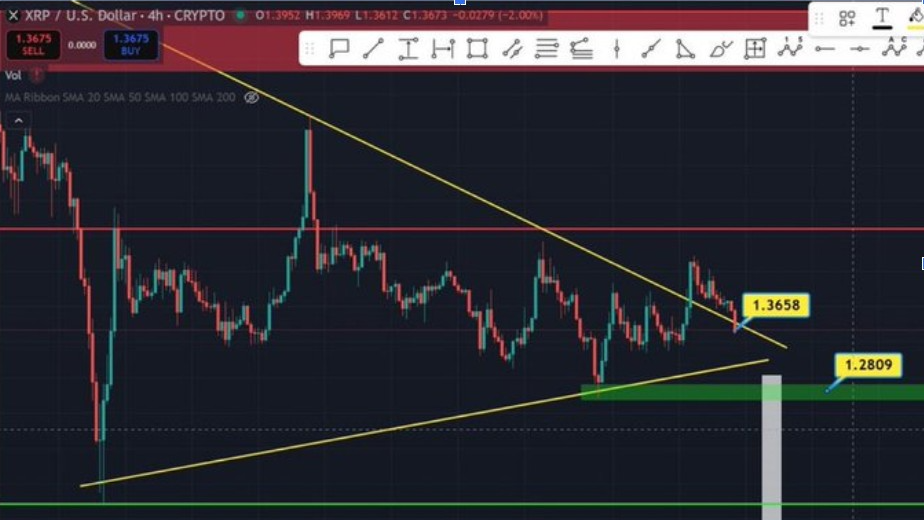
Key Insights: XRP price is trading at a fragile support zone. With this, analysts are focusing on whether the market can hold above $1.28. Recent charts show the
Share
Themarketperiodical2026/03/07 23:33