From Hype to Trust: The Evolution of Crypto Marketing If you’ve been around crypto long enough, you know the marketing game has changed massively. What used to be wild, quick hype filled now feels more like real brand building. In just a few years, the way projects “sell” themselves has gone from rocket emojis and airdrops to trust, community, and smarter strategies. Let’s take a little tour of how we got here. The Early Days (2017–2018) Back in the ICO boom, the steps for “success” was ridiculously simple: And just like that with a little help of FOMO, millions of dollars rolled in. It was exciting, sure. Every week felt like a new moonshot. But it was also messy. Scams popped up left and right, and projects cared more about buzz than actual trust. If you remember, Reddit threads were basically digital gold rush towns -lots of shouting, lots of hype, but not a lot of substance. The Wake-Up Call (2019–2021) Then reality hit. Regulators stepped in as scams looted investors, and people stopped buying into empty promises like a relationship that looked it will land but never landed and investors were tired they wanted commitment and loyalty. Projects realized: if we don’t build trust, we don’t survive. So, marketing started to evolve. Instead of quick speculative hype and quick gains, the focus shifted to long-term community building. Discord and Telegram stopped being spammy hype channels and turned into homes for real discussions. On top of that, projects started putting in real effort with: By this time, the goal changed from attracting short-term speculators to building an engaging community of crypto enthusiasts. Things got serious Era (2022–2024) This is where things got serious. Projects began thinking long-term. Suddenly: Crypto marketing started looking polished. Websites started to look corporate, messaging became clearer, and trust was the key. It wasn’t perfect, but compared to 2017, it was a glow-up. Cryptomarketing Today (2025) Now? Marketing in crypto is unrecognizable compared to those early days. The playbook today looks like this:Simple tabular representation of Crypto Tactics: Then vs. Now So Where Are We Headed? Crypto marketing has grown up from hype to trust, from quick hype chaos to strategy. The winners now are those who play the long game: build real communities, stay transparent, and make people feel part of something bigger than just a token. But here’s the million-dollar question: 👉 If crypto marketing today is all about trust and data driven strategies then what about user privacy? Evolution Of Crypto Marketing was originally published in Coinmonks on Medium, where people are continuing the conversation by highlighting and responding to this storyFrom Hype to Trust: The Evolution of Crypto Marketing If you’ve been around crypto long enough, you know the marketing game has changed massively. What used to be wild, quick hype filled now feels more like real brand building. In just a few years, the way projects “sell” themselves has gone from rocket emojis and airdrops to trust, community, and smarter strategies. Let’s take a little tour of how we got here. The Early Days (2017–2018) Back in the ICO boom, the steps for “success” was ridiculously simple: And just like that with a little help of FOMO, millions of dollars rolled in. It was exciting, sure. Every week felt like a new moonshot. But it was also messy. Scams popped up left and right, and projects cared more about buzz than actual trust. If you remember, Reddit threads were basically digital gold rush towns -lots of shouting, lots of hype, but not a lot of substance. The Wake-Up Call (2019–2021) Then reality hit. Regulators stepped in as scams looted investors, and people stopped buying into empty promises like a relationship that looked it will land but never landed and investors were tired they wanted commitment and loyalty. Projects realized: if we don’t build trust, we don’t survive. So, marketing started to evolve. Instead of quick speculative hype and quick gains, the focus shifted to long-term community building. Discord and Telegram stopped being spammy hype channels and turned into homes for real discussions. On top of that, projects started putting in real effort with: By this time, the goal changed from attracting short-term speculators to building an engaging community of crypto enthusiasts. Things got serious Era (2022–2024) This is where things got serious. Projects began thinking long-term. Suddenly: Crypto marketing started looking polished. Websites started to look corporate, messaging became clearer, and trust was the key. It wasn’t perfect, but compared to 2017, it was a glow-up. Cryptomarketing Today (2025) Now? Marketing in crypto is unrecognizable compared to those early days. The playbook today looks like this:Simple tabular representation of Crypto Tactics: Then vs. Now So Where Are We Headed? Crypto marketing has grown up from hype to trust, from quick hype chaos to strategy. The winners now are those who play the long game: build real communities, stay transparent, and make people feel part of something bigger than just a token. But here’s the million-dollar question: 👉 If crypto marketing today is all about trust and data driven strategies then what about user privacy? Evolution Of Crypto Marketing was originally published in Coinmonks on Medium, where people are continuing the conversation by highlighting and responding to this story

Evolution Of Crypto Marketing

2025/10/03 13:59

From Hype to Trust: The Evolution of Crypto Marketing

If you’ve been around crypto long enough, you know the marketing game has changed massively. What used to be wild, quick hype filled now feels more like real brand building. In just a few years, the way projects “sell” themselves has gone from rocket emojis and airdrops to trust, community, and smarter strategies.

Let’s take a little tour of how we got here.

The Early Days (2017–2018)

Back in the ICO boom, the steps for “success” was ridiculously simple:

And just like that with a little help of FOMO, millions of dollars rolled in.

It was exciting, sure. Every week felt like a new moonshot. But it was also messy. Scams popped up left and right, and projects cared more about buzz than actual trust. If you remember, Reddit threads were basically digital gold rush towns -lots of shouting, lots of hype, but not a lot of substance.

The Wake-Up Call (2019–2021)

Then reality hit. Regulators stepped in as scams looted investors, and people stopped buying into empty promises like a relationship that looked it will land but never landed and investors were tired they wanted commitment and loyalty. Projects realized: if we don’t build trust, we don’t survive.

So, marketing started to evolve. Instead of quick speculative hype and quick gains, the focus shifted to long-term community building. Discord and Telegram stopped being spammy hype channels and turned into homes for real discussions.

On top of that, projects started putting in real effort with:

By this time, the goal changed from attracting short-term speculators to building an engaging community of crypto enthusiasts.

Things got serious Era (2022–2024)

This is where things got serious. Projects began thinking long-term. Suddenly:

Crypto marketing started looking polished. Websites started to look corporate, messaging became clearer, and trust was the key. It wasn’t perfect, but compared to 2017, it was a glow-up.

Cryptomarketing Today (2025)

Now? Marketing in crypto is unrecognizable compared to those early days.

The playbook today looks like this:

Simple tabular representation of Crypto Tactics: Then vs. Now

So Where Are We Headed?

Crypto marketing has grown up from hype to trust, from quick hype chaos to strategy. The winners now are those who play the long game: build real communities, stay transparent, and make people feel part of something bigger than just a token.

But here’s the million-dollar question:

👉 If crypto marketing today is all about trust and data driven strategies then what about user privacy?


Evolution Of Crypto Marketing was originally published in Coinmonks on Medium, where people are continuing the conversation by highlighting and responding to this story.

Disclaimer: The articles reposted on this site are sourced from public platforms and are provided for informational purposes only. They do not necessarily reflect the views of MEXC. All rights remain with the original authors. If you believe any content infringes on third-party rights, please contact service@support.mexc.com for removal. MEXC makes no guarantees regarding the accuracy, completeness, or timeliness of the content and is not responsible for any actions taken based on the information provided. The content does not constitute financial, legal, or other professional advice, nor should it be considered a recommendation or endorsement by MEXC.

You May Also Like

Best Crypto to Buy as Saylor & Crypto Execs Meet in US Treasury Council

Best Crypto to Buy as Saylor & Crypto Execs Meet in US Treasury Council

The post Best Crypto to Buy as Saylor & Crypto Execs Meet in US Treasury Council appeared on BitcoinEthereumNews.com. Michael Saylor and a group of crypto executives met in Washington, D.C. yesterday to push for the Strategic Bitcoin Reserve Bill (the BITCOIN Act), which would see the U.S. acquire up to 1M $BTC over five years. With Bitcoin being positioned yet again as a cornerstone of national monetary policy, many investors are turning their eyes to projects that lean into this narrative – altcoins, meme coins, and presales that could ride on the same wave. Read on for three of the best crypto projects that seem especially well‐suited to benefit from this macro shift:  Bitcoin Hyper, Best Wallet Token, and Remittix. These projects stand out for having a strong use case and high adoption potential, especially given the push for a U.S. Bitcoin reserve.   Why the Bitcoin Reserve Bill Matters for Crypto Markets The strategic Bitcoin Reserve Bill could mark a turning point for the U.S. approach to digital assets. The proposal would see America build a long-term Bitcoin reserve by acquiring up to one million $BTC over five years. To make this happen, lawmakers are exploring creative funding methods such as revaluing old gold certificates. The plan also leans on confiscated Bitcoin already held by the government, worth an estimated $15–20B. This isn’t just a headline for policy wonks. It signals that Bitcoin is moving from the margins into the core of financial strategy. Industry figures like Michael Saylor, Senator Cynthia Lummis, and Marathon Digital’s Fred Thiel are all backing the bill. They see Bitcoin not just as an investment, but as a hedge against systemic risks. For the wider crypto market, this opens the door for projects tied to Bitcoin and the infrastructure that supports it. 1. Bitcoin Hyper ($HYPER) – Turning Bitcoin Into More Than Just Digital Gold The U.S. may soon treat Bitcoin as…
Share
BitcoinEthereumNews2025/09/18 00:27
XLM Price Prediction: Targets $0.25-$0.27 by February 2026
XLM Price Prediction: Targets $0.25-$0.27 by February 2026

The post XLM Price Prediction: Targets $0.25-$0.27 by February 2026 appeared on BitcoinEthereumNews.com. Ted Hisokawa Jan 23, 2026 05:42 Stellar (XLM) consolidates
Share
BitcoinEthereumNews2026/01/23 23:04
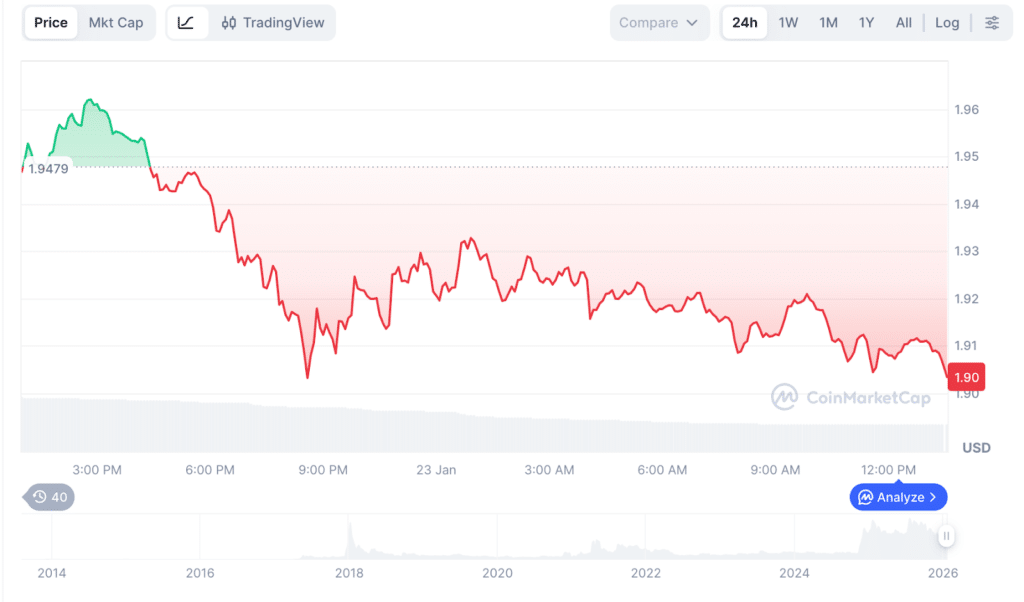
Will XRP Price Break Above $2 or Fall Below $1.80?

Will XRP Price Break Above $2 or Fall Below $1.80?

This article was first published on The Bit Journal. XRP price analysis.“XRP around at $1.91: Will It Explode or Implode?” XRP is teetering on the edge, approximately
Share
Coinstats2026/01/23 23:00