Raoul Pal believes the crypto cycle is not nearing a peak but entering a longer, more powerful expansion that can run well into 2026, driven by a global liquidity uptrend tied to government debt dynamics. In a special Sept. 25 “Everything Code” masterclass with Global Macro Investor (GMI) head of macro research Julien Bittel, the Real Vision co-founder laid out a tightly interlocked framework connecting demographics, debt, liquidity and the business cycle to asset returns—arguing that crypto and tech remain the only asset classes structurally capable of outpacing what he calls the hidden debasement of fiat. Everything Code: Liquidity Is Crypto’s Master Switch “The biggest macro variable of all time,” Pal said, “is that global governments and central banks are increasing liquidity to manage debt at 8% a year.” He separated that ongoing debasement from measured inflation, warning investors to think in hurdle rates, not headlines: “You’ve got an 11% hurdle rate on any investment that you have. If your investments are not hitting 11% you are getting poorer.” Pal and Bittel’s “Everything Code” starts with trend GDP as the sum of population growth, productivity and debt growth. With working-age populations declining and productivity subdued, public debt has filled the gap—structurally lifting debt-to-GDP and hard-wiring the need for liquidity. “Demographics are destiny,” Pal said, pointing to a falling labor-force participation rate that, in GMI’s work, mirrors the inexorable rise in government debt as a share of GDP. The bridge between the two, they argue, is the liquidity toolkit—balance sheets, the Treasury General Account (TGA), reverse repos and banking-system channels—deployed in cycles to finance interest costs that the economy cannot organically bear. “If trend growth is ~2% and rates are 4%, that gap has to be monetized,” Pal said. “It’s a story as old as the hills.” Related Reading: All-Time Highs For Gold, S&P500; Crypto Stands Alone In The Red – What’s The Root Cause? Bittel then mapped what he called the “dominoes.” GMI’s Financial Conditions Index—an econometric blend of commodities, the dollar and rates—leads total liquidity by roughly three months; total liquidity leads the ISM manufacturing index by about six months; and the ISM, in turn, sets the tone for earnings, cyclicals and crypto beta. “Our job is to live in the future,” Bittel said. “Financial conditions lead the ISM by nine months. Liquidity leads by six. That sequence is what risk markets actually trade.” In that sequence, crypto is not an outlier but a high-beta macro asset. “Bitcoin is the ISM,” Bittel said, noting that the same diffusion-index dynamics that govern small-cap equities, cyclicals, crude and emerging markets also map onto BTC and ETH. As the cycle accelerates from sub-50 ISM toward the high-50s, risk appetite migrates down the curve: first from BTC into ETH, then into large alternative L1s and, only later, into smaller caps—coinciding with falling BTC dominance. Pal cautioned investors who expect “instant altseason” that they are fighting the phasing of the real economy: “It always goes into the next safest asset first… only when the ISM is really pushing higher and dominance is falling hard do you get the rest.” Part of the recent “sideways chop,” they argued, reflected a sharp TGA rebuild—an exogenous liquidity drain that disproportionately impacts the far end of the risk curve. Bittel highlighted that the $500 billion rate of change since mid-July effectively removed fuel that otherwise would have buoyed crypto prices, while stressing that the drain is nearing an inflection. He also flagged DeMark timing signals pointing to a reversal in the TGA’s contribution to net liquidity. “That should now reverse and work lower into year-end, which then will drive our liquidity composites higher,” he said, adding that the People’s Bank of China’s balance sheet at all-time highs has partially offset US drags. Against that backdrop, the pair contend that the forthcoming 12 months are critical. “We’ve got $9 trillion of debt to roll over the next 12 months,” Pal said. “This is the 12 months where maximum money printing comes.” Their base case has policy rates moving lower into a still-subdued but improving cycle, with central banks focused on lagging mandates—unemployment and core services inflation—while early-cycle inflation breadth remains contained. Bittel underscored the sequencing inside inflation itself: commodities first, then goods, with shelter disinflation mechanically lagging, giving central banks cover to cut even as growth accelerates. The implication for portfolio construction, Pal argued, is radical. “Diversification is dead. The best thing is hyper-concentration,” he said, framing the choice not as a taste for volatility but as arithmetic survival against debasement. In GMI’s long-horizon tables, most traditional assets underperform the combined debasement-plus-inflation hurdle, while the Nasdaq earns excess returns over liquidity and Bitcoin dwarfs both. “What is the point of owning any other asset?” Pal asked rhetorically. “This is the super-massive black hole of assets, which is why we personally are all-in on crypto… It’s the greatest macro trade of all time.” Related Reading: Crypto Bloodbath Shakes Market—But Is The Real Storm Still To Come? Bittel overlaid Bitcoin’s log-regression channel—what Pal called the “network adoption rails”—on the ISM to illustrate how time and cycle amplitude interact. Because adoption drifts price targets higher through time, longer cycles mechanically point to higher potential outcomes. He showed illustrative channel levels tied to hypothetical ISM prints to explain the mechanism, from mid-$200Ks if the ISM rises into the low-50s to materially higher if the cycle extends toward the low-60s. The numbers were not presented as forecasts but as a map for how cycle strength translates into range-bound fair value bands. Macro Liquidity Extends The Crypto Bull Run Critically, Pal and Bittel argued the current cycle differs from 2020–2021, when both liquidity and the ISM peaked in March 2021, truncating the run. Today, they say, liquidity is re-accelerating into the debt-refinancing window and the ISM is still below 50 with forward indicators pointing up, setting up a 2017-style Q4 impulse with seasonal tailwinds—and, unlike 2017, a higher probability that strength spills into 2026 because the refinancing cycle itself has lengthened. “It is extremely unlikely that it tops this year,” Pal said. “The ISM just isn’t there, and global liquidity isn’t either.” The framework also locates crypto within a broader secular S-curve. Pal contrasted fiat debasement, which lifts asset prices, with GDP-anchored earnings and wages, which lag—explaining why traditional valuation optics look stretched and why owning long-duration, network-effect assets becomes existential. He placed crypto’s user growth at roughly double the internet’s at a comparable stage and argued that tokens uniquely allow investors to own the infrastructure layer of the next web. On total addressable value, he applied the same log-trend framing to the entire digital asset market, sketching a path from roughly $4 trillion today toward a potential $100 trillion by the early 2030s if the space tracks its “fair value” adoption channel, with Bitcoin ultimately occupying a role analogous to gold inside a much larger digital asset stack. Pal closed with operational advice consistent with a longer, liquidity-driven expansion: maintain exposure to proven, large-cap crypto networks, avoid leverage that forces capitulation during routine 20–30% drawdowns, and match time horizon to the macro clock rather than headlines. “We’re four percent of the way there,” he said. “Your job is to not mess this up.” At press time, the total crypto market cap stood at $3.67 trillion. Featured image created with DALL.E, chart from TradingView.comRaoul Pal believes the crypto cycle is not nearing a peak but entering a longer, more powerful expansion that can run well into 2026, driven by a global liquidity uptrend tied to government debt dynamics. In a special Sept. 25 “Everything Code” masterclass with Global Macro Investor (GMI) head of macro research Julien Bittel, the Real Vision co-founder laid out a tightly interlocked framework connecting demographics, debt, liquidity and the business cycle to asset returns—arguing that crypto and tech remain the only asset classes structurally capable of outpacing what he calls the hidden debasement of fiat. Everything Code: Liquidity Is Crypto’s Master Switch “The biggest macro variable of all time,” Pal said, “is that global governments and central banks are increasing liquidity to manage debt at 8% a year.” He separated that ongoing debasement from measured inflation, warning investors to think in hurdle rates, not headlines: “You’ve got an 11% hurdle rate on any investment that you have. If your investments are not hitting 11% you are getting poorer.” Pal and Bittel’s “Everything Code” starts with trend GDP as the sum of population growth, productivity and debt growth. With working-age populations declining and productivity subdued, public debt has filled the gap—structurally lifting debt-to-GDP and hard-wiring the need for liquidity. “Demographics are destiny,” Pal said, pointing to a falling labor-force participation rate that, in GMI’s work, mirrors the inexorable rise in government debt as a share of GDP. The bridge between the two, they argue, is the liquidity toolkit—balance sheets, the Treasury General Account (TGA), reverse repos and banking-system channels—deployed in cycles to finance interest costs that the economy cannot organically bear. “If trend growth is ~2% and rates are 4%, that gap has to be monetized,” Pal said. “It’s a story as old as the hills.” Related Reading: All-Time Highs For Gold, S&P500; Crypto Stands Alone In The Red – What’s The Root Cause? Bittel then mapped what he called the “dominoes.” GMI’s Financial Conditions Index—an econometric blend of commodities, the dollar and rates—leads total liquidity by roughly three months; total liquidity leads the ISM manufacturing index by about six months; and the ISM, in turn, sets the tone for earnings, cyclicals and crypto beta. “Our job is to live in the future,” Bittel said. “Financial conditions lead the ISM by nine months. Liquidity leads by six. That sequence is what risk markets actually trade.” In that sequence, crypto is not an outlier but a high-beta macro asset. “Bitcoin is the ISM,” Bittel said, noting that the same diffusion-index dynamics that govern small-cap equities, cyclicals, crude and emerging markets also map onto BTC and ETH. As the cycle accelerates from sub-50 ISM toward the high-50s, risk appetite migrates down the curve: first from BTC into ETH, then into large alternative L1s and, only later, into smaller caps—coinciding with falling BTC dominance. Pal cautioned investors who expect “instant altseason” that they are fighting the phasing of the real economy: “It always goes into the next safest asset first… only when the ISM is really pushing higher and dominance is falling hard do you get the rest.” Part of the recent “sideways chop,” they argued, reflected a sharp TGA rebuild—an exogenous liquidity drain that disproportionately impacts the far end of the risk curve. Bittel highlighted that the $500 billion rate of change since mid-July effectively removed fuel that otherwise would have buoyed crypto prices, while stressing that the drain is nearing an inflection. He also flagged DeMark timing signals pointing to a reversal in the TGA’s contribution to net liquidity. “That should now reverse and work lower into year-end, which then will drive our liquidity composites higher,” he said, adding that the People’s Bank of China’s balance sheet at all-time highs has partially offset US drags. Against that backdrop, the pair contend that the forthcoming 12 months are critical. “We’ve got $9 trillion of debt to roll over the next 12 months,” Pal said. “This is the 12 months where maximum money printing comes.” Their base case has policy rates moving lower into a still-subdued but improving cycle, with central banks focused on lagging mandates—unemployment and core services inflation—while early-cycle inflation breadth remains contained. Bittel underscored the sequencing inside inflation itself: commodities first, then goods, with shelter disinflation mechanically lagging, giving central banks cover to cut even as growth accelerates. The implication for portfolio construction, Pal argued, is radical. “Diversification is dead. The best thing is hyper-concentration,” he said, framing the choice not as a taste for volatility but as arithmetic survival against debasement. In GMI’s long-horizon tables, most traditional assets underperform the combined debasement-plus-inflation hurdle, while the Nasdaq earns excess returns over liquidity and Bitcoin dwarfs both. “What is the point of owning any other asset?” Pal asked rhetorically. “This is the super-massive black hole of assets, which is why we personally are all-in on crypto… It’s the greatest macro trade of all time.” Related Reading: Crypto Bloodbath Shakes Market—But Is The Real Storm Still To Come? Bittel overlaid Bitcoin’s log-regression channel—what Pal called the “network adoption rails”—on the ISM to illustrate how time and cycle amplitude interact. Because adoption drifts price targets higher through time, longer cycles mechanically point to higher potential outcomes. He showed illustrative channel levels tied to hypothetical ISM prints to explain the mechanism, from mid-$200Ks if the ISM rises into the low-50s to materially higher if the cycle extends toward the low-60s. The numbers were not presented as forecasts but as a map for how cycle strength translates into range-bound fair value bands. Macro Liquidity Extends The Crypto Bull Run Critically, Pal and Bittel argued the current cycle differs from 2020–2021, when both liquidity and the ISM peaked in March 2021, truncating the run. Today, they say, liquidity is re-accelerating into the debt-refinancing window and the ISM is still below 50 with forward indicators pointing up, setting up a 2017-style Q4 impulse with seasonal tailwinds—and, unlike 2017, a higher probability that strength spills into 2026 because the refinancing cycle itself has lengthened. “It is extremely unlikely that it tops this year,” Pal said. “The ISM just isn’t there, and global liquidity isn’t either.” The framework also locates crypto within a broader secular S-curve. Pal contrasted fiat debasement, which lifts asset prices, with GDP-anchored earnings and wages, which lag—explaining why traditional valuation optics look stretched and why owning long-duration, network-effect assets becomes existential. He placed crypto’s user growth at roughly double the internet’s at a comparable stage and argued that tokens uniquely allow investors to own the infrastructure layer of the next web. On total addressable value, he applied the same log-trend framing to the entire digital asset market, sketching a path from roughly $4 trillion today toward a potential $100 trillion by the early 2030s if the space tracks its “fair value” adoption channel, with Bitcoin ultimately occupying a role analogous to gold inside a much larger digital asset stack. Pal closed with operational advice consistent with a longer, liquidity-driven expansion: maintain exposure to proven, large-cap crypto networks, avoid leverage that forces capitulation during routine 20–30% drawdowns, and match time horizon to the macro clock rather than headlines. “We’re four percent of the way there,” he said. “Your job is to not mess this up.” At press time, the total crypto market cap stood at $3.67 trillion. Featured image created with DALL.E, chart from TradingView.com
Liquidity Wave Extends The Crypto Bull Run Into 2026, Predicts Raoul Pal

2025/09/27 09:00
6 min read

Raoul Pal believes the crypto cycle is not nearing a peak but entering a longer, more powerful expansion that can run well into 2026, driven by a global liquidity uptrend tied to government debt dynamics. In a special Sept. 25 “Everything Code” masterclass with Global Macro Investor (GMI) head of macro research Julien Bittel, the Real Vision co-founder laid out a tightly interlocked framework connecting demographics, debt, liquidity and the business cycle to asset returns—arguing that crypto and tech remain the only asset classes structurally capable of outpacing what he calls the hidden debasement of fiat.

Everything Code: Liquidity Is Crypto’s Master Switch

“The biggest macro variable of all time,” Pal said, “is that global governments and central banks are increasing liquidity to manage debt at 8% a year.” He separated that ongoing debasement from measured inflation, warning investors to think in hurdle rates, not headlines: “You’ve got an 11% hurdle rate on any investment that you have. If your investments are not hitting 11% you are getting poorer.”

Pal and Bittel’s “Everything Code” starts with trend GDP as the sum of population growth, productivity and debt growth. With working-age populations declining and productivity subdued, public debt has filled the gap—structurally lifting debt-to-GDP and hard-wiring the need for liquidity.

“Demographics are destiny,” Pal said, pointing to a falling labor-force participation rate that, in GMI’s work, mirrors the inexorable rise in government debt as a share of GDP. The bridge between the two, they argue, is the liquidity toolkit—balance sheets, the Treasury General Account (TGA), reverse repos and banking-system channels—deployed in cycles to finance interest costs that the economy cannot organically bear. “If trend growth is ~2% and rates are 4%, that gap has to be monetized,” Pal said. “It’s a story as old as the hills.”

Bittel then mapped what he called the “dominoes.” GMI’s Financial Conditions Index—an econometric blend of commodities, the dollar and rates—leads total liquidity by roughly three months; total liquidity leads the ISM manufacturing index by about six months; and the ISM, in turn, sets the tone for earnings, cyclicals and crypto beta. “Our job is to live in the future,” Bittel said. “Financial conditions lead the ISM by nine months. Liquidity leads by six. That sequence is what risk markets actually trade.”

In that sequence, crypto is not an outlier but a high-beta macro asset. “Bitcoin is the ISM,” Bittel said, noting that the same diffusion-index dynamics that govern small-cap equities, cyclicals, crude and emerging markets also map onto BTC and ETH.

As the cycle accelerates from sub-50 ISM toward the high-50s, risk appetite migrates down the curve: first from BTC into ETH, then into large alternative L1s and, only later, into smaller caps—coinciding with falling BTC dominance. Pal cautioned investors who expect “instant altseason” that they are fighting the phasing of the real economy: “It always goes into the next safest asset first… only when the ISM is really pushing higher and dominance is falling hard do you get the rest.”

Part of the recent “sideways chop,” they argued, reflected a sharp TGA rebuild—an exogenous liquidity drain that disproportionately impacts the far end of the risk curve. Bittel highlighted that the $500 billion rate of change since mid-July effectively removed fuel that otherwise would have buoyed crypto prices, while stressing that the drain is nearing an inflection.

He also flagged DeMark timing signals pointing to a reversal in the TGA’s contribution to net liquidity. “That should now reverse and work lower into year-end, which then will drive our liquidity composites higher,” he said, adding that the People’s Bank of China’s balance sheet at all-time highs has partially offset US drags.

Against that backdrop, the pair contend that the forthcoming 12 months are critical. “We’ve got $9 trillion of debt to roll over the next 12 months,” Pal said. “This is the 12 months where maximum money printing comes.” Their base case has policy rates moving lower into a still-subdued but improving cycle, with central banks focused on lagging mandates—unemployment and core services inflation—while early-cycle inflation breadth remains contained. Bittel underscored the sequencing inside inflation itself: commodities first, then goods, with shelter disinflation mechanically lagging, giving central banks cover to cut even as growth accelerates.

The implication for portfolio construction, Pal argued, is radical. “Diversification is dead. The best thing is hyper-concentration,” he said, framing the choice not as a taste for volatility but as arithmetic survival against debasement. In GMI’s long-horizon tables, most traditional assets underperform the combined debasement-plus-inflation hurdle, while the Nasdaq earns excess returns over liquidity and Bitcoin dwarfs both. “What is the point of owning any other asset?” Pal asked rhetorically. “This is the super-massive black hole of assets, which is why we personally are all-in on crypto… It’s the greatest macro trade of all time.”

Bittel overlaid Bitcoin’s log-regression channel—what Pal called the “network adoption rails”—on the ISM to illustrate how time and cycle amplitude interact. Because adoption drifts price targets higher through time, longer cycles mechanically point to higher potential outcomes. He showed illustrative channel levels tied to hypothetical ISM prints to explain the mechanism, from mid-$200Ks if the ISM rises into the low-50s to materially higher if the cycle extends toward the low-60s. The numbers were not presented as forecasts but as a map for how cycle strength translates into range-bound fair value bands.

Macro Liquidity Extends The Crypto Bull Run

Critically, Pal and Bittel argued the current cycle differs from 2020–2021, when both liquidity and the ISM peaked in March 2021, truncating the run. Today, they say, liquidity is re-accelerating into the debt-refinancing window and the ISM is still below 50 with forward indicators pointing up, setting up a 2017-style Q4 impulse with seasonal tailwinds—and, unlike 2017, a higher probability that strength spills into 2026 because the refinancing cycle itself has lengthened. “It is extremely unlikely that it tops this year,” Pal said. “The ISM just isn’t there, and global liquidity isn’t either.”

The framework also locates crypto within a broader secular S-curve. Pal contrasted fiat debasement, which lifts asset prices, with GDP-anchored earnings and wages, which lag—explaining why traditional valuation optics look stretched and why owning long-duration, network-effect assets becomes existential.

He placed crypto’s user growth at roughly double the internet’s at a comparable stage and argued that tokens uniquely allow investors to own the infrastructure layer of the next web. On total addressable value, he applied the same log-trend framing to the entire digital asset market, sketching a path from roughly $4 trillion today toward a potential $100 trillion by the early 2030s if the space tracks its “fair value” adoption channel, with Bitcoin ultimately occupying a role analogous to gold inside a much larger digital asset stack.

Pal closed with operational advice consistent with a longer, liquidity-driven expansion: maintain exposure to proven, large-cap crypto networks, avoid leverage that forces capitulation during routine 20–30% drawdowns, and match time horizon to the macro clock rather than headlines. “We’re four percent of the way there,” he said. “Your job is to not mess this up.”

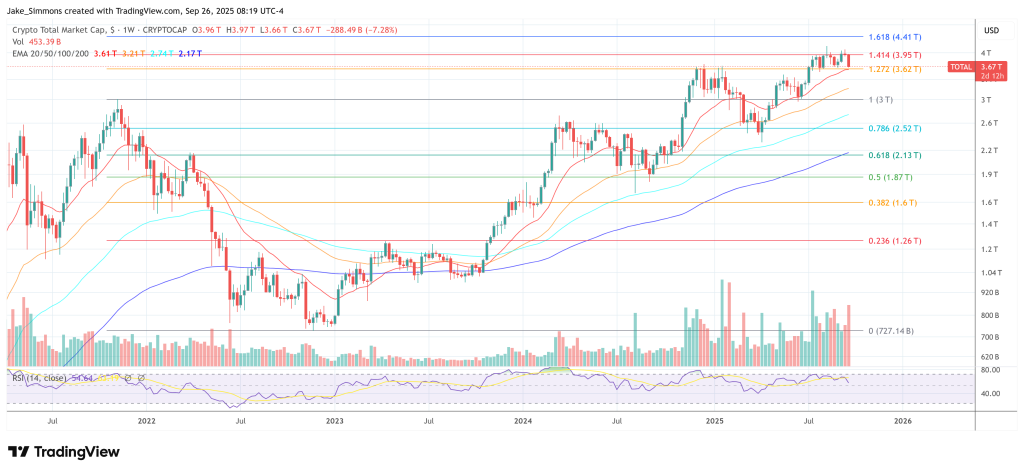
At press time, the total crypto market cap stood at $3.67 trillion.

Total crypto market cap
Market Opportunity
Palio Logo
Palio Price(PAL)
$0.002435
$0.002435$0.002435
+0.86%
USD
Palio (PAL) Live Price Chart
Disclaimer: The articles reposted on this site are sourced from public platforms and are provided for informational purposes only. They do not necessarily reflect the views of MEXC. All rights remain with the original authors. If you believe any content infringes on third-party rights, please contact crypto.news@mexc.com for removal. MEXC makes no guarantees regarding the accuracy, completeness, or timeliness of the content and is not responsible for any actions taken based on the information provided. The content does not constitute financial, legal, or other professional advice, nor should it be considered a recommendation or endorsement by MEXC.

You May Also Like

The Manchester City Donnarumma Doubters Have Missed Something Huge

The Manchester City Donnarumma Doubters Have Missed Something Huge

The post The Manchester City Donnarumma Doubters Have Missed Something Huge appeared on BitcoinEthereumNews.com. MANCHESTER, ENGLAND – SEPTEMBER 14: Gianluigi Donnarumma of Manchester City celebrates the second City goal during the Premier League match between Manchester City and Manchester United at Etihad Stadium on September 14, 2025 in Manchester, England. (Photo by Visionhaus/Getty Images) Visionhaus/Getty Images For a goalkeeper who’d played an influential role in the club’s first-ever Champions League triumph, it was strange to see Gianluigi Donnarumma so easily discarded. Soccer is a brutal game, but the sudden, drastic demotion of the Italian from Paris Saint-Germain’s lineup for the UEFA Super Cup clash against Tottenham Hotspur before he was sold to Manchester City was shockingly brutal. Coach Luis Enrique isn’t a man who minces his words, so he was blunt when asked about the decision on social media. “I am supported by my club and we are trying to find the best solution,” he told a news conference. “It is a difficult decision. I only have praise for Donnarumma. He is one of the very best goalkeepers out there and an even better man. “But we were looking for a different profile. It’s very difficult to take these types of decisions.” The last line has really stuck, especially since it became clear that Manchester City was Donnarumma’s next destination. Pep Guardiola, under whom the Italian will be playing this season, is known for brutally axing goalkeepers he didn’t feel fit his profile. The most notorious was Joe Hart, who was jettisoned many years ago for very similar reasons to Enrique. So how can it be that the Catalan coach is turning once again to a so-called old-school keeper? Well, the truth, as so often the case, is not quite that simple. As Italian soccer expert James Horncastle pointed out in The Athletic, Enrique’s focus on needing a “different profile” is overblown. Lucas Chevalier,…
Share
BitcoinEthereumNews2025/09/18 07:38
“We Cannot in Good Conscience Agree”: Anthropic Defies Pentagon Over AI Weapons

“We Cannot in Good Conscience Agree”: Anthropic Defies Pentagon Over AI Weapons

TLDR The Pentagon is demanding Anthropic remove safety guardrails from its Claude AI so it can be used for any lawful purpose, including autonomous weapons and
Share
Coincentral2026/02/27 20:18
If the dollar collapses, will Bitcoin win?

If the dollar collapses, will Bitcoin win?

The rapid decline of the US dollar has rekindled the dream of "super-Bitcoinization" among Bitcoin supporters. But there is little evidence that the dollar's demise spells victory for Bitcoin, and instead plenty of signs pointing to widespread societal dislocation. The Death of the Dollar: Lessons from Currency Collapses Fernando Nikolic, a former vice president of Blockstream who experienced Argentina's financial turmoil, warned that Bitcoin believers who hope for the demise of fiat currency don't know what they are expecting. "Bitcoiners celebrating the collapse of the dollar don't understand what they're asking for... This isn't liberation, this is your grandmother having to eat cat food because her savings evaporated... The demise of the dollar is not a victory for Bitcoin." In a period of true monetary collapse, basic necessities like water and food (not digital assets) would become the only things with real value. Many Americans who fantasize about a sudden transition to a Bitcoin economy have never experienced a true societal collapse. Nickrich warned that the reality is far more chaotic than they imagined and they would not actually welcome the expected demise of the dollar. The bleak picture across the United States points to a stressed fiat currency system The U.S. housing market has never been more unaffordable. Median single-family home prices in 2025 hit a record high, requiring double the income of 2019. The price-to-income ratio has reached an all-time high, homeownership has fallen to an all-time low, and millions of renters are spending 30% to 50% of their income on rent. The imbalance between wages and rising housing costs means that most potential homebuyers are locked out of the market, and social pressures continue to mount. To make matters worse, the U.S. unemployment rate rose slightly to 4.3% in August 2025, the highest level since the end of 2021, and the broader underemployment rate reached 8.1%. The figures mask the pain caused by a labor market that has failed to keep pace with inflation or by stagnant real wages. Against the backdrop of rising unemployment and house prices, the U.S. national debt exceeded $37 trillion in August 2025, more than twice the size of the country's economy. Borrowing costs continue to rise, with interest payments on the national debt exceeding even defense spending. The Congressional Budget Office projects that debt levels will reach that milestone five years earlier than originally planned due to increased borrowing and social spending during the pandemic. Debt growth of $1 trillion every five months is unsustainable and could push up interest rates and squeeze investment. When Fiat Fails, Bitcoin Doesn’t Automatically Win The US dollar index has fallen more than 10% against major currencies this year, its steepest decline since 1973. This decline has been linked to unpredictable economic policies, protectionism, and expansionary tax cuts. As the dollar depreciates, import prices rise, the purchasing power of ordinary Americans decreases, inflation worsens, and household budgets are strained. Depreciation further puts pressure on housing, employment and debt, exacerbating systemic vulnerabilities. All of these grim indicators paint a bleak picture of the fundamentals of the U.S. economy, and the U.S. dollar is often seen as a barometer for the rest of the world’s economies. If the world’s strongest currency is under pressure, what does that mean for the entire fiat currency system? While many Bitcoin advocates cry out that “Bitcoin can solve this problem,” hyperbitcoinization—the idea that people will massively turn to Bitcoin when fiat currencies fail—is a dangerous fantasy. This view ignores historical and social realities: when currencies collapse, trust evaporates, and abstract ideals are replaced by basic survival needs. Nikolic, whose experience was rooted in the collapse of Argentina's fiat currency, testified that the hope of so-called "liberation" was naive: the collapse meant only poverty, instability and suffering. When social safety nets and market norms break down, financial dislocations hit the vulnerable hardest. Bitcoin may offer an alternative to inflationary fiat currencies, but the demise of the dollar will bring not freedom but disaster and suffering to most people.
Share
PANews2025/09/22 17:00