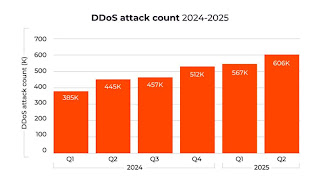
Gcore released its Q1-Q2 2025 Radar report into DDoS attack trends. The report reveals a significant escalation in the total number of DDoS attacks and their magnitude, measured in terabits per second (Tbps) The largest attack peaked at 2.2 Tbps, surpassing the 2 Tbps peak recorded in late 2024.Gcore released its Q1-Q2 2025 Radar report into DDoS attack trends. The report reveals a significant escalation in the total number of DDoS attacks and their magnitude, measured in terabits per second (Tbps) The largest attack peaked at 2.2 Tbps, surpassing the 2 Tbps peak recorded in late 2024.

Gcore Radar Report Reveals 41% Surge In DDoS Attack Volumes

Luxembourg, September 25th, 2025/CyberNewsWire/--Gcore, the global edge AI, cloud, network, and security solutions provider, today announced the findings of its Q1-Q2 2025 Radar report into DDoS attack trends.

DDoS attacks have reached unprecedented scale and disruption in 2025, and businesses need to act fast to protect themselves from this evolving threat. The report reveals a significant escalation in the total number of DDoS attacks and their magnitude, measured in terabits per second (Tbps).

It also highlights a clear shift: attackers are growing more strategic, blending brute-force volume with precise application-layer manipulation.

Key Insights From Q1-Q2 2025

·      Attack volumes increased by 41% compared to Q1-Q2 2024, evidencing dangerous long term growth trends predicted in prior Radar reports.

·      The largest attack peaked at 2.2 Tbps in Q1-Q2, surpassing the 2 Tbps peak recorded in late 2024.

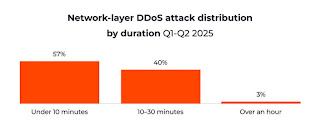
·      DDoS attacks are becoming longer in duration but more harmful.

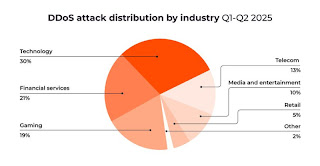
·      Attackers are shifting focus to financial services and tech, with tech overtaking gaming as the most targeted sector.

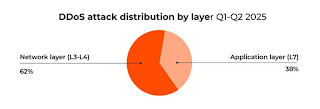
·      DDoS attacks at the application layer have increased by 10% from Q3-Q4 2024 to Q1-Q2 2025.

·      The total number of DDoS attacks climbed from 969,000 in H2 2024 to 1.17 million in H1 2025.
Andrey Slastenov, Head of Security at Gcore, commented:

Recent Data Shows Shift Toward Longer Sustained Assaults

Attacks shorter than 10 minutes have decreased by about 33%, while those lasting between 10 and 30 minutes have nearly quadrupled. While previous reports highlighted the dominance of very short, intense DDoS attacks, this change indicates that attackers are adapting to the improved automatic detection and mitigation systems employed by companies to handle brief attacks. By extending attack durations, threat actors can circumvent these temporary defense thresholds, cause more extensive damage, and test infrastructure resilience over time.
Multi-vector attacks have also increasingly become a preferred tactic of attackers. By masking malicious activity within seemingly legitimate traffic, attackers complicate detection and extend their window to cause damage. This shift toward more sophisticated attacks underscores the need for an equally layered defense approach that anticipates attacker strategies and protects critical digital assets holistically.

Data Indicates Rise in Attacks on Vulnerable Sectors

Gaming is no longer the dominant target it once was. Its share of total DDoS attacks has dropped significantly (30% in the last year). This notable decline suggests attackers are shifting focus to other sectors such as tech (attacks increased by 15%) and financial services (attacks increased by 15%). These sectors are favored targets because they may be less protected against threat actors and have higher disruption potential.
The Domino Effect of Cyberattacks

Hosting providers, in particular, have become prime targets due to their role supporting SaaS, e-commerce, gaming, and financial clients. An attack on one hosting provider can have dangerous ripple effects: massive service outages and reputation damage to dozens of dependent companies.

Geographical Distribution of DDoS Attacks

With a presence that spans six continents, Gcore can accurately track the geographical sources of DDoS attacks. Gcore derives these insights from the attackers’ IP addresses and the geographic locations of the data centers where malicious traffic is targeted.

Although the United States and the Netherlands remain top sources for attacks (as found in previous Radar reports), Hong Kong is a new source of threats. Hong Kong now accounts for 17% of all network-layer and 10% of application-layer attacks. These findings indicate that attackers are expanding into emerging areas, highlighting the need for proactive and adaptive defenses across diverse regions.

Emerging Origins of Attacks

The rapid increase in application layer attacks (28% to 38% from Q3-Q4 2024 to Q1-Q2 2025) also reveals an overall trend toward multi-layered attacks targeting web application and API vulnerabilities, which particularly impact sectors with a high degree of customer interaction (ranging from e-commerce and online banking to logistics and public services).
To access the full report, please visit: https://gcore.com/resources/gcore-radar-attack-trends-q1-q2-2025

About Gcore

Gcore is a global edge AI, cloud, network, and security solutions provider. Headquartered in Luxembourg, with a team of 600 operating from ten offices worldwide, Gcore provides solutions to global leaders in numerous industries. Gcore manages its global IT infrastructure across six continents, with one of the best network performances in Europe, Africa, and LATAM due to the average response time of 30 ms worldwide. Gcore’s network consists of 210 points of presence worldwide in reliable Tier IV and Tier III data centers, with a total network capacity exceeding 200 Tbps.

Further information is available at gcore.com and updates are also shared on LinkedInTwitter, and Facebook.

Gcore Press Contact

pr@gcore.com

PR Agency Contact

gcore@aspectusgroup.com

Contact

Ms.

Kira Kurepina

Gcore

kira.kurepina@gcore.com

:::tip This story was published as a press release by Cybernewswire under HackerNoon’s Business Blogging Program. Do your own research before making any financial decision.

:::

\

Disclaimer: The articles reposted on this site are sourced from public platforms and are provided for informational purposes only. They do not necessarily reflect the views of MEXC. All rights remain with the original authors. If you believe any content infringes on third-party rights, please contact service@support.mexc.com for removal. MEXC makes no guarantees regarding the accuracy, completeness, or timeliness of the content and is not responsible for any actions taken based on the information provided. The content does not constitute financial, legal, or other professional advice, nor should it be considered a recommendation or endorsement by MEXC.

You May Also Like

The Channel Factories We’ve Been Waiting For

The Channel Factories We’ve Been Waiting For

The post The Channel Factories We’ve Been Waiting For appeared on BitcoinEthereumNews.com. Visions of future technology are often prescient about the broad strokes while flubbing the details. The tablets in “2001: A Space Odyssey” do indeed look like iPads, but you never see the astronauts paying for subscriptions or wasting hours on Candy Crush.  Channel factories are one vision that arose early in the history of the Lightning Network to address some challenges that Lightning has faced from the beginning. Despite having grown to become Bitcoin’s most successful layer-2 scaling solution, with instant and low-fee payments, Lightning’s scale is limited by its reliance on payment channels. Although Lightning shifts most transactions off-chain, each payment channel still requires an on-chain transaction to open and (usually) another to close. As adoption grows, pressure on the blockchain grows with it. The need for a more scalable approach to managing channels is clear. Channel factories were supposed to meet this need, but where are they? In 2025, subnetworks are emerging that revive the impetus of channel factories with some new details that vastly increase their potential. They are natively interoperable with Lightning and achieve greater scale by allowing a group of participants to open a shared multisig UTXO and create multiple bilateral channels, which reduces the number of on-chain transactions and improves capital efficiency. Achieving greater scale by reducing complexity, Ark and Spark perform the same function as traditional channel factories with new designs and additional capabilities based on shared UTXOs.  Channel Factories 101 Channel factories have been around since the inception of Lightning. A factory is a multiparty contract where multiple users (not just two, as in a Dryja-Poon channel) cooperatively lock funds in a single multisig UTXO. They can open, close and update channels off-chain without updating the blockchain for each operation. Only when participants leave or the factory dissolves is an on-chain transaction…
Share
BitcoinEthereumNews2025/09/18 00:09
Gold Hits $3,700 as Sprott’s Wong Says Dollar’s Store-of-Value Crown May Slip

Gold Hits $3,700 as Sprott’s Wong Says Dollar’s Store-of-Value Crown May Slip

The post Gold Hits $3,700 as Sprott’s Wong Says Dollar’s Store-of-Value Crown May Slip appeared on BitcoinEthereumNews.com. Gold is strutting its way into record territory, smashing through $3,700 an ounce Wednesday morning, as Sprott Asset Management strategist Paul Wong says the yellow metal may finally snatch the dollar’s most coveted role: store of value. Wong Warns: Fiscal Dominance Puts U.S. Dollar on Notice, Gold on Top Gold prices eased slightly to $3,678.9 […] Source: https://news.bitcoin.com/gold-hits-3700-as-sprotts-wong-says-dollars-store-of-value-crown-may-slip/
Share
BitcoinEthereumNews2025/09/18 00:33
ZKP Crypto Presale Auction: 8,000x Returns Slipping Away with Each Burned Coin

ZKP Crypto Presale Auction: 8,000x Returns Slipping Away with Each Burned Coin

Zero Knowledge Proof (ZKP) operates a 450-day crypto ICO, burning unsold coins each day. Supply drops through phases, plus a strong deflationary design might create
Share
coinlineup2026/01/23 01:00