Just 2 companies create 90% of Ethereum blocks.Just 2 companies create 90% of Ethereum blocks.

Thinking about Ethereum block builder Titan’s monopoly with Flashbots: How chain abstraction can unlock development opportunities?

2024/12/01 15:23

Author: Austin King , Co-founder and CEO of Omni Network

Compiled by: Felix, PANews

Few people know that just two companies create 90% of Ethereum blocks. However, even fewer people know the story behind this monopoly.

Here’s the untold story of Titan, over $40M in hidden profits, and how chain abstraction will usher in even greater opportunities.

beginning

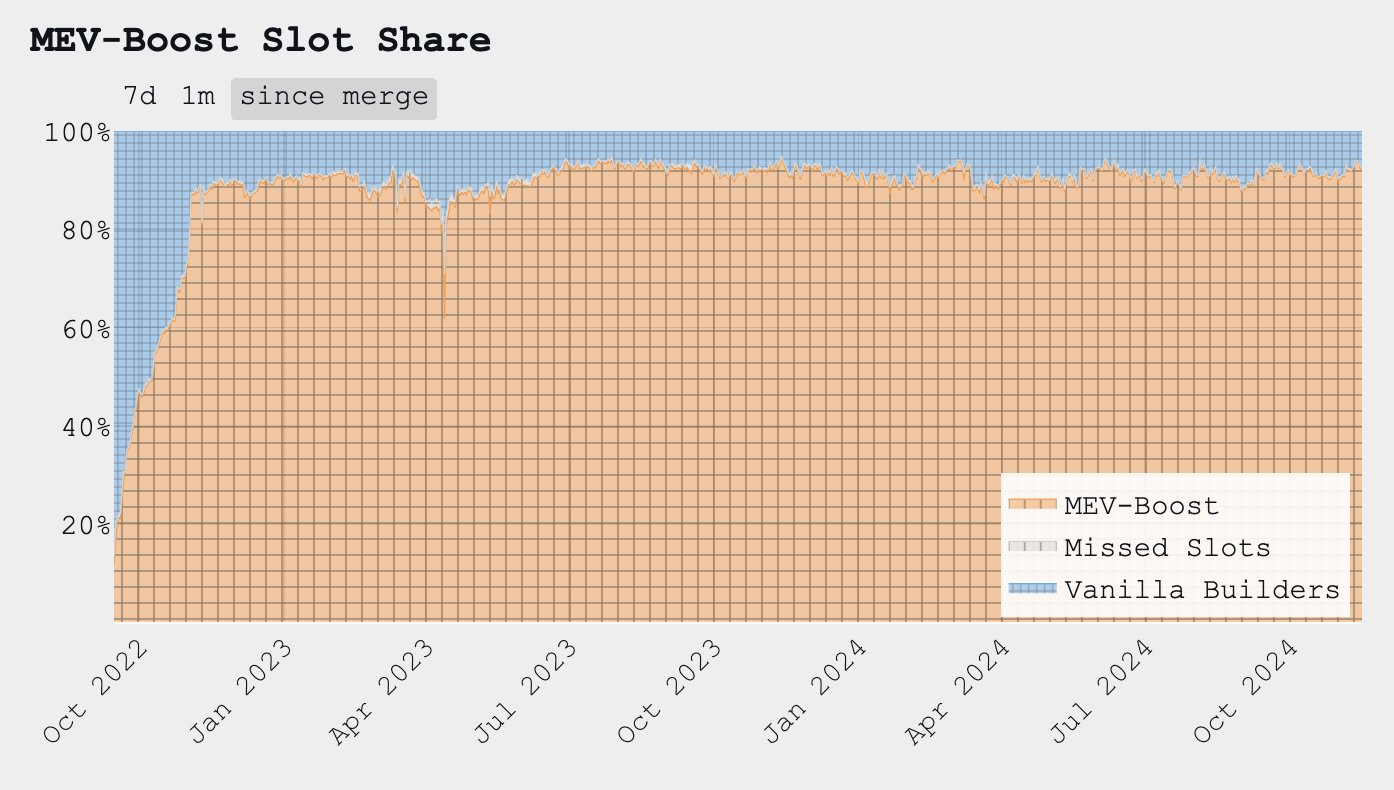
It all started at the end of 2022, when Flashbots created MEV-Boost, a software that allows Ethereum L1 validators to obtain transaction blocks from third parties (called builders, which specialize in MEV extraction), which allows validators to make more money. After this, almost all Ethereum L1 validators quickly started running this software:
Thinking about Ethereum block builder Titan’s monopoly with Flashbots: How chain abstraction can unlock development opportunities?

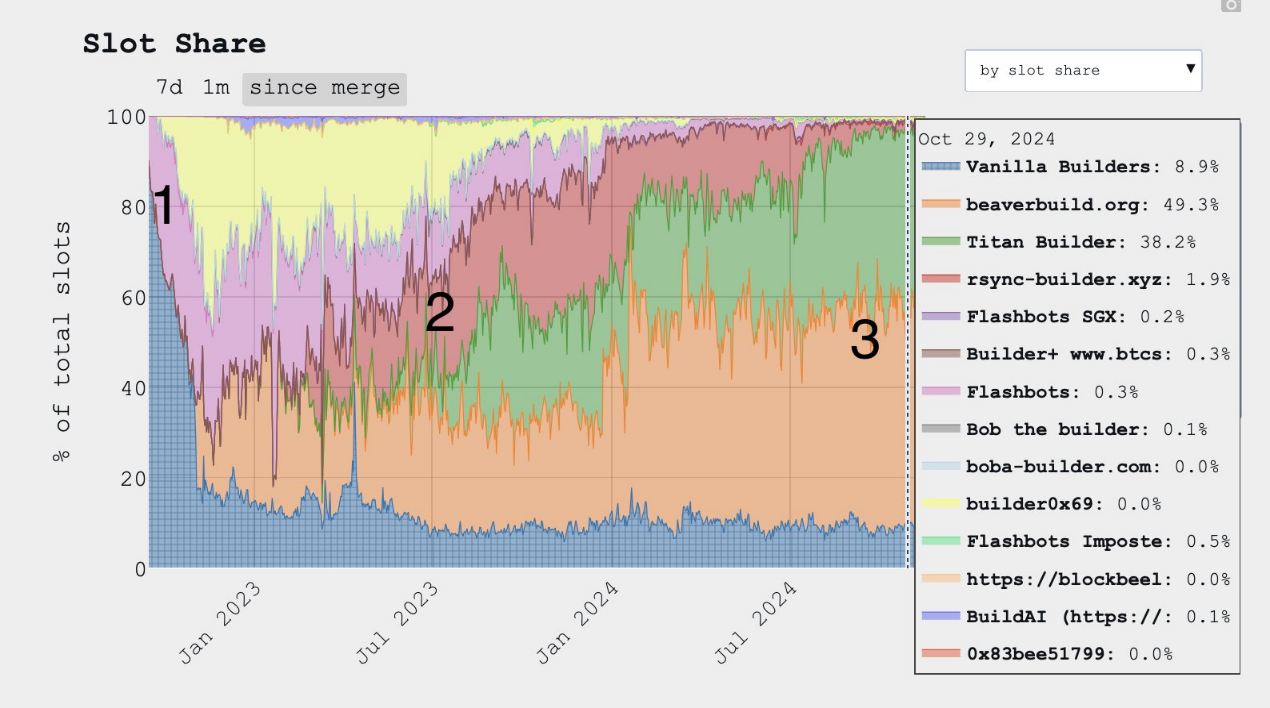
Refer to the picture below, initially (#1) Flashbots (pink) was the only running "Builder", and half a year later fierce competition emerged (#2). Now, there are only 2 important builders (#3): Beaver and Titan.
Thinking about Ethereum block builder Titan’s monopoly with Flashbots: How chain abstraction can unlock development opportunities?

Obviously, a lot of things happened during this period, but one of the most impactful events was when Titan reached an exclusive order flow (EOF) agreement with Banana Gun — who later became a top Telegram trading bot — in April 2023. After this EOF deal occurred, Titan had the opportunity to build more profitable blocks for L1 validators than any other builder, as they had exclusive access to deals that offered higher rewards.

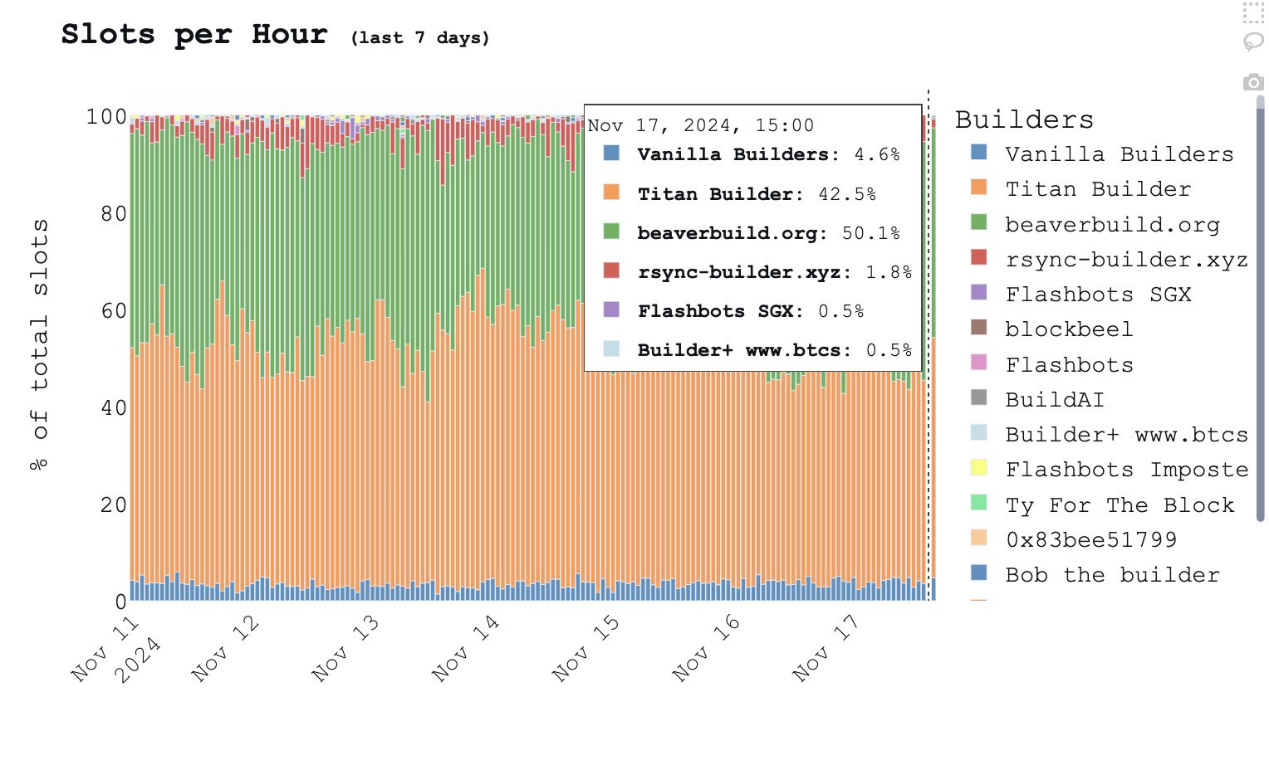
After this, more than 90% of Ethereum L1 transactions came from two companies (Beaver and Titan).
Thinking about Ethereum block builder Titan’s monopoly with Flashbots: How chain abstraction can unlock development opportunities?

Even more interesting are the earnings statistics as of August this year:

Flashbots

  • About 550,000 blocks created
  • Profit 16.7 ETH

Titan

  • About 600,000 blocks created
  • Profit 13,151 ETH

At today's prices, the difference is $44 million.

While this is public data, some interesting questions remain:

  • Why did Banana Gun choose to route its bundled services almost entirely to Titan when it had less than 1% market share?
  • Did Titan strike a multi-million dollar deal with the Banana Gun team at the outset to boost market share?
  • Is Titan promising kickbacks to the Banana Gun team to the detriment of its users?

The specific circumstances are unknown, and perhaps few people know this information.

As co-founder and CEO of Omni Network, why would Austin King take the time to think deeply about such a deal?

Because chain abstraction will unlock greater profit opportunities. The market is rapidly shifting to focus on crypto user experience (users don't think about gas, transaction submission, which chain to trade on, etc.), and the next wave of users will be far less "complex" than today's crypto users. New users will not care how all this happens, and there will be more such opportunities downstream of this abstraction, and each network can obtain a large source of income.

Today, OMNI’s 2 core primitives (EVM + Interop) are destroyed when used. However, few people understand that there is a business opportunity when revenue opportunities in the order flow supply chain are introduced directly into the core model of the token.

Related reading: Vitalik proposed a new concept of block construction, aiming to reconstruct the Ethereum ecosystem?

Disclaimer: The articles reposted on this site are sourced from public platforms and are provided for informational purposes only. They do not necessarily reflect the views of MEXC. All rights remain with the original authors. If you believe any content infringes on third-party rights, please contact service@support.mexc.com for removal. MEXC makes no guarantees regarding the accuracy, completeness, or timeliness of the content and is not responsible for any actions taken based on the information provided. The content does not constitute financial, legal, or other professional advice, nor should it be considered a recommendation or endorsement by MEXC.

You May Also Like

Coinbase Vs. State Regulators: Crypto Exchange Fights Legal Fragmentation

Coinbase Vs. State Regulators: Crypto Exchange Fights Legal Fragmentation

US-based crypto exchange Coinbase has made a significant appeal to the Department of Justice (DOJ) regarding a wave of lawsuits aimed at its operations. The company is urging federal action to address what it describes as an “increasingly fragmented and hostile” regulatory landscape for the crypto market. Coinbase Urges Federal Action  In a recent letter, Coinbase highlighted the steps taken by the current Administration to create a more equitable framework for digital asset regulation. This includes the introduction of stablecoin legislation and two pending bipartisan market-structure bills aimed at fostering uniformity in the oversight of cryptocurrencies.  Coinbase argues that these initiatives have begun to mitigate the adverse effects of the previous Administration’s enforcement-driven regulatory approach.  However, the company warns that certain states are perpetuating this problematic trend by adopting “expansive and flawed” interpretations of securities laws and implementing new licensing requirements that undermine the federal government’s pro-innovation stance. Related Reading: REX Shares Claims Its DOGE And XRP Spot ETFs Will Be Approved By US SEC Tomorrow They make an example with the Oregon Attorney General, who has filed a lawsuit against Coinbase, claiming that many digital assets traded on its platform qualify as alleged unregistered securities.  The letter affirms that the suit not only targets Coinbase but also encourages other states to address what the Attorney General perceives as a regulatory gap left by federal authorities.  Similarly, the New York Attorney General has initiated legal action to regulate transactions involving digital assets based on decentralized protocols as securities, further complicating the regulatory environment. Coinbase has faced cease-and-desist orders from four states, which demand the company halt its retail staking services. These orders are deemed by Coinbase as “legally unfounded and inconsistent.” Unified Framework For Digital Assets In light of these challenges, the letter to the DOJ calls for urgent federal intervention to establish broad preemption provisions. The crypto exchange argues that preemption has historically been an effective tool for addressing state interference in national markets, referencing past Congressional actions. Coinbase contends that the current patchwork of state regulations not only disrupts market efficiency but also leads to unequal access to cryptocurrency services based on geographic location. Related Reading: Citi’s Ethereum Forecast: No New All-Time High Expected, Year-End Target At $4,300 To remedy these issues, Coinbase advocates for Congress to adopt legislation that would exempt federally regulated digital assets from state blue-sky laws and clarify that state licensing requirements do not apply to crypto intermediaries.  Additionally, the company urges the SEC to expedite rulemaking and provide clearer guidance on why digital asset transactions and services, including staking, should not be classified as securities. Such clarity would help prevent states from imposing conflicting regulations based on their interpretations of securities laws. Featured image from Shutterstock, chart from TradingView.com
Share
NewsBTC2025/09/18 15:00