Building Decentralized Prediction Markets Across Three Blockchains With Myriad Protocol
Can a prediction market protocol maintain consistency across three different blockchains while giving developers a unified integration experience? Myriad Protocol attempts to answer this by deploying identical smart contract infrastructure on Abstract, Linea, and Celo, creating what amounts to a multi-chain experiment in decentralized forecasting.
\ The protocol does not introduce new prediction market mechanics. Instead, it packages Polkamarkets infrastructure with a REST API layer and targets developers who want to add prediction capabilities without writing smart contract code themselves.
\
What Myriad Protocol Actually Is
Think of Myriad Protocol as infrastructure for prediction markets that works across multiple blockchains. At its core, it answers a straightforward business question: how can companies add forecasting and prediction capabilities to their applications without building everything from scratch?
\ The protocol provides ready-made smart contracts deployed on three different blockchains—Abstract, Linea, and Celo. These contracts handle all the complex mechanics of prediction markets: creating markets, managing trades, tracking positions, and distributing winnings. More importantly, it wraps these contracts in an accessible API and software development kit, which means your development team can integrate prediction market features without needing deep blockchain expertise.
\ The key insight here is that Myriad Protocol is not inventing new prediction market mechanics. Instead, it takes proven infrastructure from Polkamarkets and packages it in a way that makes it practical for businesses to deploy. This distinction matters because you are building on battle-tested technology rather than experimental systems.
\
Business Use Cases: What You Can Actually Build
Let me walk through the concrete business applications where Myriad Protocol creates value. Understanding these use cases will help you evaluate whether this technology fits your strategic needs.
\ 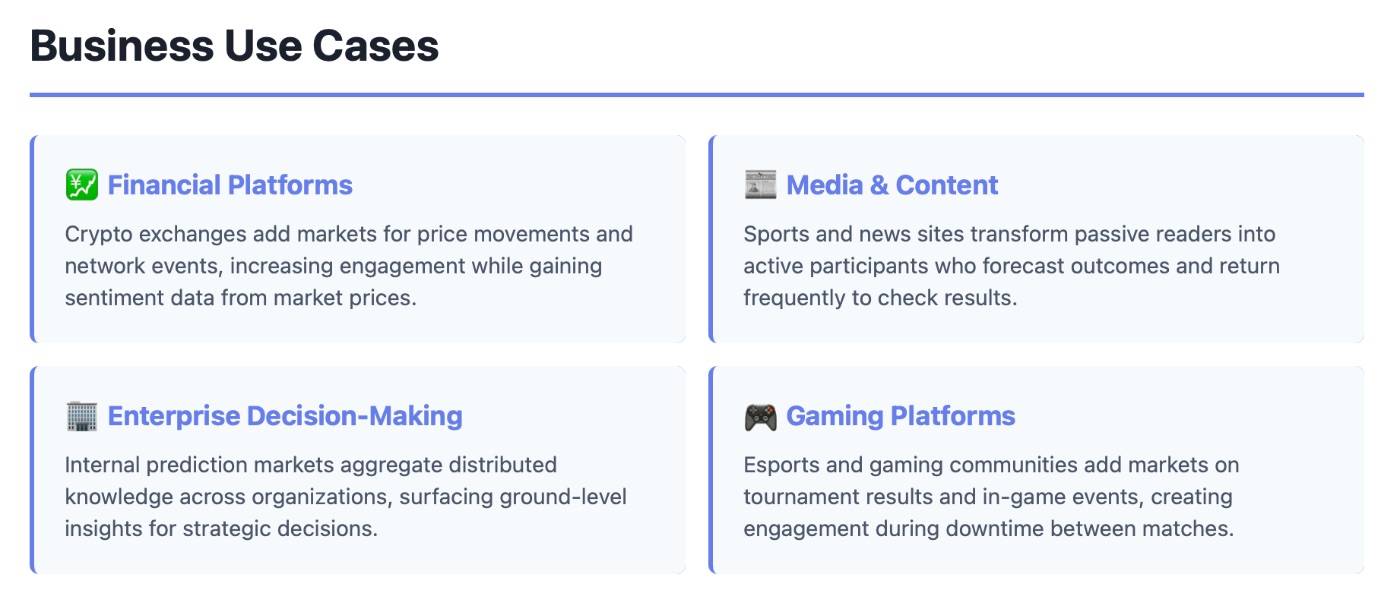
Financial Platforms and Trading Applications
If you operate a financial services platform, cryptocurrency exchange, or investment app, prediction markets offer a natural extension of your product. Your users already engage with financial forecasting through various means—following market analysts, reading research reports, tracking price movements. Prediction markets transform this passive consumption into active participation.
\ Consider a cryptocurrency exchange that adds prediction markets for major crypto events. Users could forecast Bitcoin price movements, regulatory decisions, or network upgrades. The exchange benefits from increased user engagement, additional revenue streams from trading activity, and deeper insight into user sentiment. The prediction market prices themselves become valuable data—they aggregate the collective wisdom of your user base into quantifiable probabilities.
\ The multi-chain deployment becomes particularly valuable here. Your platform might serve users across different blockchain ecosystems. Some users prefer Ethereum layer-twos like Abstract or Linea for lower fees. Others operate primarily on mobile-focused chains like Celo. Supporting all three chains means you can serve your entire user base rather than forcing them onto a single network.
\ Media and Content Platforms
\ News organizations, sports media companies, and content platforms face a persistent challenge: how do you deepen reader engagement beyond passive content consumption? Prediction markets provide an elegant answer.
\ Imagine a sports media company covering professional basketball. For each game, they create prediction markets: will the home team win, will the star player score over 25 points, will the game go to overtime? Readers transform from passive consumers into active participants. They are now incentivized to read your analysis more carefully, return to check results, and engage with other community members.
\ The financial stakes remain modest—these are engagement tools, not primarily revenue generators. But the business impact compounds. Time on site increases. Return visits multiply. Community formation accelerates. Your platform becomes stickier because users have literal skin in the game.
\ The protocol architecture supports this well. The REST API makes it straightforward to fetch current market odds and display them alongside your articles. When readers want to participate, the SDK handles the transaction complexity. Your editorial team can focus on creating compelling markets rather than wrestling with blockchain infrastructure.
\ Enterprise Decision-Making Tools
\ This use case operates differently from consumer applications but creates substantial value. Large organizations constantly make decisions under uncertainty: which product features to prioritize, which markets to enter, how to allocate research budgets. Traditional approaches rely on committee meetings, executive intuition, or consultant reports. Internal prediction markets offer a data-driven alternative.
\ The concept works like this: your organization creates prediction markets for key business questions. Employees trade based on their knowledge and expertise. The market prices aggregate distributed information across your organization. You get quantified probabilities for outcomes that help inform leadership decisions.
\ An example clarifies this. A technology company is deciding whether to launch a new product in Southeast Asia. The executive team feels 70 percent confident about success. They create an internal prediction market. Product managers, sales representatives, engineers, and regional specialists all participate. The market settles at 45 percent probability—significantly lower than executive intuition. Investigation reveals that the regional team sees problems with regulatory compliance and local competition that executive presentations glossed over. This information surfaces because employees with ground-level knowledge can express their views through anonymous trades rather than contradicting leadership in meetings.
\ Myriad Protocol's architecture supports enterprise deployment well. You can deploy on a private blockchain testnet for internal use. The smart contracts handle the market mechanics reliably. The referral system can be repurposed for departmental tracking. Your internal tools team can build dashboards that display relevant markets for each business unit.
\ Gaming and Entertainment Platforms
\ Gaming platforms represent another natural fit. Whether you operate an esports platform, a traditional gaming community, or a fantasy sports application, your users already engage with competitive outcomes and predictions.
\ The integration creates multiple value streams. Players can forecast tournament results, bet on in-game events, or predict community-voted outcomes. The prediction markets increase engagement during downtime between matches. They create additional monetization opportunities. They generate data about player sentiment that informs your content and development roadmaps.
\ The social dimension amplifies the value. Players discuss their positions, share market insights, and compete over prediction accuracy. This user-generated content and community interaction costs you nothing to create but significantly increases platform stickiness.
\ Research and Forecasting Services
\ Organizations that produce forecasts or research analysis can use prediction markets to enhance their core offerings. A market research firm might create prediction markets around the questions they research, allowing clients to see real-time market sentiment alongside traditional research reports. The prediction market prices provide a continuous, liquid estimate of probabilities rather than point-in-time research snapshots.
\ Academic institutions can deploy prediction markets for research purposes, studying how markets aggregate information or forecasting scientific outcomes. The multi-chain deployment means researchers can choose the network that best fits their budget and technical requirements.
\
Understanding the Strategic Benefits
Beyond specific use cases, Myriad Protocol offers several strategic advantages that warrant attention from business decision-makers.
\ Reduced Development Risk and Cost
Building prediction market infrastructure from scratch represents a substantial undertaking. You need smart contract developers who understand market-making algorithms, security engineers to audit the code, blockchain infrastructure specialists to handle deployment, and ongoing maintenance as blockchain platforms evolve. This easily consumes hundreds of thousands in development costs and many months of time.
\ Myriad Protocol eliminates most of this. The smart contracts already exist and have processed real transactions. The API abstracts away blockchain complexity. Your development team can integrate prediction markets in weeks rather than months. This matters particularly for experimental features—you can test market fit quickly rather than making a massive upfront investment.
\ Multi-Chain Optionality
The blockchain landscape remains fragmented. Users have different preferences based on their existing holdings, network effects, and philosophical commitments. Building for multiple chains traditionally meant duplicating development effort—deploying contracts to each chain, testing extensively, maintaining multiple codebases.
\ Myriad Protocol solves this through identical smart contract deployments across chains. Your application code works across all three supported chains with minimal modification—essentially just swapping configuration parameters. This means you can serve users wherever they are rather than constraining them to your preferred chain.
\ Proven Technology Foundation
The protocol builds on Polkamarkets infrastructure, which has operated in production and processed real trading volume. You are not betting on experimental technology. The core market-making mechanics, the smart contract security, the edge case handling—these have all been tested through real-world usage. This significantly reduces your deployment risk compared to building custom solutions.
\
How Businesses Should Evaluate Myriad Protocol
Let me provide a framework for deciding whether Myriad Protocol fits your needs. This evaluation process should involve both business and technical leadership because the decision has implications for both strategy and implementation.
\ Start with Use Case Clarity
First, articulate exactly what business problem you are solving with prediction markets. Vague aspirations about "adding Web3 features" or "increasing engagement" will not suffice. You need specific answers: What questions will users forecast? Why will they care? How does this tie to your core value proposition? What does success look like quantitatively?
\ If you cannot answer these questions crisply, the technology discussion becomes premature. The most elegant infrastructure still fails without clear product-market fit. Spend time understanding your users' needs before evaluating technical solutions.
\ Assess Technical Readiness
Your development team needs certain baseline capabilities to integrate Myriad Protocol successfully. They should be comfortable with REST APIs and JavaScript development. They need basic understanding of blockchain wallets and transactions, though not deep smart contract expertise. They should have experience with asynchronous programming and error handling.
More importantly, they need capacity to build the abstractions that production applications require. The protocol provides building blocks, not complete solutions. Your team will implement caching layers, build user-friendly interfaces, create error handling flows, and optimize performance. Budget for this engineering work when evaluating costs.
\ Consider Your User Base
Prediction markets require users who are comfortable with blockchain wallets and transactions. If your current user base operates entirely in traditional web environments, you face a significant onboarding challenge. Users need to install wallet software, manage private keys, acquire tokens for trading, and understand transaction confirmations.
This does not mean prediction markets are impossible for mainstream audiences, but it does mean you need strong onboarding flows, educational content, and support infrastructure. Some platforms succeed by abstracting away blockchain complexity—managing wallets on behalf of users, providing gasless transactions through meta-transactions, or operating in a custodial model. These approaches add development complexity but improve user experience.
\ Evaluate Long-Term Viability
Blockchain infrastructure evolves rapidly. Chains upgrade their protocols. APIs change their interfaces. Token standards evolve. You need confidence that Myriad Protocol will continue operating and improving over your planning horizon.
Examine the team and funding behind the protocol. Review their development activity and community engagement. Understand their roadmap. While no one can guarantee longevity in crypto infrastructure, you can assess the indicators that suggest sustainability versus abandonment.
\
The Technical Architecture: How It All Works
Now that we understand the business context, let me explain how Myriad Protocol actually functions under the hood. Even if you are not implementing this yourself, understanding the architecture will help you make better decisions about integration approach, performance optimization, and risk management.
\ The Three-Layer System
Myriad Protocol organizes itself into three distinct layers, each serving a specific purpose. Understanding these layers helps you grasp where different types of work happen and where potential issues might arise.
\ The bottom layer consists of the blockchains themselves—Abstract, Linea, and Celo. These blockchains function as databases that maintain all market state in a decentralized, tamper-proof manner. When someone buys shares in a prediction market, that transaction gets recorded on the blockchain permanently. The blockchain layer provides the trust foundation—no central authority can manipulate market outcomes or steal user funds because the smart contracts enforce the rules automatically.
\ 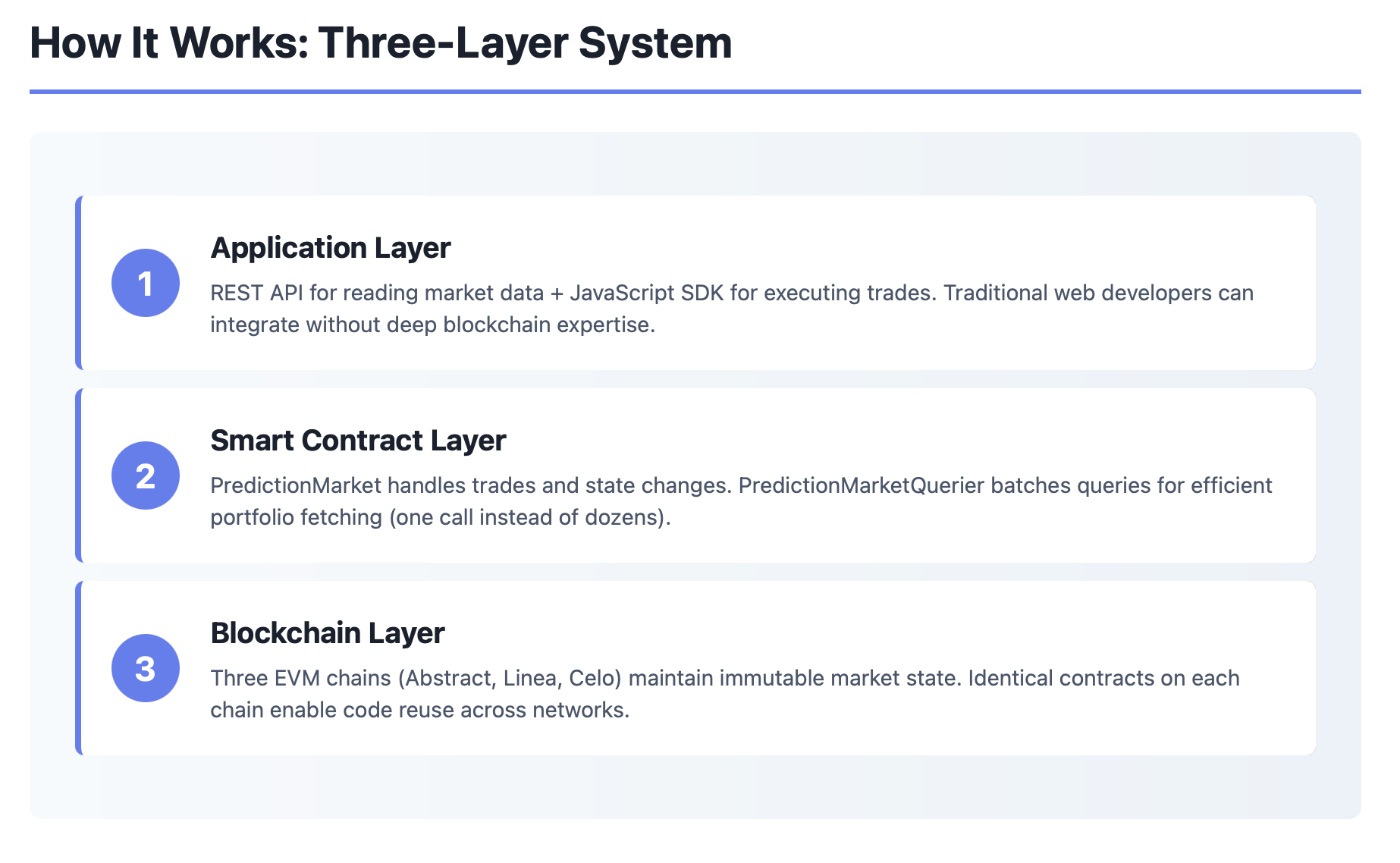
\ The middle layer contains the smart contracts. Think of these as automated programs that live on the blockchain and execute the market logic. One contract type, called PredictionMarket, handles all the state-changing operations: creating new markets, processing trades, distributing winnings. Another contract type, called PredictionMarketQuerier, specializes in reading data efficiently. This separation between writing and reading operations creates performance benefits we will explore shortly.
\ The top layer provides the interface your applications actually use. The REST API serves market information—what markets exist, current prices, trading volumes. This API runs on traditional web servers and returns data in familiar JSON format. The JavaScript SDK wraps the smart contracts in developer-friendly functions that handle transaction signing, gas estimation, and error handling. Your application code primarily interacts with this top layer, which then communicates with the smart contracts on your behalf.
\ This layered architecture creates clean separation of concerns. The blockchain handles trust and persistence. The smart contracts handle business logic. The API and SDK handle developer experience. Each layer can evolve independently without breaking the others.
\ How Prediction Market Mechanics Work
Understanding the underlying market mechanics helps you design better applications and set appropriate user expectations. Prediction markets on Myriad Protocol function as automated market makers, similar to how decentralized exchanges like Uniswap work.
\ When someone creates a market, they pose a question with defined outcomes. For simplicity, most markets offer binary outcomes—yes or no, team A wins or team B wins. The market creator must also provide initial liquidity, which means depositing tokens that traders can trade against.
\ Each outcome gets its own pool of shares. At creation, these shares split the initial liquidity according to starting probabilities. If the market creator believes there is a 60 percent chance of "Yes" and 40 percent chance of "No," the initial share allocation reflects this distribution. When traders buy shares of an outcome, they pay tokens into the pool and receive outcome shares. The purchase shifts the probability—buying "Yes" shares makes "Yes" more expensive (higher probability) and "No" cheaper (lower probability). The smart contract uses a mathematical formula called a market maker curve to determine exactly how much price moves for each trade.
\ This creates a self-balancing system. If the market becomes mispriced relative to reality, informed traders can profit by correcting it. Their profit-seeking behavior keeps market prices aligned with actual probabilities. This mechanism is why prediction markets often outperform expert forecasts—they harness the wisdom of crowds and create financial incentives for accuracy.
\ When the market resolves, the smart contract gets updated with the winning outcome. Holders of winning outcome shares can claim payouts. Each winning share pays out one token. So if you bought 100 "Yes" shares at 0.60 tokens each (spending 60 tokens total), and "Yes" wins, you receive 100 tokens, netting 40 tokens in profit. Holders of losing outcome shares receive nothing—their shares become worthless.
\ The protocol charges fees on trades. These fees get collected by a treasury rather than being distributed to liquidity providers. This design choice has implications for liquidity depth—without fee incentives, liquidity providers lack economic motivation beyond speculation. We will return to this point later.
The Multi-Chain Deployment Strategy
Deploying the same infrastructure across three different blockchains creates both opportunities and complications. The opportunity is clear—you can serve users on multiple chains with minimal code duplication. The complication arises in the details.
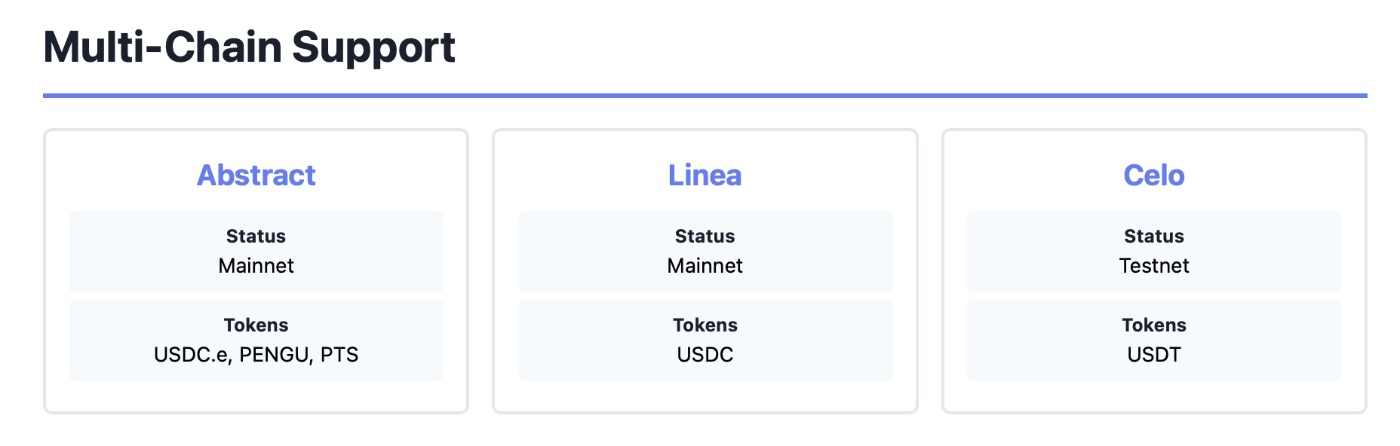
\ Each blockchain has its own native architecture, transaction format, and ecosystem. Abstract, Linea, and Celo all implement the Ethereum Virtual Machine, which means they execute smart contract code identically. This compatibility enables Myriad Protocol to deploy the same contract code to all three chains.
\ However, the deployed contracts get different addresses on each chain. Your application must know which contract address to use based on which chain the user has selected. The protocol provides this through configuration objects that map chain identifiers to contract addresses.
\ Token availability differs across chains. Abstract supports multiple tokens including USDC.e, PENGU, and PTS. Linea primarily uses USDC. Celo testnet uses USDT. Your application cannot assume a token available on one chain exists on another. This means market selection and display logic must account for chain-specific token support.
\ The API introduces an additional complexity with modified chain identifiers. Instead of using the standard chain ID that the blockchain itself reports, the API appends version numbers to create unique identifiers. Abstract mainnet has chain ID 2741 on the actual blockchain, but the API expects 274133 (representing version 3.3). This quirk means your application must translate between blockchain chain IDs and API chain IDs, adding a conversion step that creates potential for bugs.
\ The Role of Liquidity and Market Depth
Market quality depends heavily on liquidity—how much capital sits in the market available for trading. Understanding liquidity dynamics helps you set realistic expectations for market performance and user experience.
\ Deep liquid markets handle large trades with minimal price impact. If a market has 100,000 tokens in liquidity, someone can buy 1,000 tokens worth of shares and barely move the price. Shallow markets with only 1,000 tokens in liquidity see dramatic price swings from small trades. This creates poor user experience—prices shift significantly between when users see a quote and when their transaction confirms.
\ Liquidity provision typically works through incentives. Liquidity providers deposit capital into markets and earn trading fees. This creates an economic reason to provide liquidity even for markets they do not have strong opinions about. However, Myriad Protocol directs all trading fees to the treasury rather than distributing them to liquidity providers. This design choice reduces incentives for passive liquidity provision.
\ As a result, markets depend primarily on interested participants providing liquidity. Users who want to trade on a particular question must also provide the liquidity that enables that trading. This works reasonably well for high-interest topics with engaged communities, but struggles for niche or experimental markets.
\ If you are deploying Myriad Protocol for business use, consider how you will ensure adequate liquidity in your markets. Options include seeding markets with company capital, creating incentive programs that [reward liquidity provision](), or building in market-making bots that automatically maintain liquidity. The protocol provides the infrastructure, but market quality requires deliberate liquidity management.
\
Critical Considerations for Implementation
Before committing to building on Myriad Protocol, business and technical leaders should understand several important limitations and challenges that will impact your implementation success.
\ The Developer Experience Challenge
\ The protocol provides building blocks but not complete solutions. Your development team will need to build substantial abstractions around the base infrastructure. This includes implementing robust error handling for all the ways blockchain transactions can fail. Building caching layers to make the application feel responsive. Creating user-friendly interfaces that hide blockchain complexity. Implementing security best practices for key management and transaction validation.
\ The documentation covers basic usage but leaves significant gaps in advanced topics. Error handling receives minimal coverage despite being critical for production. The referral system provides functions but no explanation of how rewards calculate or get claimed. Performance optimization falls entirely to developers. This means your team will spend time reading smart contract code, experimenting with different approaches, and building features that arguably should come built-in.
\ For teams with strong blockchain development expertise, this is manageable. For teams primarily experienced with traditional web development, expect a steeper learning curve and longer development timeline than initial estimates suggest.
\ User Onboarding Complexity
\ Every user must have a blockchain wallet, own tokens for trading, and understand transaction signing. For cryptocurrency-native audiences, this poses no challenge. For mainstream users, this represents a significant barrier.
\ Your application must either accept this barrier and target crypto-experienced users, or invest heavily in onboarding. Effective onboarding might include embedded wallets that users can access with email and password, automatic token distribution for new users, gasless transactions where you sponsor transaction fees, and extensive educational content explaining blockchain concepts.
\ These onboarding solutions add development complexity and ongoing operational costs. Budget realistically for this work rather than assuming users will naturally understand blockchain interactions.
\ Chain Fragmentation Impacts
\ While multi-chain deployment provides user choice, it also fragments liquidity and activity. A market on Abstract operates completely separately from the same conceptual market on Linea. Users on different chains cannot trade with each other. This splits your user base and reduces market depth.
\ For consumer applications with millions of users, this matters less—each chain can sustain independent markets with sufficient liquidity. For smaller deployments, the fragmentation could create unusably thin markets. Consider whether you should deploy to all three chains or concentrate on one chain initially to maximize liquidity depth.
\ Regulatory and Compliance Questions
\ Prediction markets operate in complex regulatory territory. Different jurisdictions treat them differently—sometimes as gambling, sometimes as financial instruments, sometimes as exempt forecasting. The blockchain deployment does not eliminate regulatory obligations even though it decentralizes enforcement.
\ Before launching publicly, consult with legal counsel familiar with both prediction market regulations and cryptocurrency regulations in your jurisdictions. Consider whether you need licenses, how you will implement know-your-customer requirements, how you will restrict access from prohibited jurisdictions, and how you will handle potential regulatory inquiries.
\ The protocol itself is permissionless—anyone can interact with the smart contracts. But your application layer, which provides the user interface and facilitates access, likely faces regulatory requirements. Plan for this from the start rather than retrofitting compliance.
\
Is Myriad Protocol Right For You?
Myriad Protocol fits well when you have a clear business use case for prediction markets, a technically capable development team, and users who are either already comfortable with blockchain or for whom you can build strong onboarding. The protocol provides working infrastructure that reduces development time compared to building from scratch, and supports multiple blockchain networks to reach users wherever they prefer to operate.
\ The protocol fits less well when you need extensive hand-holding during implementation, when your users expect mainstream web application simplicity, or when your markets require very deep liquidity. The developer experience assumes substantial technical capability, the user experience reflects inherent blockchain complexity, and the liquidity provision model relies on engaged participants rather than passive capital.
\ For business decision-makers evaluating this technology, focus on these key questions: Does adding prediction markets meaningfully improve your core value proposition? Can your development team handle blockchain infrastructure complexity? Will your users embrace or resist blockchain interactions? Can you ensure adequate market liquidity? Do you understand the regulatory implications in your jurisdictions?
\ Only proceed if you can answer these questions affirmatively. Prediction markets offer genuine value for the right use cases, but they are not a magic solution for engagement or a simple feature to add. They require thoughtful implementation, realistic expectations, and ongoing operational attention.
\ The technology works—the smart contracts execute trades reliably, the API serves data consistently, and the SDK provides necessary functionality. The question is whether the business opportunity justifies the implementation investment and whether your organization has the capabilities to execute successfully. Answer those questions honestly before committing resources.
Don’t forget to like and share the story!
:::tip This author is an independent contributor publishing via our business blogging program. HackerNoon has reviewed the report for quality, but the claims herein belong to the author. #DYO
:::
\
You May Also Like

👨🏿🚀TechCabal Daily – Sun King makes it rain

Cathie Wood: “We Sold Some $TSLA Near Highs and Bought #Crypto”