Animoca Brands shifts to stablecoins and real-world assets as it eyes Nasdaq listing, expanding beyond gaming into on-chain finance.Animoca Brands shifts to stablecoins and real-world assets as it eyes Nasdaq listing, expanding beyond gaming into on-chain finance.

Animoca Brands push into stablecoin and RWA ahead of US IPO

animoca brands

As it advances plans for a U.S. listing, animoca brands is preparing a major expansion into stablecoins and real-world asset tokenization across its growing Web3 ecosystem.

How is Animoca Brands pivoting toward stablecoins and tokenized real-world assets?

Animoca Brands, a long-time investor in crypto and Web3 startups, will make its stablecoin and real-world asset initiatives a core focus in 2026, according to chief strategy officer Keyvan Peymani. In an interview with CNBC, Peymani said the company is preparing to scale both areas significantly over the coming year.

“We are going to launch into the stablecoin initiative in a major way. We are launching this RWA marketplace,” Peymani told CNBC. “That is a whole new sector for us.” The remarks highlight how the firm is extending beyond its established presence in blockchain gaming into more traditional financial infrastructure.

What is the strategy behind the new RWA and stablecoin ventures?

The company has already laid groundwork for this shift. In August, Animoca officially announced a Hong Kong joint venture with Standard Chartered and Hong Kong Telecommunications. The venture, called Anchorpoint Financial, intends to apply for a stablecoin issuer license from local regulators, positioning it within the emerging regulated digital money landscape.

Moreover, Animoca has signed several deals in 2024 to accelerate real-world asset tokenization. It partnered with global wealth management platform Fosun Wealth and blockchain finance firm FinChain to connect Asia’s traditional finance sector with Web3, distributing Fosun’s RWA products to international investors via a tokenized format.

Earlier this month, the company unveiled a partnership with Nasdaq-listed asset manager Hang Feng Technology Innovation Co. to develop a broader RWA tokenization ecosystem. Together, the firms aim to give institutional and retail investors easier exposure to tokenized assets on-chain.

“Together, we will make institutional-grade assets much more liquid and accessible as a necessary step toward a more inclusive on-chain financial system,” Animoca Brands Group President Evan Auyang said when announcing the collaboration. That said, the success of these plans will depend on regulatory clarity and market adoption of tokenized products.

Will there be a dedicated RWA tokenization marketplace?

Peymani’s comments suggest that a dedicated rwa tokenization marketplace sits at the center of the strategy. By building a platform for tokenizing and trading real-world assets, the company wants to bridge traditional finance instruments with Web3-native users. However, execution will require close coordination with partners and regulators across jurisdictions.

Within this framework, the firm views institutional rwa access as critical. The marketplace and related infrastructure are designed to make institutional-grade products more liquid while still meeting compliance demands. If successful, this could position the group as a key intermediary between banks, asset managers, and blockchain-native investors.

How is the core Web3 gaming business evolving?

Despite the push into stablecoins and RWA, Peymani stressed that Animoca will keep expanding its in-house Web3 projects. These include The Sandbox, Moca ID, Anichess and EDU Chain, all of which form part of its broader gaming and identity ecosystem. The company intends to deepen these products as it moves into 2026.

Moreover, Animoca started life as a mobile game developer and initially focused its investments on Web3 gaming. Peymani said the firm plans to stay true to those roots even as it branches into more finance-oriented sectors. The goal is to build synergies between gaming communities, digital identity, and new on-chain financial rails.

“We are still very bullish in what is going to happen in games,” Peymani told CNBC. He argued that players should “truly benefit” from the time, energy, and money they invest in games, by owning web3 gaming assets that persist beyond a single title and can move across the broader Web3 space.

What does the planned Nasdaq reverse merger involve?

Alongside its product roadmap, the company is preparing for a U.S. listing. Earlier this month, Animoca said it plans to go public on the Nasdaq in 2026 through a Nasdaq reverse merger with Currenc Group Inc., a Singapore-based fintech firm focused on artificial intelligence. The transaction would effectively give Animoca a U.S. public market presence.

If the reverse merger closes, Animoca would own the vast majority of Currenc Group and take over its Nasdaq listing. In turn, the group’s extensive digital asset and Web3 portfolio would gain direct access to U.S. investors and capital markets. However, the deal remains subject to regulatory and shareholder approvals.

The planned currenc group ipo structure aligns Animoca with a broader wave of crypto and digital asset companies going public in the United States. The roster already includes Coinbase, Circle, Bullish and Exodus, which collectively have helped normalize crypto-related listings since 2021.

How does Animoca Brands position itself for public investors?

Peymani framed the upcoming listing as a diversified way to access the broader crypto and Web3 sector. He argued that Animoca Brands IPO exposure could offer investors indirect stakes across multiple tokens, projects and platforms without concentrating risk in a single digital asset.

“We think we are one of those opportunities for someone to gain broad access to what is a really exciting growing market, but not to have to make too big a risk on any one token,” Peymani said. What the team aims to do, he added, is to become a market leader whenever a significant new trend emerges in Web3.

Moreover, Peymani said the company wants to be a vehicle through which “the entire industry and the entire retail sector” can benefit from structural changes in crypto, gaming, and tokenized finance. Over time, management believes this mix of gaming IP, infrastructure, and regulated asset initiatives can support long-term growth.

What could this mean for the broader Web3 and RWA landscape?

The strategy indicates that animoca brands sees convergence between gaming, digital identity and tokenized financial markets as the next major phase of Web3 adoption. By combining stablecoins, RWA platforms and gaming ecosystems, the company hopes to build user journeys that move seamlessly from entertainment to investment.

That said, progress will depend heavily on regulatory developments in Hong Kong, the United States and other key markets, as well as on sustained interest from both retail and institutional investors. If its joint ventures and reverse-merger listing proceed as planned, the group could become a prominent public proxy for the maturing tokenization and Web3 gaming sectors.

In summary, Animoca is doubling down on core gaming franchises while building new infrastructure for stablecoins and real-world assets, all underpinned by a prospective Nasdaq listing that may significantly broaden its investor base.

Tržní příležitosti
Logo EPNS
Kurz EPNS(PUSH)
$0.010292
$0.010292$0.010292
+1.70%
USD
Graf aktuální ceny EPNS (PUSH)
Prohlášení: Články sdílené na této stránce pochází z veřejných platforem a jsou poskytovány pouze pro informační účely. Nemusí nutně reprezentovat názory společnosti MEXC. Všechna práva náleží původním autorům. Pokud se domníváte, že jakýkoli obsah porušuje práva třetích stran, kontaktujte prosím service@support.mexc.com a my obsah odstraníme. Společnost MEXC nezaručuje přesnost, úplnost ani aktuálnost obsahu a neodpovídá za kroky podniknuté na základě poskytnutých informací. Obsah nepředstavuje finanční, právní ani jiné odborné poradenství, ani by neměl být považován za doporučení nebo podporu ze strany MEXC.

Mohlo by se vám také líbit

The Channel Factories We’ve Been Waiting For

The Channel Factories We’ve Been Waiting For

The post The Channel Factories We’ve Been Waiting For appeared on BitcoinEthereumNews.com. Visions of future technology are often prescient about the broad strokes while flubbing the details. The tablets in “2001: A Space Odyssey” do indeed look like iPads, but you never see the astronauts paying for subscriptions or wasting hours on Candy Crush.  Channel factories are one vision that arose early in the history of the Lightning Network to address some challenges that Lightning has faced from the beginning. Despite having grown to become Bitcoin’s most successful layer-2 scaling solution, with instant and low-fee payments, Lightning’s scale is limited by its reliance on payment channels. Although Lightning shifts most transactions off-chain, each payment channel still requires an on-chain transaction to open and (usually) another to close. As adoption grows, pressure on the blockchain grows with it. The need for a more scalable approach to managing channels is clear. Channel factories were supposed to meet this need, but where are they? In 2025, subnetworks are emerging that revive the impetus of channel factories with some new details that vastly increase their potential. They are natively interoperable with Lightning and achieve greater scale by allowing a group of participants to open a shared multisig UTXO and create multiple bilateral channels, which reduces the number of on-chain transactions and improves capital efficiency. Achieving greater scale by reducing complexity, Ark and Spark perform the same function as traditional channel factories with new designs and additional capabilities based on shared UTXOs.  Channel Factories 101 Channel factories have been around since the inception of Lightning. A factory is a multiparty contract where multiple users (not just two, as in a Dryja-Poon channel) cooperatively lock funds in a single multisig UTXO. They can open, close and update channels off-chain without updating the blockchain for each operation. Only when participants leave or the factory dissolves is an on-chain transaction…
Sdílet
BitcoinEthereumNews2025/09/18 00:09
Gold Hits $3,700 as Sprott’s Wong Says Dollar’s Store-of-Value Crown May Slip
Gold Hits $3,700 as Sprott’s Wong Says Dollar’s Store-of-Value Crown May Slip

The post Gold Hits $3,700 as Sprott’s Wong Says Dollar’s Store-of-Value Crown May Slip appeared on BitcoinEthereumNews.com. Gold is strutting its way into record territory, smashing through $3,700 an ounce Wednesday morning, as Sprott Asset Management strategist Paul Wong says the yellow metal may finally snatch the dollar’s most coveted role: store of value. Wong Warns: Fiscal Dominance Puts U.S. Dollar on Notice, Gold on Top Gold prices eased slightly to $3,678.9 […] Source: https://news.bitcoin.com/gold-hits-3700-as-sprotts-wong-says-dollars-store-of-value-crown-may-slip/
Sdílet
BitcoinEthereumNews2025/09/18 00:33
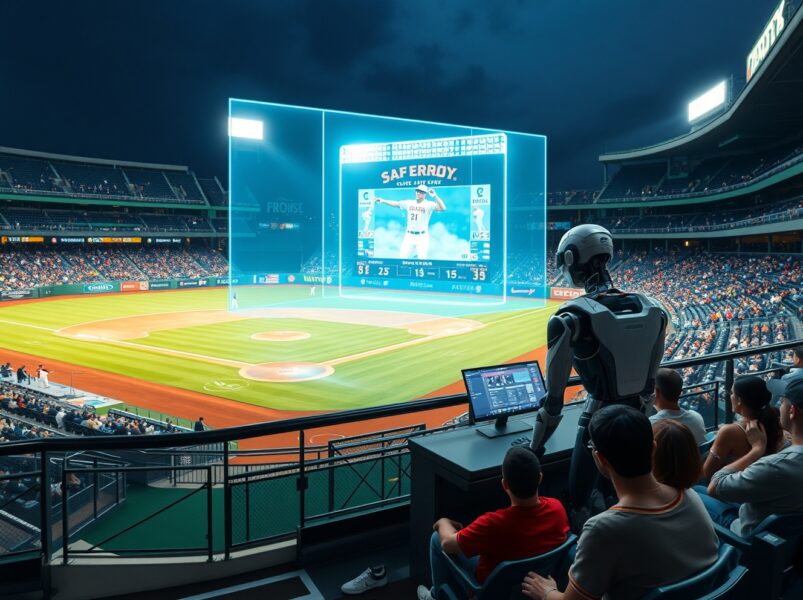
AI in Sports: The Controversial Experiment of the Oakland Ballers’ AI Manager

AI in Sports: The Controversial Experiment of the Oakland Ballers’ AI Manager

BitcoinWorld AI in Sports: The Controversial Experiment of the Oakland Ballers’ AI Manager In the rapidly evolving landscape of technology, the boundaries of innovation are constantly being pushed. For those immersed in the world of cryptocurrency and blockchain, the concept of decentralized decision-making and experimental technology is familiar territory. So, when an independent baseball team decided to let an AI manage a game, it naturally sparked a fascinating conversation. This bold move by the Oakland Ballers wasn’t just about baseball; it was a profound experiment in AI in sports, echoing the spirit of disruption and questioning traditional structures that resonates deeply within the tech community. The Mathematical Heart of Baseball and the Rise of AI in Sports Baseball, often called America’s pastime, is more than just a game of skill and athleticism; it’s a deeply mathematical sport. Every pitch, every swing, every defensive shift can be broken down into granular statistics. Major League teams employ legions of data engineers to crunch numbers, seeking minute advantages that can influence managerial decisions. This data-driven approach, while effective, sometimes leads to an almost absurd level of overanalysis, reminiscent of Mr. Burns in that classic Simpsons episode, who famously pulled an eight-time all-star for Homer Simpson based on ‘playing the percentages.’ This deep analytical foundation makes baseball a prime candidate for technological experimentation, especially with artificial intelligence. The integration of AI in sports isn’t just a futuristic fantasy; it’s becoming a tangible reality, promising to optimize strategies, enhance player performance analysis, and even redefine the role of human coaches. From predictive analytics for player injuries to real-time strategic adjustments, AI offers a new lens through which to view and manage athletic competition. The Oakland Ballers, with their independent spirit, decided to take this concept further than most, venturing into uncharted territory. The Oakland Ballers’ Bold Experiment with Baseball AI The story of the Oakland Ballers is one of resilience and innovation. Founded by edtech entrepreneur Paul Freedman, the Ballers emerged as a beacon of hope for Oakland baseball fans after the painful departure of the Major League A’s. Though a minor league team, the ‘Oakland B’s’ quickly garnered a national following, winning a title in just two seasons. This unique position—a major league team in a minor league market—gave them the freedom to experiment in ways larger leagues couldn’t. Freedman explained to Bitcoin World, "We can play with things and experiment with things way before the MLB or NBA or any of those leagues could do something." This experimental ethos led them to a groundbreaking partnership with Distillery, an AI company, to develop software capable of managing a baseball game in real time. The core of this initiative was to see how a sophisticated Baseball AI could perform under live game conditions. Unlike previous fan-controlled experiments where humorous decisions often trumped strategic ones, this AI initiative aimed for pure data-driven optimization. The implications of such an experiment extend beyond the diamond, touching upon how artificial intelligence might reshape various industries, including those reliant on complex, real-time decision-making. Navigating AI Decision-Making on the Field The choice of baseball for this AI experiment was deliberate. As Freedman noted, "Baseball is the perfect place to do an initial experiment like this, because it is so data-driven, and decisions are made very analytically." The slow pace between pitches allows ample time for an AI system to process data and recommend actions. Distillery trained OpenAI’s ChatGPT on an immense dataset, including over a century of baseball statistics and specific Ballers game data, to mimic the strategic thinking of their human manager, Aaron Miles. The goal wasn’t to replace human ingenuity but to augment it. Freedman clarified, "What the AI did was figure out what our human coach would have done – the ingenuity on strategy and the concepts came from [Miles], and the ability to use the data and recognize patterns… is what the AI did throughout the course of the game." This highlights a critical distinction in the current state of AI decision-making: AI as a powerful tool for optimization, rather than an autonomous replacement for human expertise. During the AI-controlled game, the system performed remarkably, making almost identical decisions to Miles regarding pitching changes, lineup adjustments, and pinch hitters. The only instance where Miles had to intervene was due to a player’s unexpected illness, a scenario outside the AI’s programmed scope. This singular override underscores the enduring necessity of human oversight for unforeseen circumstances and ethical considerations. The manager himself, Aaron Miles, embraced the experiment with good humor, even offering the tablet running the AI for a handshake with the opposing manager, a symbolic gesture of technology meeting tradition. Aspect Human Manager (Aaron Miles) AI Manager (Distillery’s AI) Decision-making Basis Experience, intuition, real-time observation, data analysis Centuries of baseball data, Ballers’ game history, pattern recognition via ChatGPT Key Decisions Made Pitching changes, lineup construction, pinch hitters Identical decisions to Miles for pitching changes, lineup, pinch hitters Override Instances Miles overrode AI once due to player illness Required human override for unexpected player health issue Outcome of Game Smooth execution of managerial strategy Smooth execution, mirroring human decisions The Critical Role of Fan Engagement and Backlash Despite the smooth execution of the AI’s managerial duties, the experiment triggered an unexpected wave of backlash from the Oakland Ballers’ dedicated fanbase. For many, the involvement of companies like OpenAI, which powered Distillery’s AI, felt like a betrayal. Fans expressed concerns that such enterprises prioritize "winning" the AI race over thorough safety testing and ethical deployment. This sentiment was amplified by the recent history of corporate greed that led to the departure of multiple professional sports franchises from Oakland, creating a deep-seated mistrust among locals. Comments like "There goes the Ballers trying to appeal to Bay Area techies instead of baseball fans" highlighted a perceived disconnect. The issue wasn’t just about AI; it was about the broader cultural tension between technological advancement and community values. Fan engagement, crucial for any sports team, proved to be a double-edged sword. While fans had previously embraced novel concepts like fan-controlled games, the AI experiment touched a nerve related to corporate influence and the perceived erosion of authenticity. Paul Freedman acknowledged the unforeseen negative reaction, stating, "It never feels good to have your fans be like, ‘We hate this.’" The Ballers do not intend to repeat this specific AI experiment. However, the experience sparked a vital conversation about the ethical implications and societal acceptance of new technologies. This public discourse, though initially uncomfortable, is essential for navigating the complex future of AI. It underscores that while technology can optimize processes, the human element—emotion, community, and trust—remains paramount. A Look Ahead: Balancing Innovation and Community in the Age of AI The Oakland Ballers’ experiment serves as a compelling case study in the ongoing dialogue surrounding artificial intelligence. It showcased the impressive capabilities of AI in sports for data-driven strategy while simultaneously revealing the critical importance of public perception and fan engagement. The journey of the Oakland Ballers, from a team born out of protest to pioneers in sports technology, reflects a broader societal challenge: how to embrace innovation without alienating the communities it serves. As AI continues to integrate into various aspects of life, including sports and even the financial sector where cryptocurrencies thrive, understanding its practical applications and potential pitfalls becomes increasingly vital. The Ballers’ experience reminds us that while AI can be an incredible tool for optimization, the human touch, ethical considerations, and genuine connection with stakeholders are indispensable. The conversation about AI’s role in our future has just begun, and experiments like these, even with their bumps, are crucial steps in shaping that dialogue responsibly. To learn more about the latest AI in sports trends, explore our article on key developments shaping AI features, institutional adoption, and future applications. This post AI in Sports: The Controversial Experiment of the Oakland Ballers’ AI Manager first appeared on BitcoinWorld.
Sdílet
Coinstats2025/09/23 04:45