

Stablecoins as Accidental Treasury Disruptors: Why Franklin Templeton's CEO is Sounding the Alarm
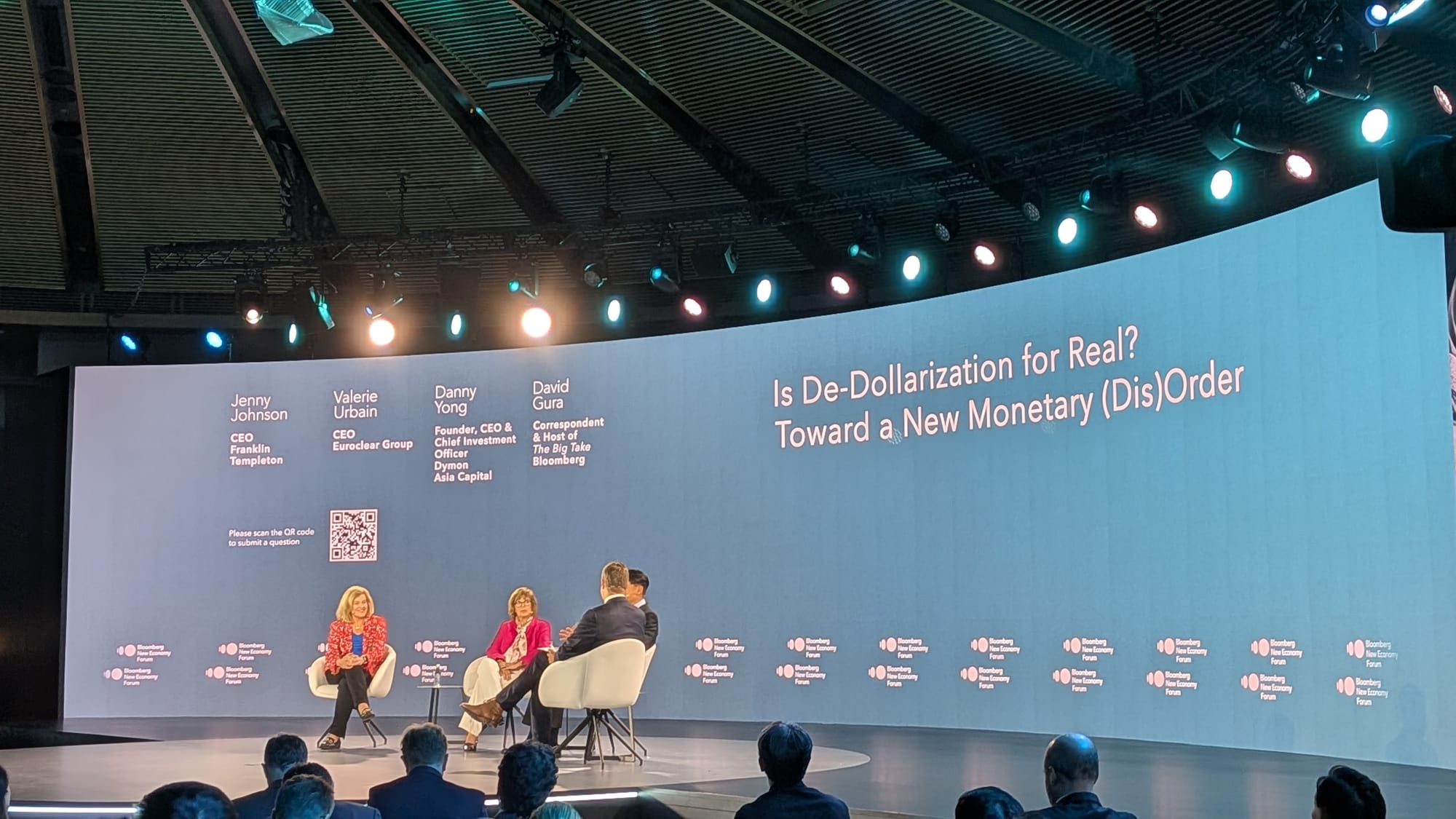
In a discussion ostensibly about de-dollarization at the Bloomberg New Economy Forum in Singapore on Wednesday, Franklin Templeton CEO Jenny Johnson delivered a critique of how stablecoins could destabilize the financial system – not by threatening the dollar, but by rewiring how it gets funded.
"Stablecoins give funding to the US Treasury, away from the consumer in a bank," Johnson said during the panel discussion. "You're competing with bank deposits, bank checking accounts. Stablecoins are mostly backed by US treasuries."
The mechanism is straightforward but the implications are deep. When users shift money from bank accounts into stablecoins like USDC or USDT, that capital no longer sits on bank balance sheets available for lending. Instead, it flows into short-term Treasuries held by stablecoin issuers. The $300 billion stablecoin market — small today, but growing rapidly — effectively represents deposits that can't be lent out to businesses and consumers.
"What do banks [usually] do with that money? They lend to people. They lend to corporations. They lend to individuals," Johnson noted. "That's where I think it's more of a stablecoin issue."
The Question Nobody Wants to Answer
Johnson posed the critical question that regulators have largely sidestepped: "Do the banks use the technology there of blockchain to then be part of their deposit mechanism, and does it shift it back to the bank's balance sheets?"
It's a scenario that assumes banks can compete for deposits in a stablecoin-native world. But if they can't — if consumers and businesses prefer the programmability, 24/7 settlement, and composability of stablecoins over traditional deposits — then the flow continues in one direction.
"I would get worried if too much money left banks into the stablecoin market, such that the funding mechanism is the US government versus the end consumer," Johnson said.
The irony is rich: stablecoins are often celebrated as reinforcing dollar dominance by spreading dollar-denominated instruments globally. But in doing so, they may be hollowing out the credit creation mechanism that makes banking systems functional. You can have dollar hegemony and a broken lending market at the same time.
A Hedge Against Government Overreach
The panel also revealed how digital assets are increasingly viewed not as dollar competitors, but as insurance policies against government control — a distinction with significant implications for adoption.
Johnson acknowledged her own evolution on Bitcoin. "I used to be negative on bitcoin in the sense that I'd say, well, you know, as soon as it gets too big and threatens the US dollar, then the US will just make it illegal, like China did."
But conversations with investors in Israel and the Middle East changed her perspective. "I remember talking to somebody who said, 'My parents and grandparents had money the government took away.' So they'll always keep a percentage in Bitcoin, not in Bitcoin ETFs, but Bitcoin, where nobody can get to it," she recounted. "Folks in the Middle East say, you know, if I say the wrong thing, I worry that my accounts would be frozen."
The insight matters because it reframes Bitcoin and crypto adoption as fundamentally defensive rather than offensive to the dollar system. It's not about displacing the dollar as a unit of account. It's about having assets the government can't freeze or confiscate.
Why Scarcity Assets Win
Dymon Asia Capital's Danny Yong connected the dots to the broader fiscal reality driving interest in both stablecoins and Bitcoin. With governments facing massive deficit spending and likely returning to quantitative easing, "You don't want your savings to be in fiat. You want to invest in something that has any form of scarcity. So it could be gold. It could be Bitcoin. It could be high-end real estate and equities as well."
Yong predicted the US would restart QE within three to six months to keep funding rates low as deficits balloon. The implication: even as stablecoins reinforce dollar dominance for transactions, the underlying debasement of fiat currencies continues to drive diversification into scarce digital assets.
"Most governments will have no choice, especially if we have more job disruptions down the road with technology," Yong said. "Then you need more essentially universal basic income, and to fund that you need to print."
Exorbitant Privilege Meets Digital Reality
When pressed on the benefits of dollar hegemony, Johnson was blunt about the stakes: "It's cheap financing of our debt. We could not possibly operate as a country without that."
Already, interest payments consume a growing share of the US budget. If dollar dominance erodes and borrowing costs rise, "It really crowds out everything else."
But here's the paradox: the very fiscal profligacy that stablecoins help finance by providing demand for Treasuries is also what's driving investors toward Bitcoin and other scarce assets as insurance. Stablecoins may extend the dollar's reach while simultaneously accelerating the conditions that make alternatives attractive.
The dollar isn't being displaced by another currency, as moderator, Bloomberg's David Gura, noted. Instead, we're entering an era of fragmentation where the dollar remains dominant for commerce while investors increasingly hedge against government control and monetary debasement through digital assets that exist outside the traditional system.
Johnson's warning about stablecoins disrupting bank lending deserves more attention. But the bigger story may be that stablecoins are just one piece of a broader digital transformation that's unbundling the functions of money itself — store of value, unit of account, and medium of exchange no longer need to be provided by the same instrument or institution.
For an industry audience watching regulatory frameworks like the GENIUS Act take shape, the Franklin Templeton CEO's concerns signal that stablecoin regulation will need to grapple not just with consumer protection and reserve requirements, but with fundamental questions about credit creation and monetary sovereignty.
The dollar may not be going anywhere. But how it works, and who controls access to it, is already changing.
Elsewhere
 Blockhead
Blockhead
Blockhead
 Blockhead
Blockcast
Kaia's Path to Mass Adoption: Blockchain in Everyday Apps
This week, Takatoshi Shibayama hosts Dr Sangmin "Sam" Seo and John Cho from the Kaia DLT Foundation. They discuss the merger of Kakao and Line to create the Kaia blockchain, the integration of stablecoins and DeFi into their messaging apps, and the strategies for attracting Web2 users to Web3. The conversation also covers the potential of stablecoins in cross-border remittance and the user journey from fiat to digital assets.
Thanks for tuning in! If you enjoyed this episode, please like and subscribe to Blockcast on your favorite podcast platforms like Spotify and Apple.

Blockhead is a media partner for Consensus Hong Kong 2026. Readers can save 20% on tickets using exclusive code BLOCKDESK at this link.
Mohlo by se vám také líbit

Thunderclap Review 2026: Is it the Best Social Media Service for Instant Gains?

The GENIUS Act Is Already Law. Banks Shouldn’t Try to Rewrite It Now
What next for XRP as volatility sinks to 2024 lows
Copy linkX (Twitter)LinkedInFacebookEmail