📌 Table of Contents What is Sui? The Silicon Valley Blockchain Revolution From Facebook’s Crypto Ruins: The Birth of Sui Move Language & Performance: Why Sui is Different Ecosystem & Partnerships: Where Sui Stands Today Real-World Applications: DeFi, NFTs & Gaming SUI Tokenomics Explained Sui in 2025: Growth, Challenges & Milestones FAQ: 10 Unanswered Questions [...]]]>📌 Table of Contents What is Sui? The Silicon Valley Blockchain Revolution From Facebook’s Crypto Ruins: The Birth of Sui Move Language & Performance: Why Sui is Different Ecosystem & Partnerships: Where Sui Stands Today Real-World Applications: DeFi, NFTs & Gaming SUI Tokenomics Explained Sui in 2025: Growth, Challenges & Milestones FAQ: 10 Unanswered Questions [...]]]>

Sui Blockchain Explained (2025): Move Language, High-Speed Layer-1 & The Future of Web3

2025/10/02 21:16
5 min čtení

📌 Table of Contents

  • What is Sui? The Silicon Valley Blockchain Revolution
  • From Facebook’s Crypto Ruins: The Birth of Sui
  • Move Language & Performance: Why Sui is Different
  • Ecosystem & Partnerships: Where Sui Stands Today
  • Real-World Applications: DeFi, NFTs & Gaming
  • SUI Tokenomics Explained
  • Sui in 2025: Growth, Challenges & Milestones
  • FAQ: 10 Unanswered Questions About Sui

🚀 What is Sui? The Silicon Valley Blockchain Revolution

While Ethereum struggles with scalability, a new blockchain from Silicon Valley promises a revolution: Can Sui deliver what others only claim?

🌍 From Facebook’s Crypto Ruins: The Birth of Sui

Sui was born in 2022 when former engineers from Meta’s failed Diem project founded Mysten Labs. Drawing on years of experience in high-performance systems, they launched Sui’s mainnet in May 2023 with backing from a16z and Coinbase Ventures. The vision: a blockchain for mass adoption, especially in gaming, NFTs, and DeFi, but without the regulatory baggage that doomed Facebook’s Libra.
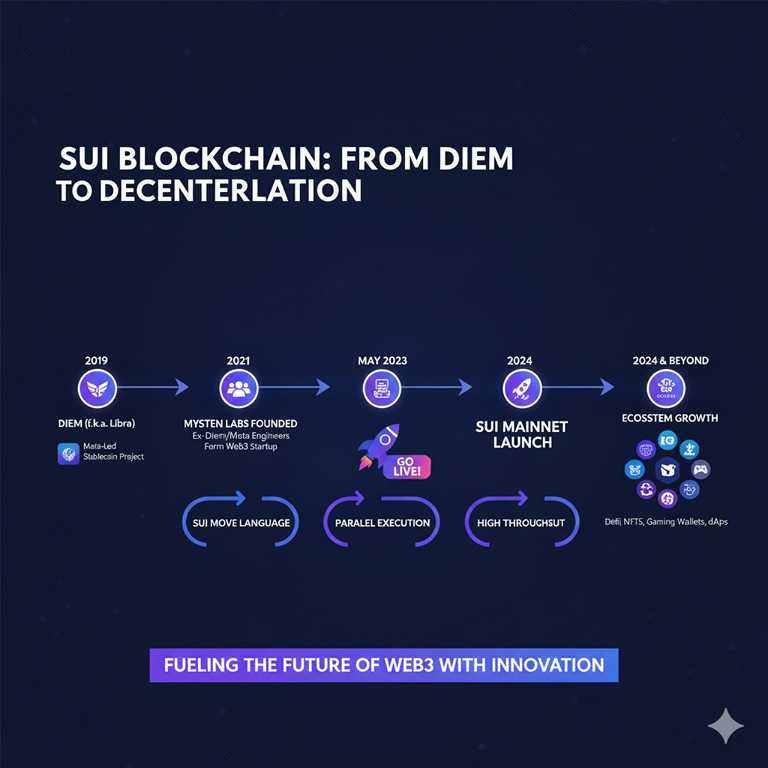
graphic illustrating the progression from Diem to Mysten Labs, the Sui Mainnet Launch in 2023, and subsequent Ecosystem Growth

⚙ Move Language & Performance: Why Sui is Different

At the heart of Sui lies the Move programming language, developed for Diem but now fully unleashed. Unlike Ethereum’s Solidity, Move treats digital assets as independent objects with their own properties. This architecture allows Sui to theoretically handle 100,000+ TPS with <400ms latency, dwarfing Ethereum’s 15 TPS.

BlockchainTransactions per Second (TPS)Latency
Ethereum (Mainnet)~15>10 seconds
Solana~65,000 (theoretical)400–600ms
Sui100,000+<400ms

🌐 Ecosystem & Partnerships: Where Sui Stands Today

The strength of a blockchain lies in its ecosystem. In DeFi, Cetus Protocol has emerged as Sui’s leading DEX, while Scallop provides lending and borrowing infrastructure. In NFTs and gaming, BlueMove and OriginX show promise, though liquidity still trails Solana and Avalanche.
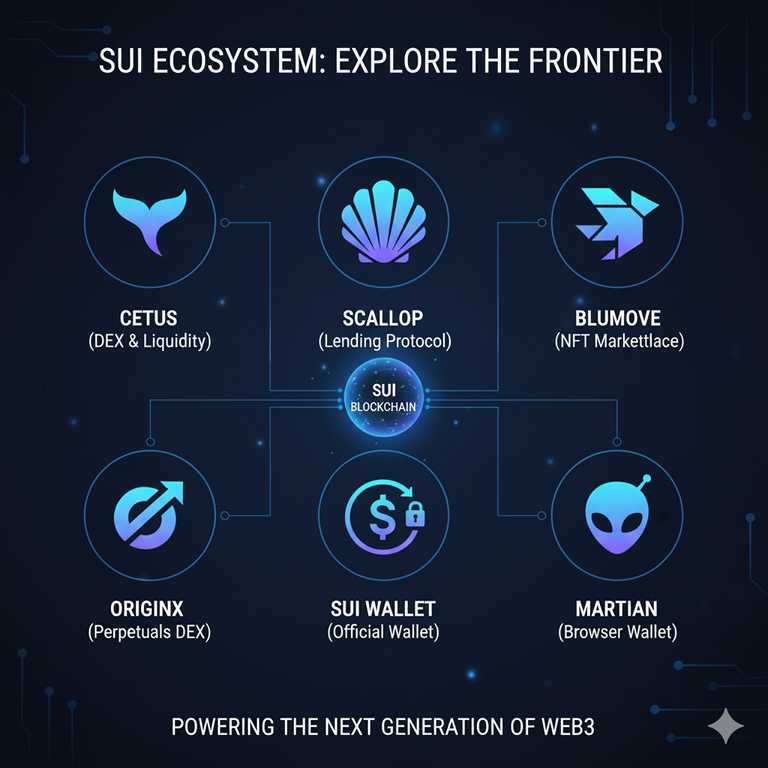
ogos of Cetus, Scallop, BlueMove, OriginX, Sui Wallet, and Martian

🎮 Real-World Applications: DeFi, NFTs & Gaming

Sui demonstrates strengths beyond theory:

  • DeFi: Near-instant token swaps, low slippage, minimal fees.
  • NFTs: Affordable minting for small creators, unlike Ethereum’s gas-heavy model.
  • Gaming: Cost-effective, high-frequency asset transactions for in-game economies.
  • Micropayments: Content creators can sell digital goods for cents—unviable on Ethereum.

💰 SUI Tokenomics Explained

Sui has a fixed max supply of 10 billion SUI, unlike Ethereum’s theoretically unlimited supply. Token utilities include:

  1. Transaction fees
  2. Staking for validator security
  3. Governance rights

UtilityFunctionCurrent Impact
FeesKeep the network runningUltra-low compared to Ethereum
StakingValidators secure the networkRewards ~3–5% annually
GovernanceProtocol upgrade votingGrowing role in decision-making

📰 Sui in 2025: Growth, Challenges & Milestones

2025 brought new gaming partnerships (often under NDA), steady DeFi growth, and improved NFT marketplace activity. Network upgrades further reduced latency, underscoring Sui’s tech advantage. Yet, mass adoption remains elusive, with active wallets and daily transactions still below major competitors.

❓ FAQ: 10 Unanswered Questions About Sui

1. Can Sui maintain its performance under massive real-world usage?
Current stress tests demonstrate impressive throughput and low latency, but true scalability will only be proven once millions of users and complex dApps interact on-chain simultaneously. Network upgrades planned for 2025–2026 aim to address this.
2. How does Sui handle regulatory compliance compared to Ethereum or Solana?
Unlike Facebook’s Libra, Sui does not face direct political scrutiny. Mysten Labs structures partnerships with regional incubators and ensures projects follow local KYC/AML requirements. However, global regulatory harmonization remains a challenge.
3. Will Sui become the go-to blockchain for gaming?
Sui’s architecture is ideal for gaming—low fees and fast transactions fit in-game economies. Several studios are already testing pilots, but it must still compete with Solana, ImmutableX, and Polygon, which have established ecosystems.
4. How sustainable are Sui’s staking rewards long term?
Initial staking rewards range from 3–5% annually. As circulating supply grows via token unlocks, yields will likely decrease. Long-term sustainability depends on balancing validator incentives with token scarcity.
5. What risks exist for early investors and token unlocks?
Vesting schedules gradually release tokens into circulation, which could pressure prices if demand does not scale equally. Institutional holders could realize gains, creating volatility during major unlock periods.
6. Does Sui plan to support Layer-2 or cross-chain interoperability?
Discussions around cross-chain bridges and interoperability with Ethereum Virtual Machine (EVM) ecosystems are ongoing. While promising, no fully deployed Layer-2 solutions exist yet. Integration with Cosmos IBC and other protocols may follow.
7. How does Sui secure against validator centralization risks?
Sui uses Proof-of-Stake, where decentralization depends on validator distribution. Mysten Labs encourages broad staking participation, but avoiding dominance by a few validators remains a core governance challenge.
8. Can Sui challenge Solana and Ethereum in DeFi liquidity depth?
Sui’s DeFi protocols (like Cetus and Scallop) show steady growth, but liquidity remains a fraction of Solana or Ethereum. For Sui to compete, it must attract larger capital inflows and cross-chain liquidity providers.
9. How attractive is Sui for NFT creators compared to Polygon?
Sui provides cheaper and faster NFT minting, which helps small artists. However, Polygon’s strong marketplace integrations and partnerships with brands give it a stronger network effect. Adoption will depend on whether Sui can onboard major NFT platforms.
10. What milestones must Sui hit in 2026 for mass adoption?
Key milestones include:
– Launching robust developer tools and SDKs
– Scaling gaming integrations with AAA studios
– Expanding liquidity depth in DeFi
– Growing daily active wallets beyond competitors
If achieved, Sui could emerge as a mainstream Layer-1 contender.
]]>
Tržní příležitosti
Logo SUI
Kurz SUI(SUI)
$0.967
$0.967$0.967
-2.16%
USD
Graf aktuální ceny SUI (SUI)
Prohlášení: Články sdílené na této stránce pochází z veřejných platforem a jsou poskytovány pouze pro informační účely. Nemusí nutně reprezentovat názory společnosti MEXC. Všechna práva náleží původním autorům. Pokud se domníváte, že jakýkoli obsah porušuje práva třetích stran, kontaktujte prosím service@support.mexc.com a my obsah odstraníme. Společnost MEXC nezaručuje přesnost, úplnost ani aktuálnost obsahu a neodpovídá za kroky podniknuté na základě poskytnutých informací. Obsah nepředstavuje finanční, právní ani jiné odborné poradenství, ani by neměl být považován za doporučení nebo podporu ze strany MEXC.

Mohlo by se vám také líbit

Gold Hits $3,700 as Sprott’s Wong Says Dollar’s Store-of-Value Crown May Slip
Gold Hits $3,700 as Sprott’s Wong Says Dollar’s Store-of-Value Crown May Slip

The post Gold Hits $3,700 as Sprott’s Wong Says Dollar’s Store-of-Value Crown May Slip appeared on BitcoinEthereumNews.com. Gold is strutting its way into record territory, smashing through $3,700 an ounce Wednesday morning, as Sprott Asset Management strategist Paul Wong says the yellow metal may finally snatch the dollar’s most coveted role: store of value. Wong Warns: Fiscal Dominance Puts U.S. Dollar on Notice, Gold on Top Gold prices eased slightly to $3,678.9 […] Source: https://news.bitcoin.com/gold-hits-3700-as-sprotts-wong-says-dollars-store-of-value-crown-may-slip/
Sdílet
BitcoinEthereumNews2025/09/18 00:33
SoftBank (SFTBY) Stock; Slight Dip Amid AMD Collaboration on AI Infrastructure

SoftBank (SFTBY) Stock; Slight Dip Amid AMD Collaboration on AI Infrastructure

TLDRs; SoftBank stock slips slightly as AI GPU collaboration with AMD is announced. The partnership tests GPU partitioning for efficient multi-tenant AI infrastructure
Sdílet
Coincentral2026/02/16 15:29
Unlocking Massive Value: Curve Finance Revenue Sharing Proposal for CRV Holders

Unlocking Massive Value: Curve Finance Revenue Sharing Proposal for CRV Holders

BitcoinWorld Unlocking Massive Value: Curve Finance Revenue Sharing Proposal for CRV Holders The dynamic world of decentralized finance (DeFi) is constantly evolving, bringing forth new opportunities and innovations. A significant development is currently unfolding at Curve Finance, a leading decentralized exchange (DEX). Its founder, Michael Egorov, has put forth an exciting proposal designed to offer a more direct path for token holders to earn revenue. This initiative, centered around a new Curve Finance revenue sharing model, aims to bolster the value for those actively participating in the protocol’s governance. What is the “Yield Basis” Proposal and How Does it Work? At the core of this forward-thinking initiative is a new protocol dubbed Yield Basis. Michael Egorov introduced this concept on the CurveDAO governance forum, outlining a mechanism to distribute sustainable profits directly to CRV holders. Specifically, it targets those who stake their CRV tokens to gain veCRV, which are essential for governance participation within the Curve ecosystem. Let’s break down the initial steps of this innovative proposal: crvUSD Issuance: Before the Yield Basis protocol goes live, $60 million in crvUSD will be issued. Strategic Fund Allocation: The funds generated from the sale of these crvUSD tokens will be strategically deployed into three distinct Bitcoin-based liquidity pools: WBTC, cbBTC, and tBTC. Pool Capping: To ensure balanced risk and diversified exposure, each of these pools will be capped at $10 million. This carefully designed structure aims to establish a robust and consistent income stream, forming the bedrock of a sustainable Curve Finance revenue sharing mechanism. Why is This Curve Finance Revenue Sharing Significant for CRV Holders? This proposal marks a pivotal moment for CRV holders, particularly those dedicated to the long-term health and governance of Curve Finance. Historically, generating revenue for token holders in the DeFi space can often be complex. The Yield Basis proposal simplifies this by offering a more direct and transparent pathway to earnings. By staking CRV for veCRV, holders are not merely engaging in governance; they are now directly positioned to benefit from the protocol’s overall success. The significance of this development is multifaceted: Direct Profit Distribution: veCRV holders are set to receive a substantial share of the profits generated by the Yield Basis protocol. Incentivized Governance: This direct financial incentive encourages more users to stake their CRV, which in turn strengthens the protocol’s decentralized governance structure. Enhanced Value Proposition: The promise of sustainable revenue sharing could significantly boost the inherent value of holding and staking CRV tokens. Ultimately, this move underscores Curve Finance’s dedication to rewarding its committed community and ensuring the long-term vitality of its ecosystem through effective Curve Finance revenue sharing. Understanding the Mechanics: Profit Distribution and Ecosystem Support The distribution model for Yield Basis has been thoughtfully crafted to strike a balance between rewarding veCRV holders and supporting the wider Curve ecosystem. Under the terms of the proposal, a substantial portion of the value generated by Yield Basis will flow back to those who contribute to the protocol’s governance. Returns for veCRV Holders: A significant share, specifically between 35% and 65% of the value generated by Yield Basis, will be distributed to veCRV holders. This flexible range allows for dynamic adjustments based on market conditions and the protocol’s performance. Ecosystem Reserve: Crucially, 25% of the Yield Basis tokens will be reserved exclusively for the Curve ecosystem. This allocation can be utilized for various strategic purposes, such as funding ongoing development, issuing grants, or further incentivizing liquidity providers. This ensures the continuous growth and innovation of the platform. The proposal is currently undergoing a democratic vote on the CurveDAO governance forum, giving the community a direct voice in shaping the future of Curve Finance revenue sharing. The voting period is scheduled to conclude on September 24th. What’s Next for Curve Finance and CRV Holders? The proposed Yield Basis protocol represents a pioneering approach to sustainable revenue generation and community incentivization within the DeFi landscape. If approved by the community, this Curve Finance revenue sharing model has the potential to establish a new benchmark for how decentralized exchanges reward their most dedicated participants. It aims to foster a more robust and engaged community by directly linking governance participation with tangible financial benefits. This strategic move by Michael Egorov and the Curve Finance team highlights a strong commitment to innovation and strengthening the decentralized nature of the protocol. For CRV holders, a thorough understanding of this proposal is crucial for making informed decisions regarding their staking strategies and overall engagement with one of DeFi’s foundational platforms. FAQs about Curve Finance Revenue Sharing Q1: What is the main goal of the Yield Basis proposal? A1: The primary goal is to establish a more direct and sustainable way for CRV token holders who stake their tokens (receiving veCRV) to earn revenue from the Curve Finance protocol. Q2: How will funds be generated for the Yield Basis protocol? A2: Initially, $60 million in crvUSD will be issued and sold. The funds from this sale will then be allocated to three Bitcoin-based pools (WBTC, cbBTC, and tBTC), with each pool capped at $10 million, to generate profits. Q3: Who benefits from the Yield Basis revenue sharing? A3: The proposal states that between 35% and 65% of the value generated by Yield Basis will be returned to veCRV holders, who are CRV stakers participating in governance. Q4: What is the purpose of the 25% reserve for the Curve ecosystem? A4: This 25% reserve of Yield Basis tokens is intended to support the broader Curve ecosystem, potentially funding development, grants, or other initiatives that contribute to the platform’s growth and sustainability. Q5: When is the vote on the Yield Basis proposal? A5: A vote on the proposal is currently underway on the CurveDAO governance forum and is scheduled to run until September 24th. If you found this article insightful and valuable, please consider sharing it with your friends, colleagues, and followers on social media! Your support helps us continue to deliver important DeFi insights and analysis to a wider audience. To learn more about the latest DeFi market trends, explore our article on key developments shaping decentralized finance institutional adoption. This post Unlocking Massive Value: Curve Finance Revenue Sharing Proposal for CRV Holders first appeared on BitcoinWorld.
Sdílet
Coinstats2025/09/18 00:35