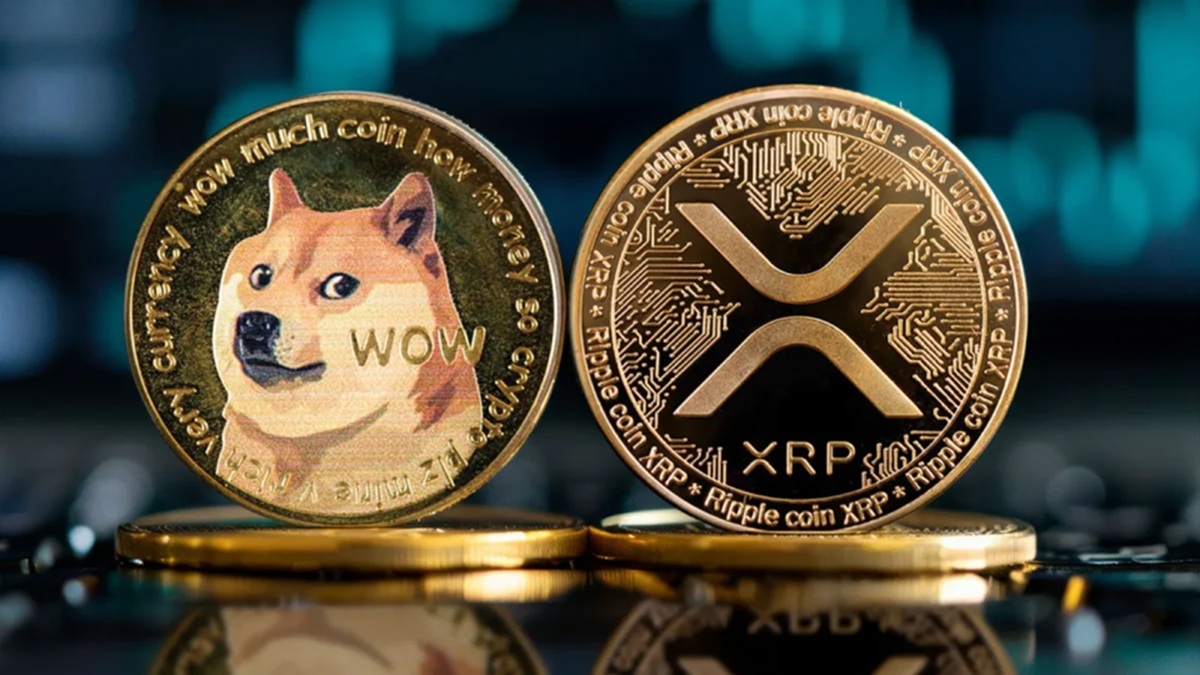
As investors plan their crypto portfolios for 2026, the debate is growing between established assets and emerging DeFi crypto projects. Ripple remains one of the most recognized cryptocurrencies thanks to its role in cross-border payments and strong market presence, but newer platforms like Mutuum Finance are gaining attention for their early-stage growth potential and expanding DeFi utility. With the next crypto market cycle approaching, many investors are comparing XRP’s stability with the higher-risk, higher-reward outlook of rising altcoins.
Ripple (XRP)
Ripple (XRP) is currently trading at $1.41, maintaining its position as a top-five asset by market size. With a market capitalization of approximately $84 billion, it remains a heavy hitter in the space. The token is well known for its early surge years ago, when it reached an all-time high near $3.84. This growth was driven by its goal to change how banks move money across borders. Even today, it is supported by major partnerships with names like Deutsche Bank and Mastercard. However, its recent performance tells a more difficult story for holders.

The asset has struggled to keep its value since its 2025 peak of $3.66. It has lost a significant portion of its price momentum, leading to several bad price predictions for the 2026-2027 period. Some analysts suggest that if XRP cannot stay above the $1.34 support floor, it could slide back toward the $1.10 zone. Technical resistance is very firm between $1.43 and $1.44. Sellers have repeatedly pushed the price down every time it tries to break higher. This stagnation has caused many to worry that its best days of growth are in the past.
Mutuum Finance (MUTM)
While Ripple deals with slow movement, Mutuum Finance (MUTM) is gaining attention. Mutuum Finance is an Ethereum-based protocol building an automated hub for non-custodial lending. It is currently in Phase 7 of its distribution, with the native token priced at $0.04. The project has already raised over $20.8 million from a community of more than 19,100 individual holders. This shows a high level of demand for a project that is still in its early stages of growth.
The protocol is designed to remove the middleman from borrowing. It uses smart contracts to allow users to lend their assets and earn a return or borrow against their holdings instantly. This system is managed by the code rather than a central company. By focusing on a “security-first” design, the project aims to provide a safer and more transparent way to handle money on the blockchain. With a confirmed launch price of $0.06, the project offers a clear path for appreciation that is not tied to the slow trends of older assets.
Why Several Investors are Rotating from XRP to MUTM
Many long-time XRP holders are starting to move their capital into MUTM. The main reason is that XRP has lost a huge chunk of its market cap in the last six months. Since the start of 2026, it has shed nearly 30% of its value from the yearly open. This is largely due to its high liquidity needs; it requires billions of dollars in new money just to move the price a few cents. This “liquidity trap” makes it hard for the asset to deliver the same returns it did in its early years.
In contrast, Mutuum Finance is showing strong technical progress with its V1 launch on the testnet. This working version of the protocol has already handled over $230 million in simulated volume. One of its standout features is the mtToken system. When users supply liquidity, they receive these yield-bearing receipts. As borrowers pay interest into the pool, the value of the mtTokens grows. This creates a mechanical link between the platform’s use and the token’s value. Unlike XRP, which relies on bank news that rarely moves the price, MUTM grows based on the actual activity within its own engine.
Price Prediction and Safety Checks
The outlook for these two assets shows a clear difference in potential. For XRP, the best-case scenario for late 2026 is a return to the $2.00 range, which is a modest gain from today. However, many bearish forecasts suggest it could stay stuck below $1.50 for a long time. For MUTM, the outlook is much more positive. Analysts believe that as the protocol scales, the price could realistically move toward the $0.25 to $0.40 range. This is driven by its revenue-sharing model and its fixed supply of 4 billion tokens.
Safety is also a major factor for those making the switch. Mutuum Finance has completed a manual audit with Halborn Security, a firm known for deep code reviews. It also holds a high safety score of 90/100 from CertiK. To keep the community active, the platform features a 24-hour leaderboard that gives a $500 bonus to the top daily contributor. As Phase 7 nears its end, the window to join at the $0.04 level is closing.
For more information about Mutuum Finance (MUTM) visit the links below:
Website: https://www.mutuum.com
Linktree: https://linktr.ee/mutuumfinance